Assist agents in the moment, deflect with smart self-service, and turn service data into insight, not a chatbot bolted on.
Explore all Vivantio AIWhether your IT is outsourced, in-house, or both, the work needs a system of record: every request, approval, and change tracked, confidential, and provable after the fact.
Demo built around your firm's request types. ~30 minutes.

Trusted by IT, finance, and legal teams at leading organizations


Vivantio is the service management platform law firms and their IT providers run on, not a managed services provider. It sits underneath whichever model a firm chooses, in-house, outsourced, or both, and gives every request a confidential, provable trail from intake to close.
See Managed IT and Service Management for Financial Institutions.
A typical managed services agreement covers service desk support, security monitoring and patching, backup and recovery, and the applications a practice runs on, from document management to billing.
The intake and tracking layer is the part of managed IT that firms most often get wrong, and it is the part the rest of this page is about.
Most firms above boutique size end up hybrid, with an internal lead who owns strategy and a provider who covers depth and after-hours coverage.
| Decision factor | In-house IT | Outsourced (managed services) | Hybrid |
|---|---|---|---|
| Control over process | Full control, shaped to the practice | Provider's playbook, tuned by contract | Firm sets process, provider executes inside it |
| Evidence for clients and audits | As good as the firm's tracking system | As good as the provider's reporting, in the provider's format | One shared system of record, if the firm owns the platform |
| Cost shape | Fixed salaries, spiky project costs | Predictable monthly fee, change orders for scope | Base salary plus a scoped contract |
When the firm owns the service management platform and gives the provider a workspace inside it, every model produces the same auditable record, and switching providers later means changing who works the queue rather than losing the history.
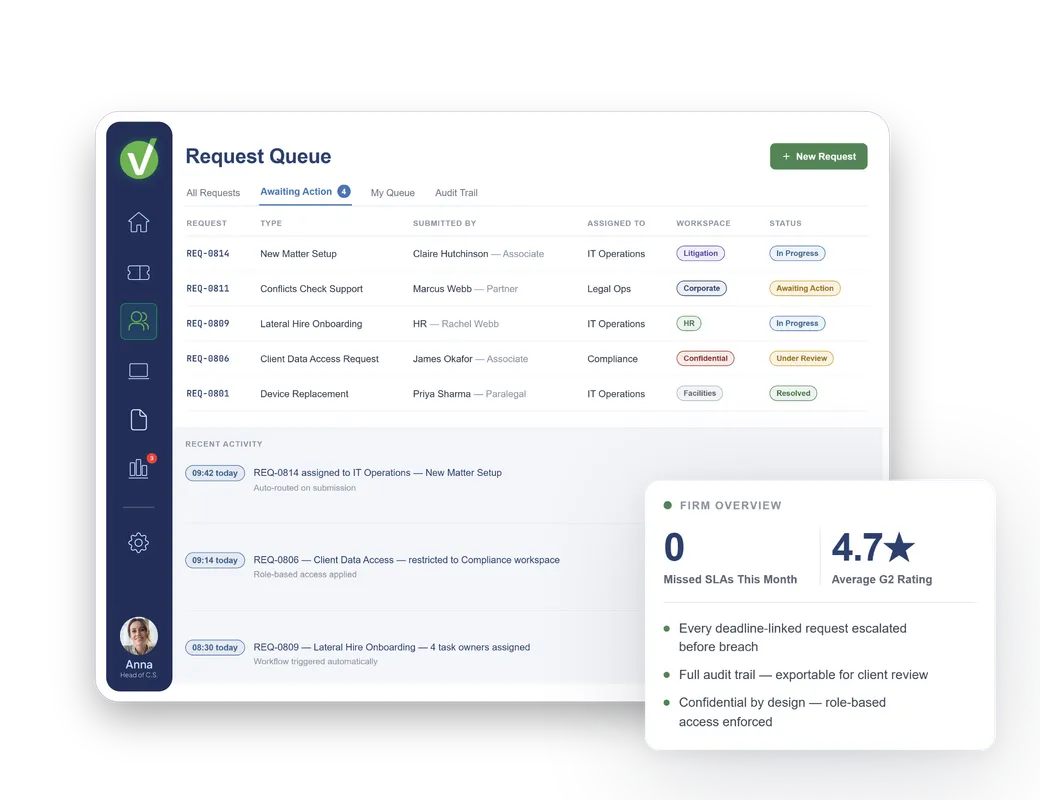
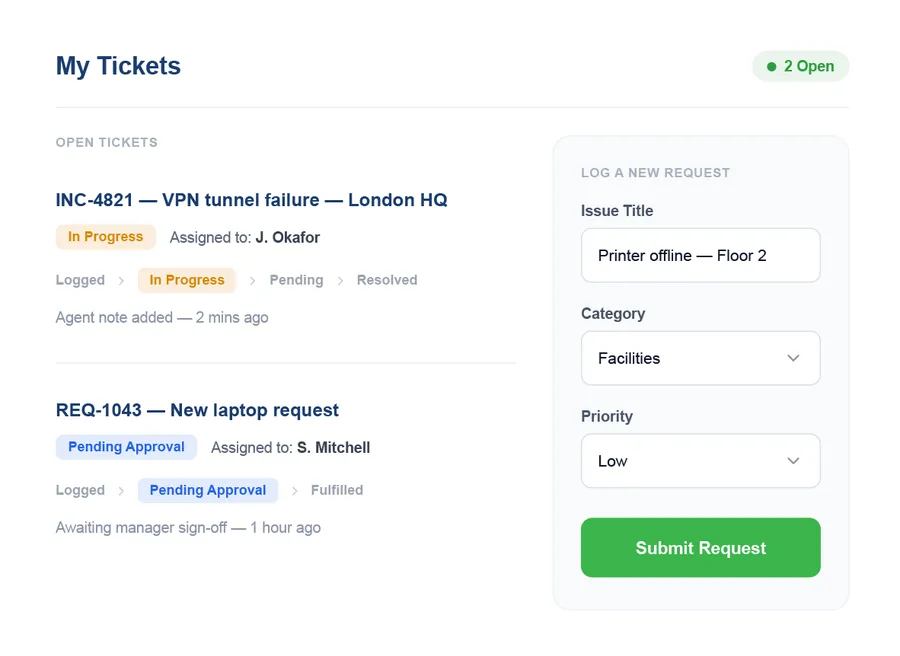
Attorneys and staff submit through a self-service portal with request types that match the work: new matter setup, conflicts-check support, contract review, records requests, client onboarding, access changes, and device trouble. Each request routes automatically to the right team, whether that team sits in the firm or at the provider.
Explore self-service
Service level management tracks response and resolution targets by request type and priority, escalating before a breach instead of reporting one afterward, so a request tied to a filing deadline behaves differently from a password reset.
Explore SLA management
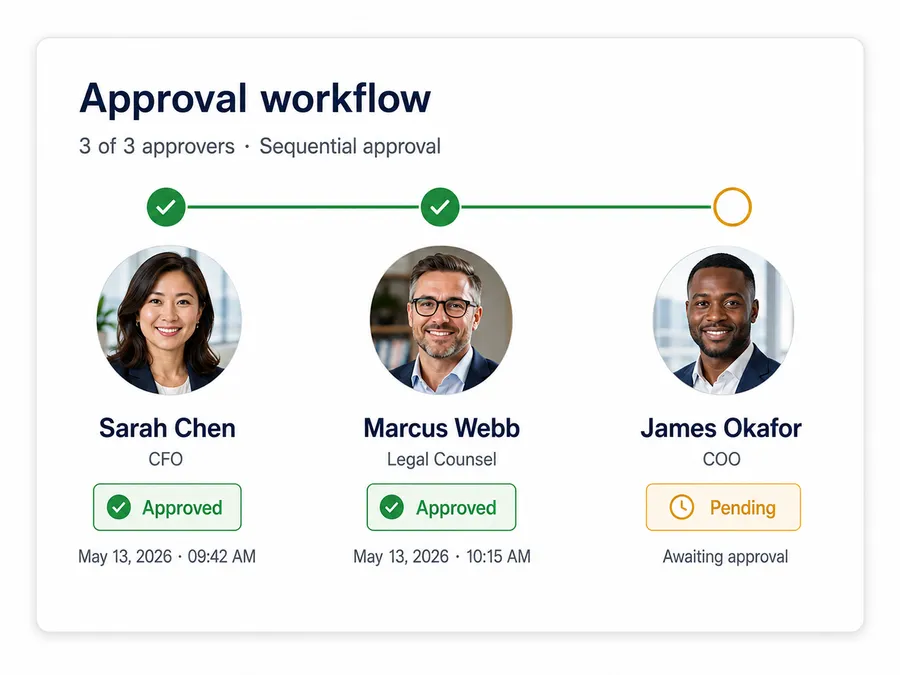
A contract review moves through intake, assignment, review, and sign-off as defined stages, with each handoff timestamped and each approval recorded. Multi-step processes, like onboarding a lateral hire, give accounts, devices, research access, and billing setup each an owner and a sequence instead of a shared inbox.
Explore workflow & automation
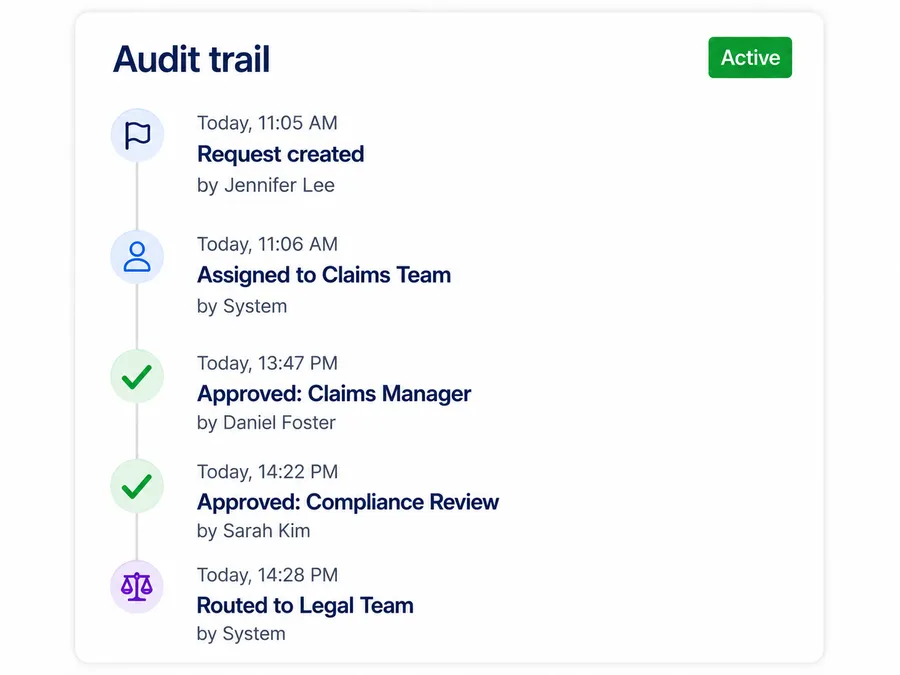
An immutable activity history on every request and change captures who did what and when, exportable for a client audit or internal review. Role-based access control limits every record to the people who should see it, and private workspaces keep a practice group, HR, and an IT provider each working their own queue without visibility into one another's.
Explore audit & reporting
Self-service, automation, SLA tracking and knowledge management — all included in your Vivantio licence, ready whether IT is run in-house, by a provider, or both.
Attorneys and staff submit requests in plain legal-workplace language, not IT jargon.
Route each request type to the right team automatically, in the firm or at the provider.
Response and resolution targets by request type and priority, escalated before a breach.
Common questions answered at the portal, reducing routine enquiries to IT.
Included on every plan. Surfaces knowledge base answers in the self-service portal as staff type.
Every device and configuration item tracked, included on every plan, not a paid add-on.
Most firms go live on Vivantio in three to four weeks. A dedicated consultant configures request types, routing, SLAs, and workspaces around the practice through the Rapid Deployment System. Every capability on this page, including the CMDB, workflow automation, and AI Assist, is included on every plan, so the platform a ten-person firm starts with is the platform a hundred-person firm still runs.
Vivantio connects to ERP, document management, directory services and communication tools, no code required. Microsoft Teams, SAP, DocuSign, Active Directory and hundreds more.


Vivantio is configured for your firm's language: requests, approvals, queries, reviews. No incidents, changes or CIs unless you want them.
We ditched a 3-year development project in Dynamics with multiple full-time on-staff developers and replaced it with Vivantio in 3 weeks.G2 Review · Verified User
Legal, HR, IT and Facilities can all share one Vivantio platform, each with a completely separate, private workspace, on one licence.
We evaluated 8 different vendors, and Vivantio was our number one choice. It's full-featured, has all the solutions we needed in one place.G2 Review · Verified User
Our professional services team sets up your audit trail and compliance reporting during onboarding, then stays on to help you extend it as your needs evolve.
I've worked in IT for 35 years, and I cannot think of another vendor that gets support so right, so often.G2 Review · IT Professional
IT providers and consultancies that serve legal clients run client-facing service delivery on Vivantio, with multi-team structure, per-client SLAs, and reporting that stands up in a quarterly business review. Vivantio focuses on the service management layer, so providers pair it with their own tooling for the rest of the stack.
See Technology and Service ProvidersThey are outsourced IT operations for a legal practice, typically covering service desk support, security monitoring, backup, and care of the firm's applications under a monthly agreement. Many firms run a hybrid model, keeping strategy in-house while a provider covers depth and after-hours coverage.
Firms under roughly fifty people usually get better coverage per dollar from a provider, since a single internal hire cannot cover security, applications, and after-hours support alone. The firm should still own its service management platform, so the request history and audit trail survive any change of provider.
Firms use service management software to submit, route, approve, and track requests in one system. Vivantio provides request types in legal language, matter and contract workflows, SLA tracking, and an immutable audit trail, included on every plan.
Every record carries role-based access control, and private workspaces keep practice groups, departments, and outside providers in separate queues. Vivantio holds ISO 27001 and SOC 2, is HIPAA compliant, and carries Cyber Essentials Plus, with details at trust.vivantio.com.
Yes. A branded self-service portal gives attorneys, paralegals, and staff forms written in plain legal-workplace language, and each submission routes automatically to the right team. Departments beyond IT, including legal operations and HR, can run their own request queues on the same platform.
No. Vivantio is the service management platform that law firms and their IT providers run on. Firms use it to manage requests in-house, providers use it to serve legal clients, and hybrid setups share one system of record with separated workspaces.
About 30 minutes. Pricing is published, so you can model the cost before anyone calls.
Running IT for a financial institution too? See the Financial Institutions solutions page.