Assist agents in the moment, deflect with smart self-service, and turn service data into insight, not a chatbot bolted on.

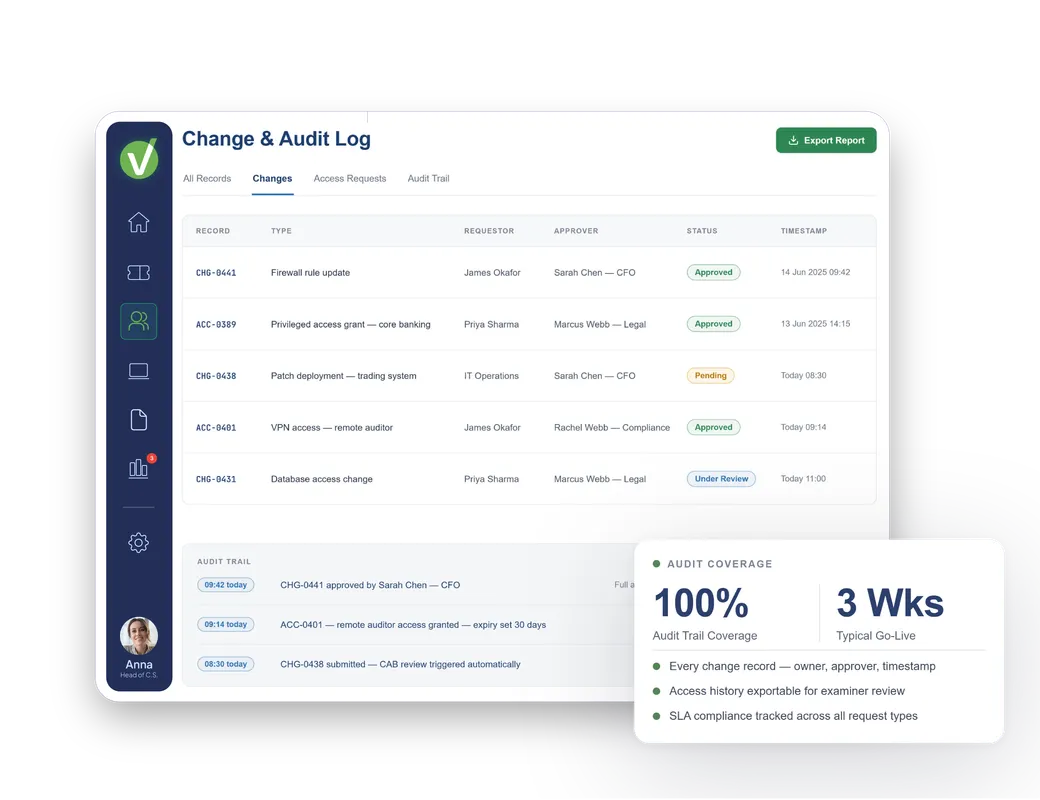
Explore all Vivantio AIExaminers ask for documented change records and access history. An email thread doesn't survive that review. Vivantio gives every IT request an owner, an SLA, and an immutable audit trail, whether your IT is run in-house, outsourced, or both.
Demo built around your institution's own request types. ~30 minutes.

In this industry, the deciding question is rarely who resets the passwords. It is whether the institution can prove, months later, exactly how a request was handled, who approved a change, and when access was granted and removed. Vivantio is the service management platform financial institutions and their IT providers run that proof on. Whether your IT is staffed in-house, outsourced, or a hybrid of both, the audit trail, SLA tracking, and access controls stay the same, because they live in one system instead of in whoever's inbox picked up the request.
Financial institutions and their IT providers run on Vivantio


The model changes who's on the desk. It doesn't change what examiners ask for.
| Decision factor | In-house | Outsourced (MSP) | Hybrid |
|---|---|---|---|
| Control over process | Full control, shaped to the institution | Provider's playbook, tuned by contract | Institution sets process, provider works inside it |
| Audit evidence | Owned directly, as good as the institution's tracking system | Held in the provider's format and system, accessible if exportable | One shared system of record when the institution owns the platform |
| Cost shape | Fixed salary cost, scales in headcount steps | Predictable monthly fee, change orders for scope | Core team cost plus flexed capacity on top |
Vivantio doesn't pick a model for you. It's the platform underneath whichever one you run, so the evidence trail is the same regardless of who's staffing the desk.
Vivantio gives financial institutions structured intake forms for every request type: access changes, incident reports, vendor onboarding, branch and equipment issues, and internal queries, so nothing arrives as an ambiguous email and nothing sits unowned in a shared inbox. Response and resolution targets are tracked automatically, with escalation before an SLA breaches, not after. AI Assist, included on every plan, surfaces knowledge base answers inside the self-service portal as staff type, trimming routine volume before it becomes a ticket.

Financial institutions face internal audit, external examinations, and regulatory review on a recurring basis. Vivantio's immutable activity log records every action on every request: timestamp, user, change, with role-based access controlling who can see and act on what. Approval chains capture sign-offs as structured data, so the question of who authorized a change has a timestamped answer instead of an email thread. Reports export directly for examiner or audit review, so demonstrating compliance is a query, not a reconstruction.

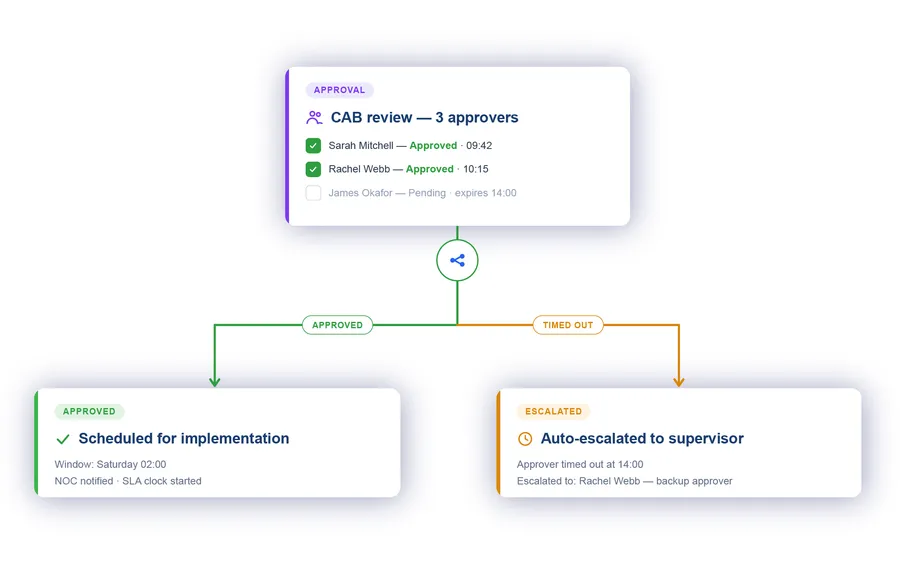
Changes to the systems an institution runs on need both. Vivantio's ITIL-aligned change management provides staged approval chains, a change calendar, and a full history on every change, so scheduled maintenance and emergency fixes alike leave the trail a reviewer expects to find.

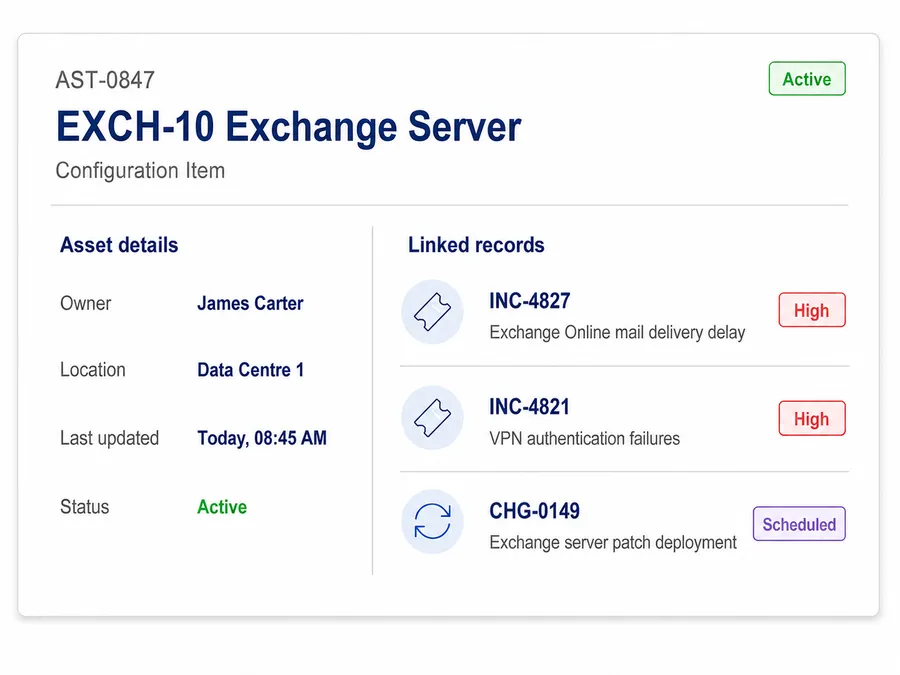
Every device, system, and configuration item is tracked in Vivantio's CMDB and linked to the incidents, changes, and requests that touch it, included on every plan, not gated behind a higher tier. For a regulated institution, that's the difference between answering "what changed on this system, and who approved it" in a search, versus a week of reconstruction.

Self-service, automation, reporting and knowledge management — all included in your Vivantio licence, ready whether IT is run in-house, by a provider, or both.
Staff submit and track requests through a structured portal — no ambiguous email to the wrong inbox.
Route each request type to the right person automatically — no manual triage, no shared inbox ambiguity.
Request volumes, SLA performance and audit exports — visible to leadership without a manual pull.
Common employee questions answered at the portal — reducing routine enquiries to IT.
Immutable audit trail on every request, approval and decision, ready for internal review or an examination.
Vivantio connects to accounting platforms, directory services and communication tools — no code required. QuickBooks, Sage, Xero, Microsoft Teams, Active Directory and hundreds more.


Vivantio has been trusted by mortgage, insurance and finance operations to bring order to service requests that used to live in spreadsheets and shared inboxes.
A residential mortgage lender that replaced spreadsheet-based service management with Vivantio, ahead of a period of rapid growth.
It was obvious from the start that Vivantio's service management system was the simplest and easiest to use, yet powerful and feature-rich.Michael Canigilia, Technical Director, Planet Financial Group
A Luxembourg insurer that needed compliance-driven, on-premise-capable service management during a system migration, and introduced SLAs for the first time.
Suddenly we were able to trace all issues in a much more coordinated way.Frank Brandenburger, Chef de Service, LALUX Assurances
A mutual insurance holding company that started with IT, then expanded Vivantio into HR, facilities, marketing and legal, all on the same platform.
We reached a point where we thought, "How do we get an affordable, customizable system that empowers our team without requiring domain and coding knowledge?"Burt Hixenbaugh, Cloud Architect, American Enterprise
IT providers serving banks, credit unions and insurers run client-facing delivery on Vivantio with multi-team structure, per-client SLAs and reporting built for quarterly reviews. Vivantio covers the service management layer; providers pair it with their own security and infrastructure tooling.
They are outsourced IT operations for banks, credit unions, insurers, and other financial firms, typically covering the service desk, security monitoring, backup, and application support under a monthly agreement. Many institutions run hybrid models, keeping oversight in-house while a provider supplies depth and coverage.
Smaller institutions often gain coverage and specialist depth by outsourcing, while larger ones tend to run hybrid models. Either way, the institution should own its service management platform, so request history, approvals, and audit evidence stay continuous across any provider relationship.
Vivantio keeps an immutable activity history on every request, change, and asset, with role-based access control and approval chains recorded as structured data. Evidence exports directly from the platform, and Vivantio itself holds ISO 27001 and SOC 2, is HIPAA compliant, and carries Cyber Essentials Plus.
Yes. Vivantio provides ITIL-aligned incident, problem, change, and service request management with SLA tracking, a CMDB, and workflow automation, included on every plan. Financial institutions use it as the system of record for IT and operational requests.
Yes. The same platform runs service management for HR, facilities, legal, and operations with separated workspaces per team. Wellabe's American Enterprise brought Vivantio in for IT and extended it across four departments as one enterprise service management deployment.
No. Vivantio is the service management platform that institutions and their IT providers run on. Institutions use it in-house, providers use it to serve financial clients, and hybrid arrangements share one system of record with separate workspaces.
We'll show you how Vivantio handles structured intake, SLA tracking, asset management and the audit trail examiners actually want to see, configured around your institution. Most teams go live in three to four weeks through Vivantio's Rapid Deployment System, and every capability on this page ships on every plan, so the renewal price is the price you modeled on day one.