Assist agents in the moment, deflect with smart self-service, and turn service data into insight, not a chatbot bolted on.
Explore all Vivantio AIManual asset inventories are out of date the moment they're finished. Shadow IT devices, unregistered laptops, and software installed outside the approved catalogue create gaps in the CMDB that show up as surprises during incidents, changes and audits. Vivantio's automated asset discovery keeps your records current — continuously.
Scheduled or on-demand discovery — no manual audit required.

IT teams at leading organizations trust Vivantio


Manual asset records go stale the moment a device is added, moved or retired. By the time the spreadsheet is updated, the estate has already moved on.
Without automated discovery
Asset register is out of date before the manual audit is finished
Shadow IT devices on the network with no record in the CMDB
Quarterly audit projects needed to rebuild what should always be current
New device added to the network: not recorded until someone updates the spreadsheet
With Vivantio asset discovery
Discovery scans the network continuously: the CMDB updates itself
Every device on the network found and recorded, including shadow IT
No audit projects needed: the asset register is always current between scheduled scans
New devices detected and recorded automatically: the record is never behind
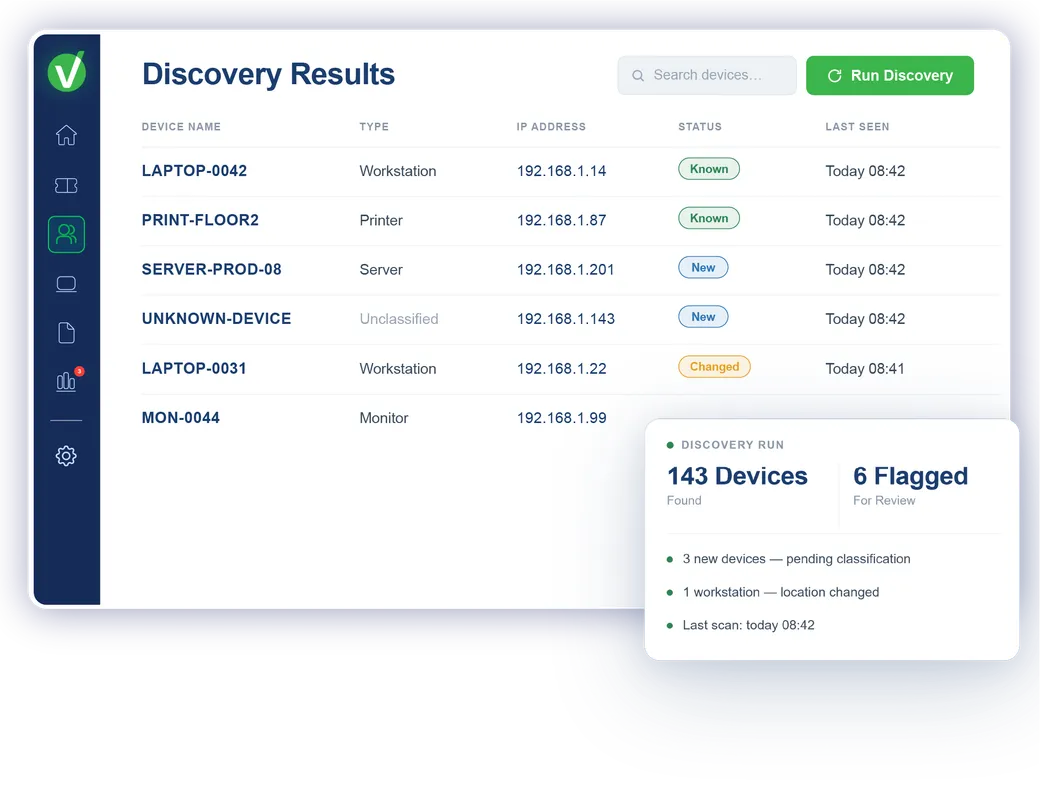
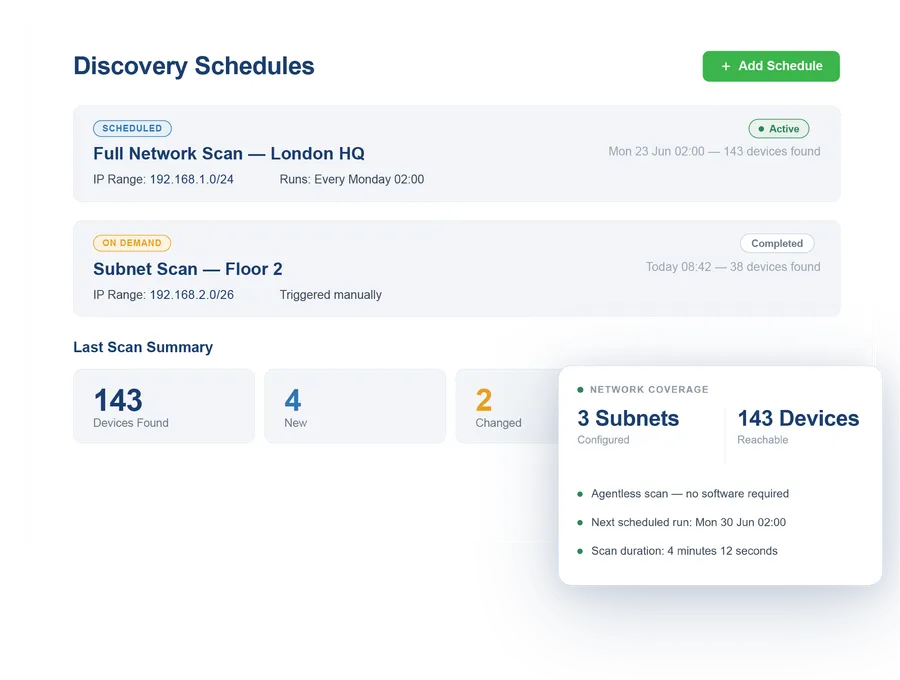
Vivantio asset discovery scans configured IP ranges, subnets or specific addresses and identifies every reachable device: workstations, servers, network hardware, printers, and other connected equipment. Each discovered device is classified by type, and its network details are recorded. Scans run on a configurable schedule or on demand — so the picture stays current without manual intervention.

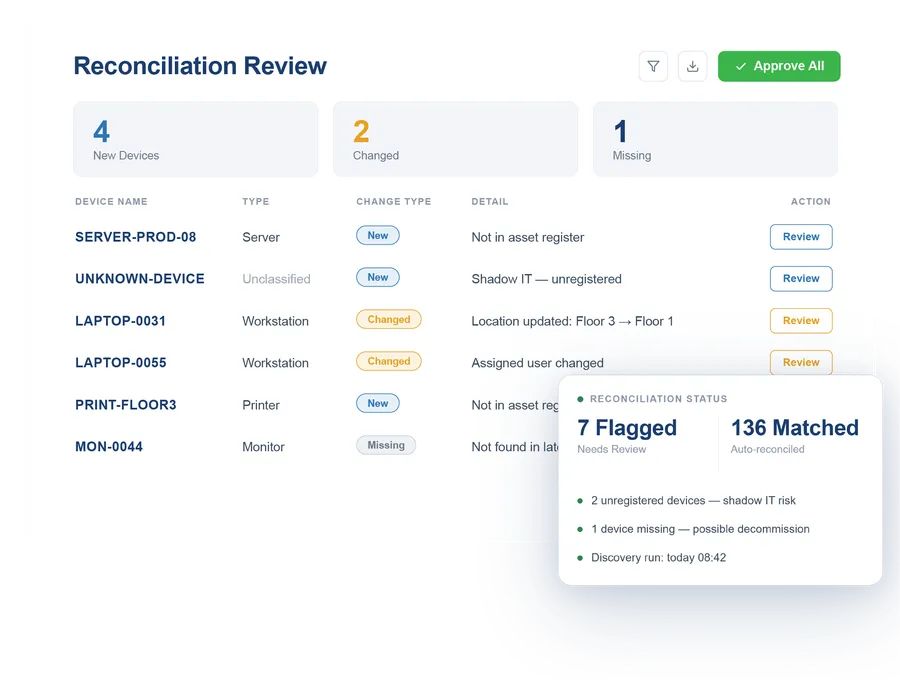
Discovery results are reconciled against existing asset records in the platform. New devices not in the asset register are flagged for review and approval. Known devices with changed attributes (new location, different user, updated software) are highlighted for update. Devices that should be present but weren't discovered are flagged as potentially decommissioned or missing. Teams control the reconciliation, so discovery informs rather than overwrites.

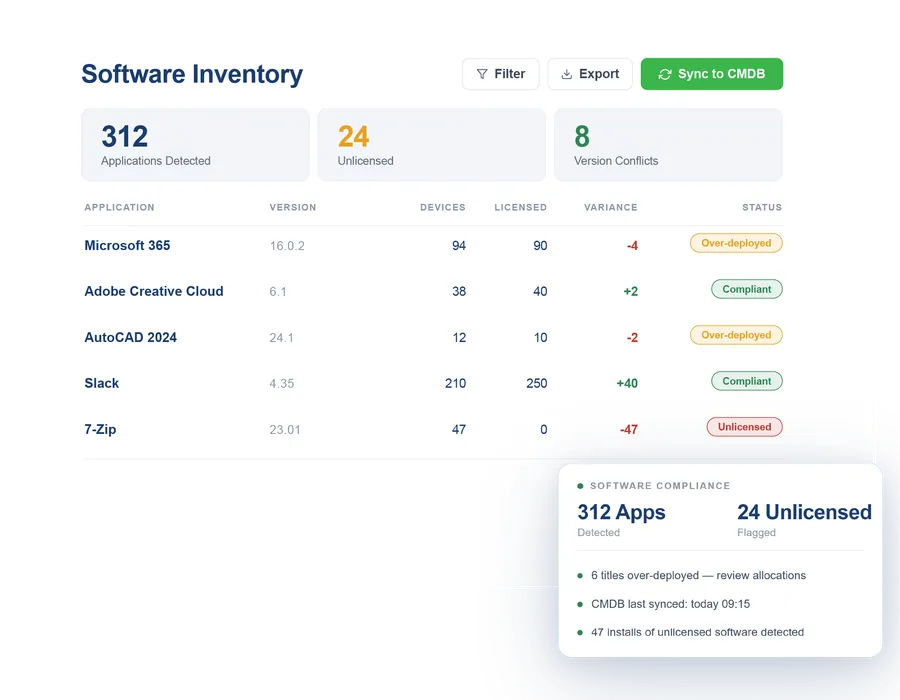
Approved discovery results populate and refresh CMDB configuration items automatically — so the CMDB reflects the estate as it actually is, not as it was last manually audited. Agent-based discovery collects software inventory from managed devices, identifying installed applications and versions for licence compliance comparison against entitlement records in asset management.

IT asset discovery is the process of automatically identifying and inventorying devices, software and configuration items on a network, without requiring manual audits. Discovery tools scan the network, detect devices, classify them by type, and record their details in an asset management system or CMDB. This keeps records current with the actual state of the estate.
Vivantio scans the network using configurable discovery profiles — scanning IP ranges, subnets or specific addresses on a scheduled or on-demand basis. Discovered devices are classified and compared against existing records. New assets are flagged for review; existing records are updated with current details. Agent-based discovery supplements this for devices not always on the network.
Yes. Discovery is integrated with the Vivantio CMDB — discovered assets can be reconciled against existing records to create or update configuration items. Teams control the reconciliation rules, so automated discovery populates and refreshes the CMDB without overwriting manual records or approved configuration data.
Yes. Agent-based discovery collects software inventory from managed devices — identifying installed applications and versions. This feeds into the licence compliance view in asset management, enabling comparison of installed vs. licenced counts.
We'll show you how Vivantio's asset discovery fits your network environment — with a demo built around your infrastructure type and CMDB requirements.