Asset Management & CMDB

You can't manage what you can't see.

Run asset management on spreadsheets and you get caught short at the worst moments: an incident that needs root cause, a change that needs impact assessment, an audit that demands an accurate licence count. Vivantio's CMDB gives you one source of truth.

Assets linked to incidents, changes and problems — not in a separate tool.

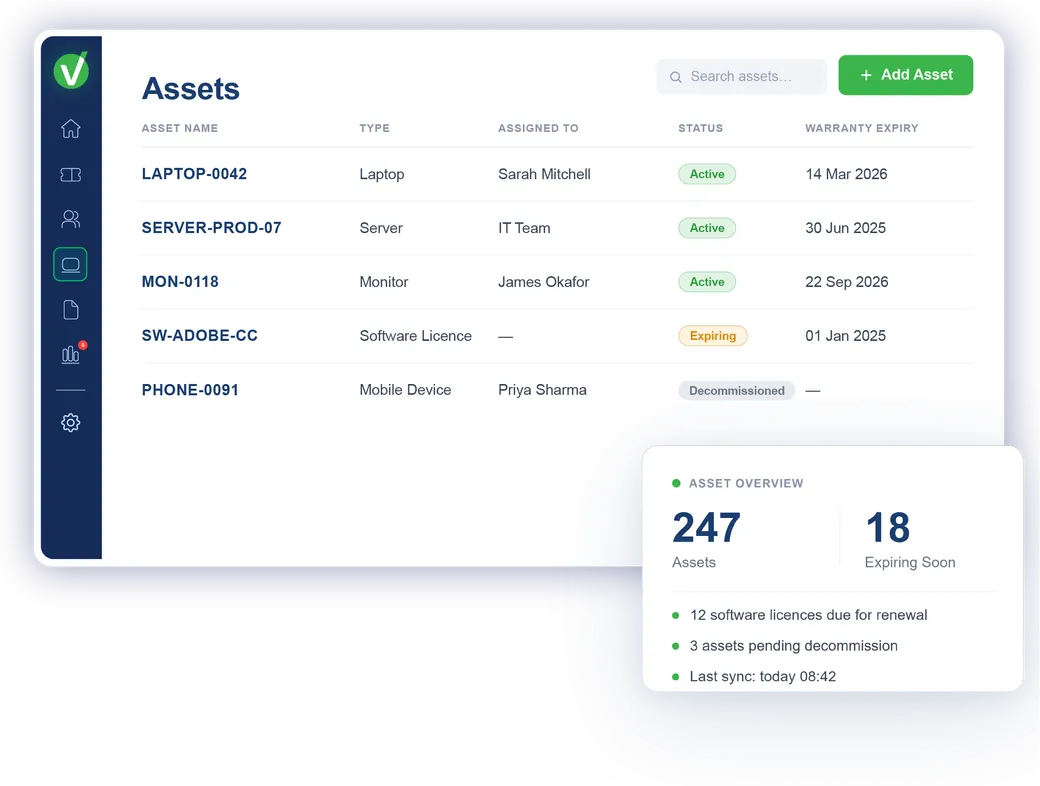
Vivantio CMDB — IT asset management with configuration item relationships

IT teams at leading organizations trust Vivantio

The problem it solves

Spreadsheet asset registers fail in the moments that matter.

Static records disconnected from service events can't tell you what's running, what's connected or what's at risk — until it's too late.

Without a live asset register

Major incident hits: no reliable way to know what else in the estate is connected

Change impact assessment depends on whoever knows the environment best

Software licence audit shows a count that doesn't match what's actually deployed

Asset register updated manually after a change: often not updated at all

With Vivantio CMDB

Every connected CI visible on the incident: impact assessed before the call is over

Change risk assessment draws from a live CMDB, not institutional memory

Licence counts reflect deployed reality: audit evidence produced on demand

Asset records linked to the tickets that affected them: full service history per CI

What it does

Assets. Configuration. Lifecycle. All in one place.

IT asset lifecycle management

Every asset from procurement to retirement — in a single record

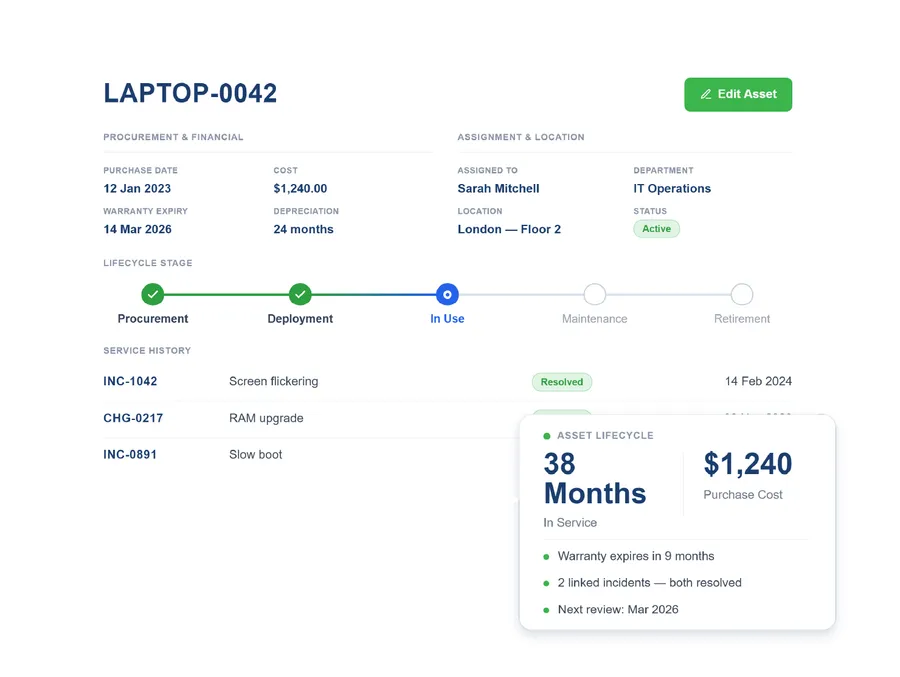
Vivantio tracks IT assets across their full lifecycle: procurement, deployment, assignment, maintenance and retirement. Each asset record holds financial detail (purchase date, cost, warranty expiry), operational detail (assigned user, location, status) and service history (linked incidents and changes). Software licence records track allocation against entitlement for a live compliance view.

  • Full lifecycle records: procurement → deployment → retirement
  • Financial fields: cost, purchase date, warranty and depreciation
  • Software licence tracking with allocation vs. entitlement view
See how automated discovery keeps asset records current
Vivantio IT asset management — full lifecycle asset record
CMDB & configuration item relationships

Understand what connects to what — before you make a change

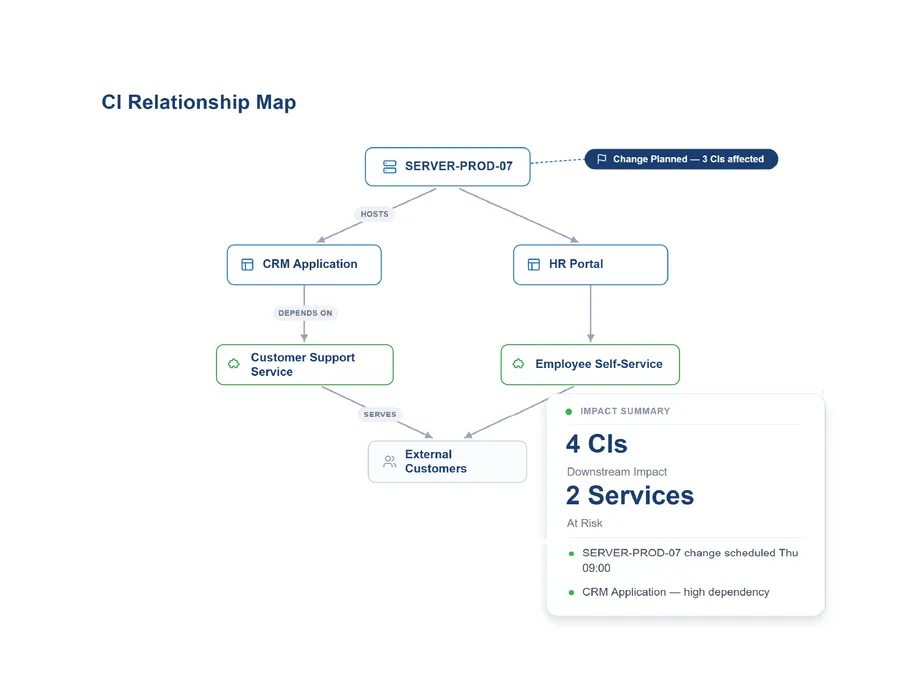
Vivantio's CMDB stores configuration items and the relationships between them: server to application, application to service, service to customer. Before raising a change, teams see what downstream CIs are affected. When an incident hits a service, the CI relationship map shows what else is at risk. Impact assessment becomes data-driven, not guesswork.

  • CI relationships mapped across devices, applications and services
  • Impact visualisation for change and major incident management
  • Service map: from infrastructure CI to customer-facing service
See how CMDB feeds change impact assessment
Vivantio CMDB — configuration item relationship mapping
Audit & compliance reporting

Audit-ready asset data — without a pre-audit scramble

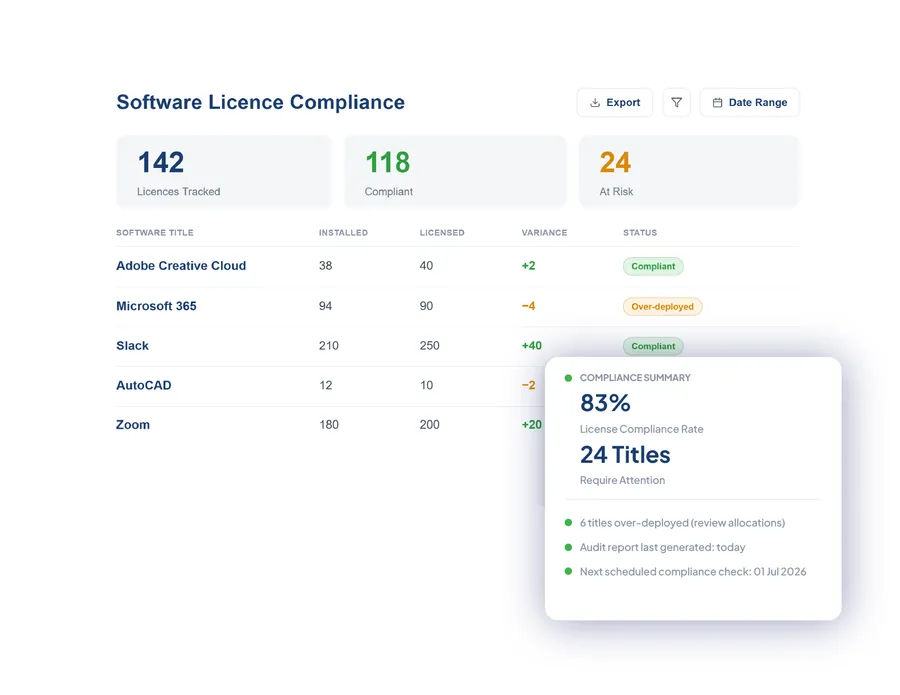
Vivantio asset records are always current — not rebuilt before an audit. Software licence compliance reports compare installed vs. licenced counts across the estate. Hardware audit reports show every device by location, user and status. Full change history on every CI provides an audit trail of what changed, when, and under which change record.

  • Software licence compliance: installed vs. entitled — live, not exported
  • Hardware audit reports by location, assigned user and status
  • Full change history on every configuration item
Vivantio asset management — software licence compliance reporting
Recognised by IT teams who depend on accurate asset data
G2 Leader — United Kingdom Service DeskG2 Leader — Enterprise Service DeskG2 Leader — Mid-Market Complaint ManagementG2 Leader — HR Service DeliveryG2 Leader — Mid-Market IT Asset ManagementG2 Leader — Mid-Market ITSMG2 Leader — IT Service Management
Common questions

Asset management & CMDB: what teams ask us

What is a CMDB and why do IT teams need one?

A Configuration Management Database (CMDB) is a central record of IT assets and configuration items — devices, software, services, and their relationships. Without one, incident root cause analysis and change impact assessment rely on institutional knowledge and guesswork, creating risk at exactly the moments you can't afford it.

What is the difference between IT asset management and a CMDB?

IT Asset Management (ITAM) tracks the lifecycle, financial status and ownership of IT assets — what you own, where it is, what it costs, when it needs replacing. A CMDB tracks configuration items and their relationships — how components connect and the impact of changes. Vivantio provides both in the same platform.

How does Vivantio link assets to incidents and changes?

Assets and configuration items can be linked directly to tickets, incidents, problems and changes. When an incident is logged, agents select the affected CI; when a change is raised, impacted assets are attached for impact assessment. This gives a clear view of which assets generate the most incidents and which CIs are most affected by change activity.

Does Vivantio support software licence tracking?

Yes. Software licence tracking records installed software, licence counts, renewal dates and allocation per user or device — providing compliance visibility and licence renewal planning without a separate tool.

See it in action

A single source of truth for your entire IT estate.

We'll show you how Vivantio's asset management and CMDB fits your environment — built around your asset types and service workflows.

~30-minute demo No commitment Built around your asset types