






Why Using a Managed Service Provider Is Essential for Business Success
Unlock the benefits of partnering with a Managed Service Provider (MSP) to drive your business success. From reducing costs and enhancing productivity to…

Jump to section
Introduction
Ever wondered how some businesses stay ahead of tech changes while others lag behind? The answer often lies in their partnership with a managed service provider (MSP) and their adoption of IT Service Management (ITSM) practices. Many businesses turn to MSPs equipped with ITSM expertise to streamline their IT processes, enhance customer service, and stay agile and ready to quickly adapt to industry needs.
But why do businesses choose to work with managed service providers that specialize in ITSM rather than handle the work in-house? For many, the answer lies in the benefits of tapping into specialized expertise, freeing up internal resources, and gaining access to scalable, cutting-edge solutions without the burden of managing them independently.
For example, a B2B company struggling with high IT costs and frequent downtime partnered with an MSP. The MSP’s proactive monitoring, automated workflows, and structured IT approach reduced incident response times and aligned IT services with the company’s business goals. This partnership allowed the company to focus resources on growth initiatives, enhancing resilience and agility without the distraction of daily IT challenges.
The Role of Managed Service Providers (MSPs) in Modern Business
Many companies reach a critical fork in the road: should they manage IT operations in-house or bring in a specialized partner? Deciding whether to handle everything internally or outsource to a Managed Service Provider (MSP) isn’t always straightforward. What are the key factors to consider? Beyond just offloading tasks, partnering with an MSP can offer valuable cost savings, continuous access to expertise, and streamlined IT operations that align with your company’s goals. Let’s explore the true advantages of MSPs and why they can be the right strategic choice.
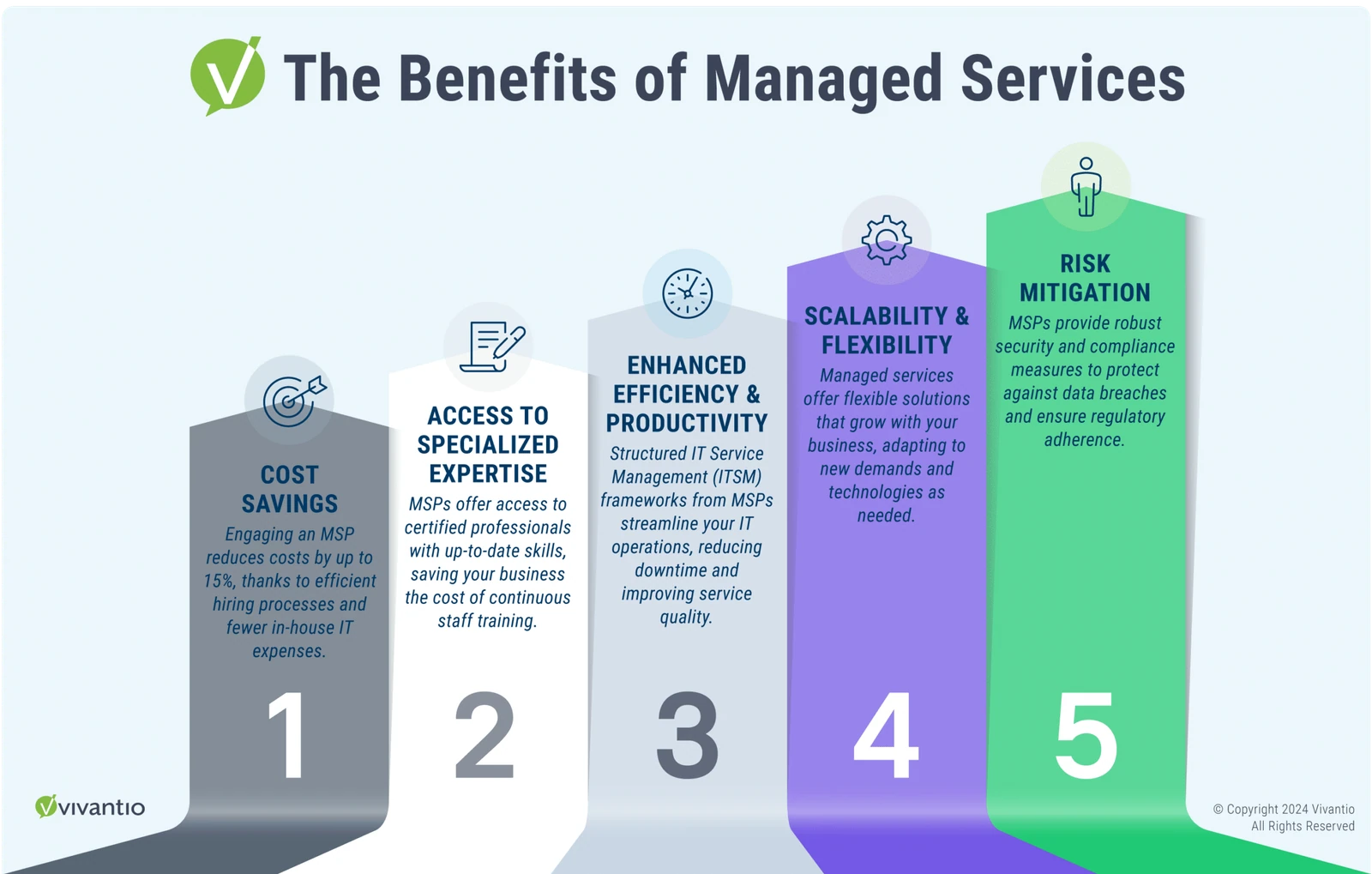
Benefits of Managed Services
The benefits of managed services are many. They include saving money, getting access to specialized skills, and improving how things work. MSPs make sure your IT is strong, grows with your business, and is safe. This means fewer IT problems and smoother business running.
Cost Savings:
Engaging an MSP can lead to significant financial advantages. Businesses often outsource IT operations to MSPs for cost savings and specialized expertise. ScribeHow
Additionally, MSPs typically deliver hard cost savings of as much as 15% by increasing hiring efficiency and dramatically reducing fill times for open positions. Nextsource
Access to Specialized Expertise:
MSPs invest in continuous professional development, ensuring their teams are up-to-date with the latest technologies and best practices. This expertise is then leveraged to enhance client operations without the client bearing the costs of training and certifying in-house staff. For instance, MSP certification equips project managers with the necessary skills and knowledge to effectively manage complex programs. Techno PM
Enhanced Efficiency and Productivity:
By implementing structured IT Service Management (ITSM) frameworks, MSPs streamline IT processes, leading to improved service quality and consistency. This structured approach ensures that IT operations align with business goals, optimizing performance and minimizing downtime.
Scalability and Flexibility:
MSPs offer scalable solutions that can adapt to a company’s evolving needs. Whether expanding operations or integrating new technologies, MSPs provide the flexibility to adjust resources and services accordingly.
Risk Mitigation:
With their specialized knowledge, MSPs help businesses navigate complex compliance requirements and implement robust security measures, reducing the risk of data breaches and ensuring adherence to industry standards.
| ### Key Benefits | ### Description |
|---|---|
| Cost Savings | Predictable budgeting and reduced need for in-house IT staff. |
| Access to Expertise | Certified professionals with specialized skills. |
| Enhanced Security | Proactive monitoring and implementation of advanced cybersecurity measures. |
| Operational Efficiency | Streamlined workflow with minimal downtime. |
In short, partnering with an MSP can be a smart business move, delivering both time and cost efficiencies.

How MSPs Provide Value
To see the value of MSPs, look at how they use the latest tech and best practices. They quickly update software and keep your systems safe from threats. The managed services model boosts efficiency and performance at all levels of your business.
“At Vivantio, we are deeply committed to helping our customers help their customers. Robust Service Level Management is central to this commitment, ensuring that services not only meet but exceed expectations. This approach drives every interaction and feature we develop, empowering MSPs and technology service providers to deliver consistent, high-quality service that aligns with customer needs.”
– Greg Rich, CEO of Vivantio
MSPs do more than just IT services however. They also share insights on how to improve. By watching and managing your systems, they help cut downtime and spot problems early. This makes your workflow smoother.
Enhancing Efficiency with Outsourced IT Management
What does a Managed Service Provider (MSP) actually do for your company on a daily basis? The fact of the matter is companies often rely on MSPs to handle the complexities of IT management so that their teams can stay focused on core business goals. By outsourcing these critical tasks, your business benefits from smooth, uninterrupted operations without the burden of constant system checks and maintenance. This shift not only boosts efficiency but also allows your team to focus on what they do best—ultimately driving stronger business results.
🗹 Proactive Monitoring and Management
With managed services, your IT operations aren’t just reactive—they’re proactive. MSPs continuously monitor your networks, applications, and infrastructure, catching issues before they can disrupt your day. This proactive approach means your business runs smoothly, allowing your team to stay productive without unexpected tech hurdles. Imagine the peace of mind knowing potential problems are handled before you even notice them—leaving you free to focus on growth.
🗹 Minimizing System Downtime
Nothing slows down a business like unexpected system downtime—it impacts productivity and, ultimately, profits. Managed services are designed to keep these disruptions to a minimum. MSPs respond swiftly to any technical hiccups, reducing downtime and helping your systems stay consistently operational. By avoiding costly interruptions, you’re able to maintain momentum, meet client expectations, and keep your team on task—all of which supports a healthier bottom line.
| ### Aspect | ### Benefits of Managed Services |
|---|---|
| Proactive Monitoring | Prevents issues before they happen, ensuring uninterrupted service |
| System Downtime | Substantially reduced, translating to higher reliability and productivity |
| Management | Efficient handling of all IT-related tasks, freeing your team for core business activities |
Why Use a Managed Service Provider
Many companies face a pivotal decision: should they handle IT tasks in-house or outsource them to a managed service provider (MSP)? The right MSP can help streamline IT operations, allowing organizations to focus on strategic goals rather than spending time on technical issues.
Pros of Using a Managed IT Service Provider
MSPs provide a wide range of services, including network monitoring, disaster recovery, cybersecurity, and cloud computing. This service model enables businesses to offload complex IT tasks to skilled professionals who have the right skills to handle everything from system downtime to proactive monitoring and management. By choosing to outsource to an MSP, organizations can access enterprise-level technology, troubleshoot issues remotely, and maintain business continuity without requiring in-house IT staff.
Managed IT service providers also offer flexible, scalable solutions that align with your company’s business objectives. Small and medium-sized businesses (SMBs), as well as large enterprises, can benefit from the level of service that an MSP offers, from proactive support to customized service-level agreements (SLAs). This allows managers to focus on core business activities, knowing their IT systems are being handled by a single point of contact.
Considerations When Choosing to Outsource to an MSP
While the pros of managed services are substantial, it’s essential to consider potential drawbacks. For example, while managed services allow cost-effective IT support, some businesses may hesitate to depend on third-party providers for crucial tasks. Additionally, organizations need to ensure that their MSP aligns with their business goals, company culture, and cybersecurity standards.
Despite these considerations, many organizations are discovering the benefits of managed services. MSPs can provide the expertise, range of services, and support needed to keep IT operations agile and efficient. This partnership can be especially valuable as a business grows, helping companies stay ahead in a fast-paced services market projected to reach $356.24 billion by 2025.
In short, using a managed service provider is a powerful solution for companies looking to optimize IT management. The importance of managed services cannot be overstated in order to stay competitive in a business environment where reliable IT support, remote monitoring, and business continuity are vital.
Selecting the Right Software Tools with Your Managed Service Provider
It’s also essential to evaluate the software platform of choice a Managed Service Provider used to manage and support your business. The right software not only keeps your operations efficient but also ensures scalable growth, enhanced security, and a seamless user experience.
⇨ Advanced Network Monitoring and Proactive Issue Management
A high-quality MSP platform will provide advanced network monitoring, alerting your team to potential risks before they escalate. With powerful remote monitoring and management tools, MSPs can quickly spot irregularities, troubleshoot efficiently, and prevent disruptions. This keeps your systems running smoothly and reduces the costly downtime that can impact productivity and revenue.
⇨ Integrated Service Desk and Customization Capabilities
Look for an MSP that offers software with a configurable service desk tailored to meet your unique business needs. Flexible service desk solutions allow you to create workflows, automate repetitive tasks, and provide a single point of contact for IT requests—all of which streamline your operations. With software that adapts to your processes, your MSP becomes an extension of your team, enabling you to focus on core business goals.
⇨ Robust Security and Compliance Features
With rising cyber threats, your MSP’s software should include the latest cybersecurity features to protect your data and ensure compliance. A solid platform will incorporate multi-layered security measures like firewalls, regular patch updates, and data encryption. Comprehensive reporting tools also allow you to track compliance and demonstrate a proactive approach to data security, keeping your business protected.
⇨ Scalability for Growing Enterprises
Your business may start small, but the right MSP software allows it to grow without limits. Choose an MSP whose software can easily scale and adapt to changing demands, whether you’re adding new locations, handling increased data, or expanding services. With cloud-based solutions and customizable options, an MSP can provide the agility needed to support your organization’s evolution.
⇨ Making an Informed Choice
Selecting an MSP with advanced, flexible software can significantly impact your success. With the right tools, your MSP becomes a strategic partner, providing valuable insights, security, and operational support. Make sure to evaluate your MSP’s software thoroughly—it’s a critical component of building a resilient and responsive IT environment that supports your long-term business objectives.
Choose a Managed Service Provider with the Right Software to Enhance Your IT Management
Take the Next Step Toward Excellence in IT Management and Support
Choosing a Managed Service Provider with the right software can make all the difference in optimizing your IT operations. With the right tools, an MSP ensures that your systems run efficiently, supporting your business’s growth and enabling your team to focus on core objectives.
Schedule a Free Consultation:
Discover how a well-equipped MSP can elevate your IT management strategy, driving stronger performance and helping your team achieve business goals more effectively.
Request a Personalized Demo:
Explore how an MSP’s software platform can transform your IT processes with features like:
- Advanced Analytics and Insights: Gain powerful insights into service performance, identifying areas for improvement and enabling data-driven decision-making.
- Comprehensive Service Management: Streamline every stage of IT service—from request handling to issue resolution—ensuring seamless operations that align with your objectives.
- Dedicated Success Managers: Get hands-on guidance from success managers focused on helping you maximize the value of your IT services and optimize your processes.
By selecting a Managed Service Provider that prioritizes advanced, adaptable software, you’re investing in a solution that enhances efficiency, improves customer satisfaction, and positions your organization for ongoing success.
Read more
Browse all resources


Ready to see it?
See Vivantio in action
Step your team up to real service management, without the leap to enterprise. Get a walkthrough tailored to your workflows.