






Optimized ITSM & Customer Service for ISVs
Scaling an ISV isn’t just about delivering great software—it’s about providing seamless service and support. IT Service Management (ITSM) helps streamline…

Jump to section
Why ITSM Matters for ISVs
Meet Emma, the founder of SoftEdge Solutions, a growing Independent Software Vendor (ISV). As her company expanded its client base, it became clear that delivering high-quality products wasn’t enough. Managing internal operations, addressing client service requests, and ensuring smooth software deployments became overwhelming for her team.
Emma realized that scaling her business wasn’t just about delivering great software—it also meant:
- Providing seamless support
- Managing service requests efficiently
- Ensuring smooth software deployments
To keep pace with growth, she needed a structured ITSM framework.
The Foundation of Success: ITSM Service Management Processes
Turning Chaos into Efficiency – Recently, a key client reported a bug in a newly deployed software module:
-
Before ITSM: Misaligned communication between developers and customer service led to:
- Delays in resolution.
-
After ITSM: With a structured incident management process, Emma’s team:
- Identified the root cause
- Prioritized the issue
- Deployed a patch within hours, minimizing disruption
Meanwhile, the service desk played a critical role by:
- Automating status updates to keep the client informed
- Strengthening trust and transparency
Enhancing Efficiency with Modern ITSM Practices
Implementing ITSM tools streamlined operations, allowing Emma’s team to:
- Track service requests more effectively
- Automate workflows to improve efficiency
- Manage resources strategically
Customer Service Management & ITSM
Bridging ITSM & Customer Service Management (CSM)
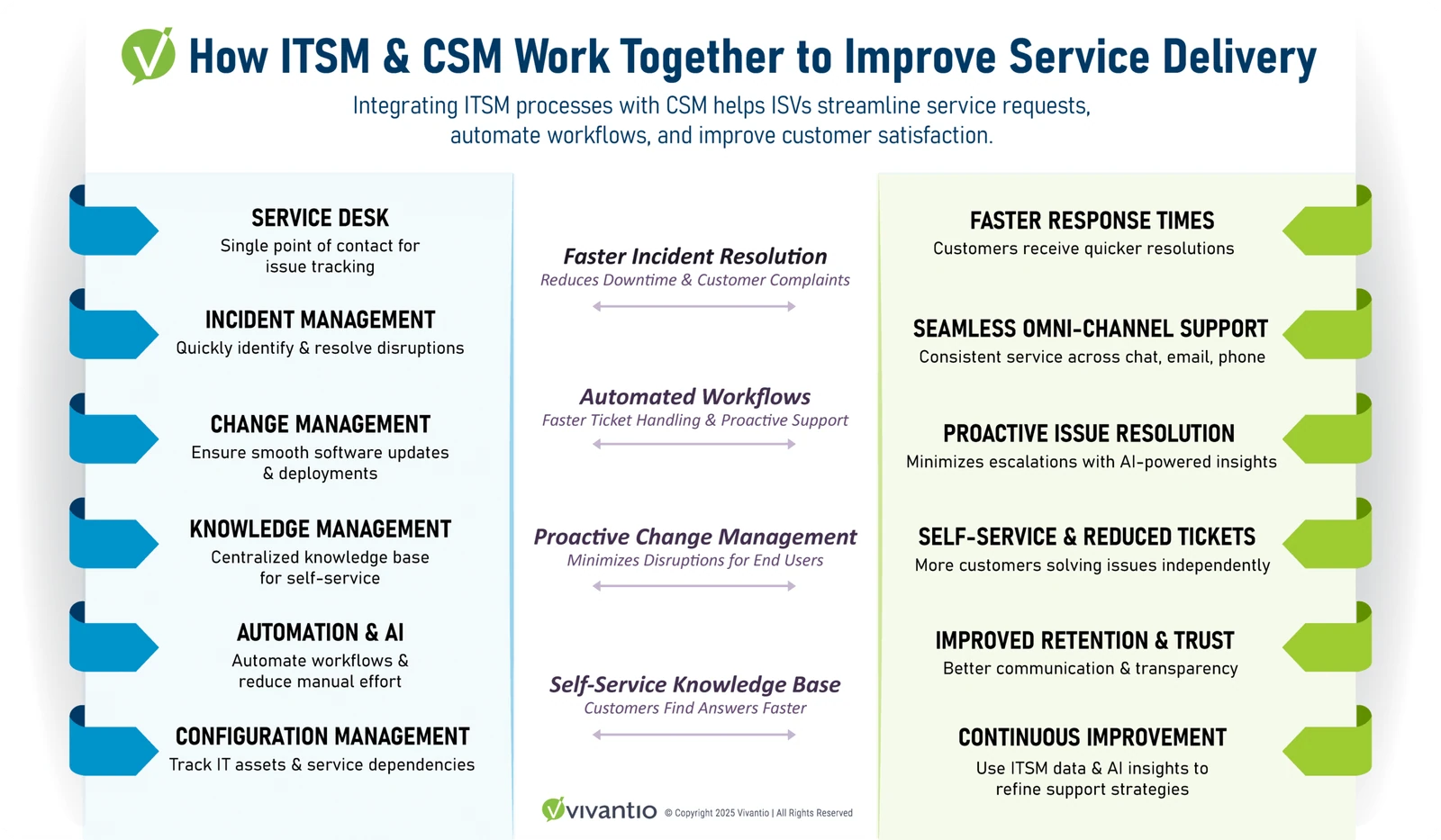
While ITSM focuses on internal service efficiency, Customer Service Management (CSM) extends these principles to enhance external customer interactions.
For ISVs, ITSM isn’t just about keeping internal processes running—it’s about providing a seamless customer experience that fosters trust and retention.
Key CSM Elements That Align with ITSM:
-
Omni-Channel Support for a Better Customer Experience
- Customers expect support across multiple platforms—email, chat, phone, and self-service portals.
- ITSM systems integrated with CSM tools ensure a unified view of all customer interactions.
- Example: Instead of customers repeating their issue across different channels, an integrated ITSM + CSM platform provides a complete service history, ensuring a frictionless support experience.
-
AI & Automation in Customer Service
- AI-powered chatbots and virtual agents handle common customer requests automatically.
- Automated ticketing and service desk workflows ensure faster resolution of complex issues.
- Predictive analytics helps identify recurring problems before they escalate.
- Example: A customer-facing AI chatbot deflects routine inquiries while the ITSM system automatically escalates unresolved tickets to live agents.
-
Self-Service & Knowledge Management for Faster Issue Resolution
- A centralized knowledge base empowers customers to find answers quickly without submitting a ticket.
- Well-maintained FAQs, troubleshooting guides, and AI-assisted search can dramatically reduce support volume.
- Example: A well-integrated knowledge management system allows customers to resolve 40%+ of their issues without ever needing to contact support—reducing costs and increasing satisfaction.
-
Proactive Incident Communication Improves Customer Trust
- ITSM tools can automate status updates to customers about outages, downtime, or scheduled maintenance.
- Transparency reduces frustration by keeping customers informed about issue resolution progress.
- Example: Instead of frustrated customers calling in about an unresolved issue, proactive incident updates sent via email or portal notifications keep them reassured.
Real-World Example: Handling Custom Requests
When a prospective client requested a demo tailored to their unique requirements, Emma’s team leveraged service request management to:
- Track, deliver, and document the customization request
- Ensure no details were overlooked
- Showcase their commitment to high-quality service
By integrating ITIL 4 principles, SoftEdge Solutions:
- Achieved faster turnaround times
- Improved client satisfaction
- Gained data-driven insights into performance
💡“We’re no longer operating on guesswork,” Emma explained. “Now, we’re leveraging data to make smarter decisions.”

Building for the Future: Expanding ITSM Beyond IT
Emma recognized that ITSM benefits extend beyond IT, leading her to adopt Enterprise Service Management (ESM) in departments such as:
- HR → Employee onboarding & service requests
- Finance → Expense approvals & budget management
- Marketing → Project workflows & campaign requests
By standardizing workflows and automating repetitive tasks, her company:
- Reduced bottlenecks
- Improved cross-department collaboration
- Maintained an agile, forward-thinking approach
Achieving Long-Term Success with ITSM
Today, Emma reflects on those early challenges with a sense of accomplishment:
“Implementing a robust ITSM framework didn’t just help us scale—it fundamentally transformed how we operate.”
Her structured ITSM strategy allowed SoftEdge Solutions to:
- Reduce downtime
- Improve collaboration
- Strengthen customer loyalty
While Emma’s story is fictional, her challenges are very real for many ISVs. The right ITSM strategy can enhance service efficiency, improve customer experience, and drive long-term growth.
Whether you’re an ISV or operate in another industry, leveraging ITSM software, adopting ITIL frameworks, and applying key service management principles can drive seamless service delivery and sustainable success.
Understanding ITSM for ISV Businesses
For ISVs, delivering high-quality software isn’t enough—you also need to:
- Provide seamless support
- Manage service requests efficiently
- Ensure smooth software updates
However, as customer expectations rise and service teams become stretched thin, operations can become overwhelming.
Common ITSM Challenges for ISVs
- Support teams struggle with growing backlogs of service requests
- Slow response times lead to dissatisfied customers
- Developers face challenges managing rolling software updates
- Onboarding new clients while supporting existing ones creates operational strain
How ITSM Solves These Challenges
🔹 Incident Management: Reduce Downtime
- Quickly identify and resolve service disruptions
- Use historical data to prevent recurring issues
- Minimize customer frustration with faster resolution times
🔹 Change Management: Minimize Risk in Updates
- Plan, test, and deploy updates without unexpected failures
- Implement rollback plans for stability
- Improve customer trust through proactive change management
🔹 AI & Automation: Improve Support Efficiency
- Self-service portals deflect routine inquiries
- AI-driven tools enable faster issue resolution
- Centralized tracking improves team collaboration
Unlocking ITSM Success: The Power of Asking the Right Questions
To implement a structured ITSM framework, ISVs should assess:
- Are we prioritizing customer requests effectively?
- Do we have clear escalation paths for complex issues?
- Can we provide real-time updates to customers?
- How quickly can we detect and resolve service disruptions?
- Are we using data to prevent recurring issues?
- Do we have a structured communication plan during incidents?
- Are we testing all changes in a controlled environment?
- Do we have a rollback plan for problematic updates?
- How do we proactively inform customers about changes?
- Do we have a centralized knowledge base for support teams and customers?
- Are we using AI-powered search or automated recommendations to improve self-service?
- How do we ensure knowledge articles are kept up to date and easily accessible?
- Do we have a clear inventory of IT assets and software configurations?
- Are we tracking dependencies between services, applications, and infrastructure?
- How do we ensure configuration changes are properly documented and controlled?
Answering these questions helps ISVs identify inefficiencies and implement ITSM tools that drive efficiency and growth.
Building an ITSM Roadmap for ISVs
To enhance service management and cut costs, follow these steps:
- Assess Current Processes → Identify inefficiencies in service desk, incident, change, and problem management
- Set Clear Goals → Define KPIs like reducing resolution times and improving customer satisfaction
- Leverage ITSM Tools → Implement automation and centralized tracking
- Foster Collaboration → Align ITSM strategies across departments
- Monitor & Improve → Use ITSM reporting & analytics to refine workflows
Choosing the right ITSM platform is critical for:
- Centralized service desk operations
- Real-time incident tracking & automated workflows
- Data-driven insights for continuous optimization
Taking the Next Step in ITSM for ISV Success
Optimizing your service management strategy is key to:
- Improving efficiency
- Reducing downtime
- Increasing customer satisfaction
Get Started Today!
💡 Schedule a Free Consultation – Discover how ITSM can transform your service delivery and drive growth.
🔹 Request a Demo – Explore ITSM solutions tailored to streamline operations, boost efficiency, and enhance customer experiences.
🚀 Start optimizing ITSM for your ISV and stay ahead of the competition!
Frequently Asked Questions About ITSM for ISVs
__&#xNAN;1. What is ITSM, and why does it matter for ISVs?
Answer:
✅ ITSM (IT Service Management) provides structured processes and automation to help ISVs manage service requests, incident resolution, and software deployments efficiently.
✅ Without ITSM, ISVs often struggle with growing service backlogs, miscommunication between teams, and delayed response times, which impact customer satisfaction.
__&#xNAN;2. How does ITSM differ from basic help desk software?
Answer:
✅ Traditional help desk tools primarily handle basic ticketing and issue tracking, while ITSM includes structured processes for change management, automation, and enterprise-wide service efficiency.
✅ ITSM platforms integrate incident resolution, service requests, automation, and reporting, helping ISVs scale and improve customer support without adding manual effort.
__&#xNAN;3. What are the first steps to implementing ITSM for an ISV?
Answer:
✅ Step 1: Identify your biggest service management challenges (e.g., slow ticket resolution, update failures).
✅ Step 2: Select ITSM tools that fit your business size and needs.
✅ Step 3: Implement incident & change management to streamline service requests.
✅ Step 4: Track performance metrics like Mean Time to Resolution (MTTR) and Customer Satisfaction (CSAT).
__&#xNAN;4. How does ITSM help ISVs improve customer service?
Answer:
✅ Automates service request tracking, ensuring faster response times
✅ Reduces downtime with incident management & AI-powered insights
✅ Improves transparency with automated status updates for customers
__&#xNAN;5. What is Enterprise Service Management (ESM), and how does it apply to ISVs?
Answer:
✅ Enterprise Service Management (ESM) applies ITSM principles beyond IT, helping departments like:
- HR → Employee onboarding, IT support requests
- Finance → Budget approvals & service cost tracking
- Marketing → Managing campaign workflows & project tracking
__&#xNAN;6. What are the most common ITSM challenges ISVs face?
Answer:
❌ Miscommunication between development and customer service teams
❌ Slow incident response times and update rollouts
❌ Lack of automation, leading to high support workloads
✅ ITSM addresses these challenges by integrating processes, automating workflows, and reducing inefficiencies.
__&#xNAN;7. How do I know if my ISV is ready for ITSM?
Answer:
✅ If you experience any of these pain points, it’s time to implement ITSM:
- 🚨 Support tickets piling up faster than your team can handle
- 🚨 Frequent software update failures causing disruptions
- 🚨 Lack of visibility into service performance metrics
Even small ISVs can benefit from ITSM by starting with automation and structured service request management.
Read more
Browse all resources

Ready to see it?
See Vivantio in action
Step your team up to real service management, without the leap to enterprise. Get a walkthrough tailored to your workflows.