






MSP vs. MSSP: Key Differences Explained
Understand the key differences between Managed Service Providers (MSPs) and Managed Security Service Providers (MSSPs). This concise comparison highlights…

Jump to section
Introduction
When navigating through IT management and cybersecurity, understanding the terms Managed Service Provider (MSP) and Managed Security Service Provider (MSSP) is crucial. Recognizing the difference between MSP and MSSP can significantly impact your organization’s efficiency and security posture. Both service providers play vital roles in ensuring your business operates smoothly while safeguarding against various threats. MSPs typically manage your everyday IT needs, while MSSPs focus on the security of your databases and sensitive data.
By the end of this article, you’ll have a clear understanding of MSP vs MSSP and can make informed decisions regarding your company’s cybersecurity and operational needs.
Exploring the Fundamentals: What is an MSP?
A Managed Service Provider (MSP) is essential for businesses of all sizes, acting as your primary IT partner to ensure that your technology runs efficiently and effectively.
Defining Managed Service Providers (MSPs)
An MSP is a company that oversees your IT systems remotely, allowing businesses to focus on their core operations without getting bogged down in technical issues. MSPs provide a comprehensive range of services, from routine maintenance to complete IT management. Today, they go beyond traditional IT services, playing a pivotal role in helping organizations stay competitive in a rapidly evolving technological landscape.
Core Services Offered by MSPs
- General IT Support: MSPs deliver help desk support, manage both hardware and software, and are crucial to ensuring daily operations run smoothly.
- Monitoring and Management: They utilize advanced monitoring tools to maintain the integrity of your network, ensuring it remains safe, reliable, and fully operational.
- Data Backup and Recovery: MSPs implement robust backup solutions to protect your data from loss due to cyber threats or system failures, ensuring business continuity.
- Cloud Services: They offer cloud solutions that facilitate easy data access and enhance team collaboration, vital for modern business operations.
- Network Services: MSPs are responsible for the setup, optimization, and ongoing maintenance of your network infrastructure, ensuring peak performance.
MSPs and Their Role in Daily IT Operations
MSPs adopt a proactive approach to IT management, aiming to prevent issues before they escalate. This foresight helps maintain optimal business operations and minimizes potential downtimes. By partnering with an MSP, businesses can shift their focus from technical concerns to strategic growth initiatives.
Introduction to MSSPs: Guardians of Cybersecurity Services
As cyber threats become increasingly sophisticated, having specialized security measures in place is more critical than ever. Managed Security Service Providers (MSSPs) deliver robust and advanced cybersecurity solutions designed to protect businesses from evolving threats. Their expertise ensures your data is fortified against breaches and unauthorized access.
The Emergence of Managed Security Service Providers (MSSPs)
MSSPs emerged in response to the complex landscape of modern cyber threats, addressing the urgent need for heightened security. They provide comprehensive managed security services that continuously monitor, detect, and respond to threats. Unlike traditional providers, MSSPs leverage cutting-edge technologies and threat intelligence to ensure your organization remains secure.
Advanced Security Services Under the MSSP Umbrella
MSSPs offer an extensive array of services, including but not limited to:
- Managed Detection and Response (MDR): This service actively identifies and mitigates threats, reducing potential damage from security incidents.
- Incident Response: Incident Management Response provides immediate response strategies to security breaches, helping organizations recover quickly and effectively.
- Security Operations Center (SOC): The SOC is at the heart of MSSPs’ cybersecurity strategies, operating 24/7 to monitor systems, detect breaches, and ensure timely responses.
Choosing an MSSP is more than just outsourcing your cybersecurity. It means having a strong strategy with threat hunting, real-time checks, and full incident response plans. This approach ensures your data is safe now and in the future. MSSPs let you focus on your business while they handle online threats.
| ### Feature | ### Benefit |
|---|---|
| 24/7 Monitoring & Response | Ensures immediate response to security incidents, minimizing potential damage. |
| Compliance Management | Helps in adhering to legal and regulatory standards, avoiding fines and sanctions. |
| Advanced Threat Intelligence | Provides insights into potential threats, enabling proactive defense mechanisms. |
| Endpoint Security | Secures endpoints to prevent entry of malware and other malicious attacks. |

Difference Between MSP and MSSP: A Comparative Analysis
Choosing between an MSP or an MSSP is key to meeting your business’s cybersecurity needs. An MSP handles your daily IT tasks, keeping your network running smoothly. On the other hand, an MSSP protects your data from cyber threats with advanced security tools.
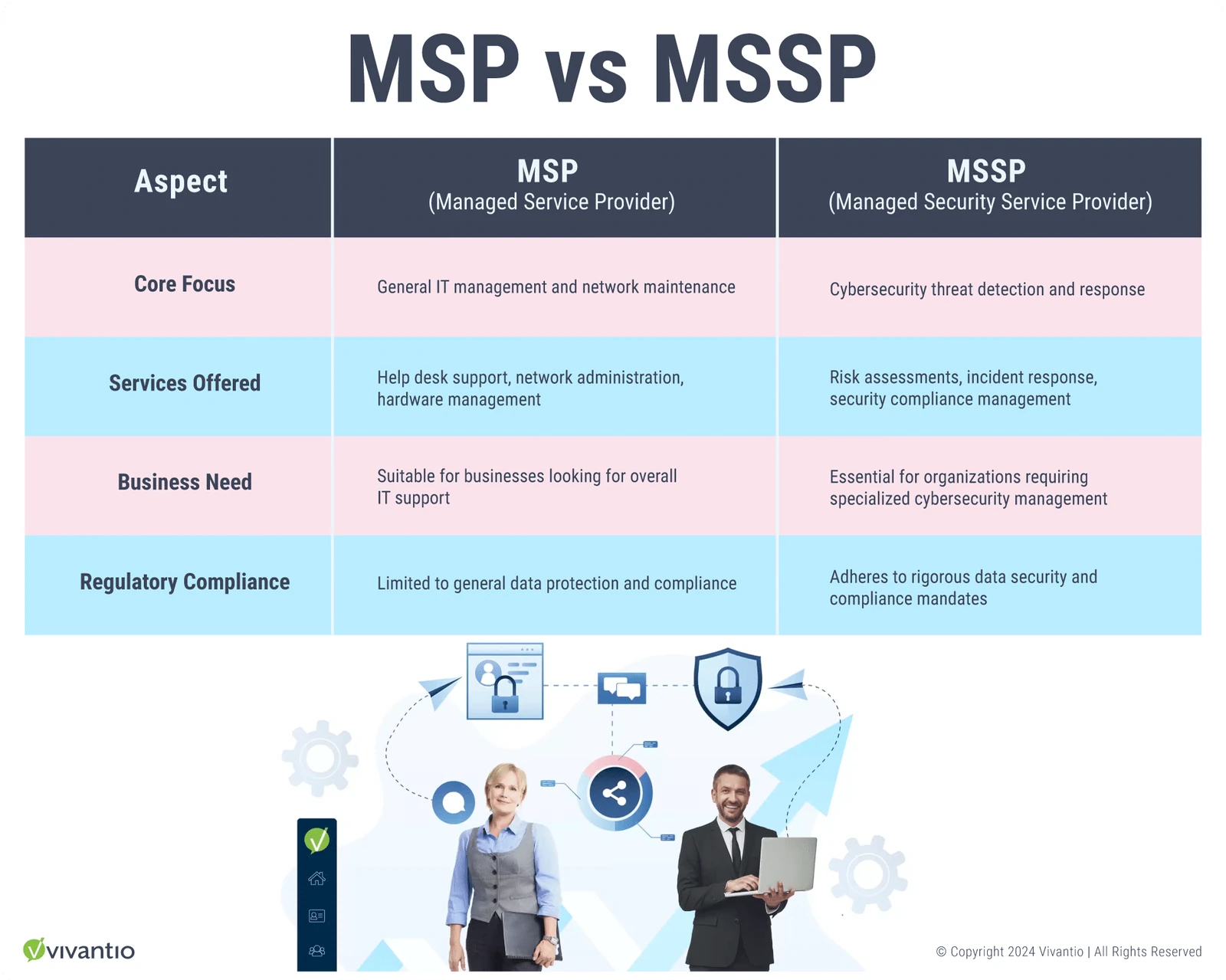
| Aspect | MSP (Managed Service Provider) | MSSP (Managed Security Service Provider) |
|---|---|---|
| Core Focus | General IT management and network maintenance | Cybersecurity threat detection and response |
| Services Offered | Help desk support, network administration, hardware management | Risk assessments, incident response, security compliance management |
| Business Need | Suitable for businesses looking for overall IT support | Essential for organizations requiring specialized cybersecurity management |
| Regulatory Compliance | Limited to general data protection and compliance | Adheres to rigorous data security and compliance mandates |
When deciding between msp or mssp, think about how much security you need. If you’re looking to boost your cybersecurity and meet strict standards, go with an MSSP. But if you need help with your IT and want to improve efficiency, an MSP is a good choice. Think about what your company really needs to pick the right option from msp and mssp offerings.
Strategic Impact on Your Business Needs: Choosing Between MSP and MSSP Services
Choosing between MSP services and MSSP services is crucial for protecting your business effectively. It’s not just about having a cybersecurity program; it’s about selecting the right security solution that aligns with your business needs and provides the necessary support. Let’s explore key factors to consider.
Assessing Cybersecurity Needs and Legal Compliance
First, evaluate your business’s risk level and the legal frameworks you must adhere to. If your organization requires robust data security and strict legal compliance, MSSP services might be the ideal choice. MSSPs offer enhanced cybersecurity program features that help ensure compliance while protecting against evolving threats. Their expertise in managed IT security can provide a significant advantage in navigating complex regulations.
Understanding the Scope of Security Support Required
Every business has unique cybersecurity needs. Some organizations may only require basic monitoring, while others demand comprehensive threat management and rapid incident response automation. It’s essential to consider what your business needs now and in the future. An MSP might be sufficient for basic IT services, but for advanced protection and proactive threat management, an MSSP is often the better option.
Making the Right Choice for Your Business
Ultimately, choosing between an MSP or MSSP involves assessing your specific needs and understanding how each can enhance your cybersecurity posture. Organizations shouldn’t necessarily choose one over the other; in many cases, partnering with an MSSP alongside an MSP can provide comprehensive protection and support for your IT environment. Whether you opt for security as a service or a full-scale managed IT security solution, ensure that the provider you select aligns with your business goals and future growth.
Cost-Benefit Perspective for MSP and MSSP Solutions
Think about the costs and benefits of each option. For small businesses or simple networks, MSP services might be enough and cost less. But, big businesses with high security risks might find MSSP services worth the higher cost for better protection.
| ### Parameters | ### MSP Services | ### MSSP Services |
|---|---|---|
| Primary Focus | IT Management and Support | Advanced Cybersecurity Management |
| Typical Use Case | Smaller businesses, Less complex needs | Businesses with higher exposure to cybersecurity threats |
| Cost | Lower initial investment | Higher initial cost, but potential for greater ROI on security investment |
| Scope of Services | Monitoring, maintenance, basic security | Comprehensive cybersecurity, compliance management, incident response |
Think about these points to make a smart choice for your business. Whether it’s msp or mssp, the goal is to protect your business from cybersecurity threats and follow the law.
Integrating MSP and MSSP: Can You Have the Best of Both Worlds?
As organizations assess the benefits of MSSP versus traditional MSP services, it’s crucial to consider the value of using both for a comprehensive strategy. Many MSPs and MSSPs turn to robust software solutions like Vivantio as the backbone of the services they provide. This integration ensures seamless operations and strengthens the overall service delivery.
By collaborating with an MSSP, your clients gain access to expert cybersecurity capabilities, including incident response automation, essential for protecting their data and ensuring compliance. Meanwhile, MSPs maintain reliable IT systems and optimize performance. Knowing that your MSP and MSSP partners utilize advanced tools like Vivantio adds a layer of confidence in their ability to meet your needs effectively.
Integrating both MSP and MSSP services allows businesses to develop a strong IT and cybersecurity strategy. With Vivantio supporting their operations, these providers can efficiently manage everything from everyday IT tasks to complex security challenges. This partnership enhances service delivery, giving clients peace of mind and a competitive edge in the digital landscape.
By leveraging both MSPs and MSSPs equipped with top-tier solutions like Vivantio, organizations can significantly boost their cybersecurity posture while ensuring optimal IT performance. Whether it’s security monitoring or comprehensive managed IT services, this integrated approach guarantees that all technology needs are addressed.
Contact us today to schedule a free consultation or schedule a personalized demo to learn more about how Vivantio’s solutions are empowering MSPs and MSSPs to enhance service delivery, streamline operations, and strengthen client relationships in an increasingly complex digital landscape.
Read more
Browse all resources


Ready to see it?
See Vivantio in action
Step your team up to real service management, without the leap to enterprise. Get a walkthrough tailored to your workflows.