






Right-Sized ITIL: Structure Without Process Drag
Service teams often feel slower even when nothing is technically broken. This guide introduces Right-Sized ITIL — a practical governance model that reduces…

Jump to section
When Nothing Is Broken… But Everything Feels Slower
This scenario is increasingly common for mid-market service teams: operations appear stable on paper, yet day-to-day execution feels slower and more complicated.
Last month, nothing “broke.”
Ticket volume was steady.
SLAs were technically met.
No major incidents.
And yet your team felt behind.
Standard changes took longer than they should.
Approvals stacked up.
Escalations required more coordination than resolution.
No single process was the problem.
But together, they created drag.
This is a common inflection point for growing service teams — especially in mid-market software organizations where complexity expands faster than headcount.
ITIL is not the issue.
Misapplied structure is.
Frameworks rarely fail because they’re wrong.
They fail because they’re applied without proportion.
Right-Sized ITIL (Definition)
Right-Sized ITIL is the practice of applying ITIL governance proportionally to operational risk and team scale—preserving structure and accountability without introducing unnecessary process overhead.
Rather than replicating enterprise governance models designed for large organizations, service teams implement only the layers of process required to maintain stability, decision clarity, and predictable service performance.
What Is Right-Sized ITIL in Practice?
Right-Sized ITIL applies core ITIL principles — including incident management, change control, and service level management — proportionally to team size and operational risk.
This aligns with ITIL 4’s emphasis on focusing on value and optimizing and automating rather than layering unnecessary procedural controls.
It also preserves accountability and visibility while preventing governance layers from slowing operational execution.
For growing service organizations, the goal is not enterprise-level procedural depth.
The goal is calibrated structure that scales with complexity.
Within a Right-Sized ITIL model, governance flexes as operational maturity increases — rather than remaining fixed at an enterprise standard designed for organizations ten times your size.
When ITIL Starts Creating Process Drag
Rigidity rarely appears overnight.
It accumulates.
Service teams often notice the symptoms before leadership does:
- Uniform change approvals regardless of risk level
- Deep categorization trees that slow routing
- Retrospective SLA reporting instead of predictive monitoring
- Governance meetings that consume more time than they protect
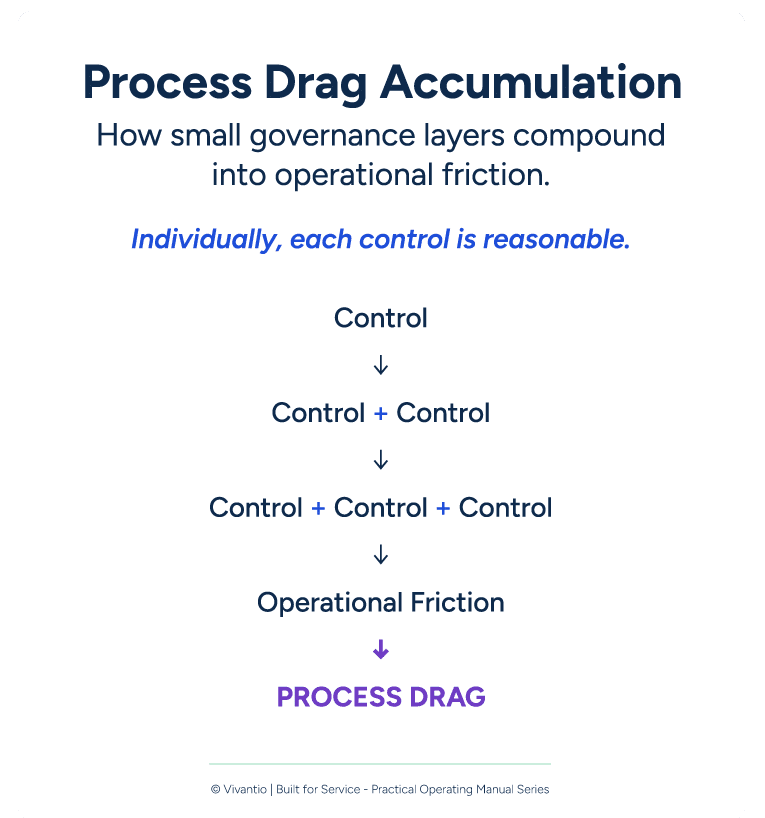
Individually, each control feels reasonable.
Collectively, they create friction.
Over time, governance shifts from protective to restrictive.
For growing ITSM teams — whether you’re managing 10 service professionals or 100 — that friction compounds quickly, increasing burnout risk and slowing customer response velocity.
Operating Insight
Process rarely becomes restrictive all at once.
Operational drag usually emerges from multiple
reasonable controls layered over time.
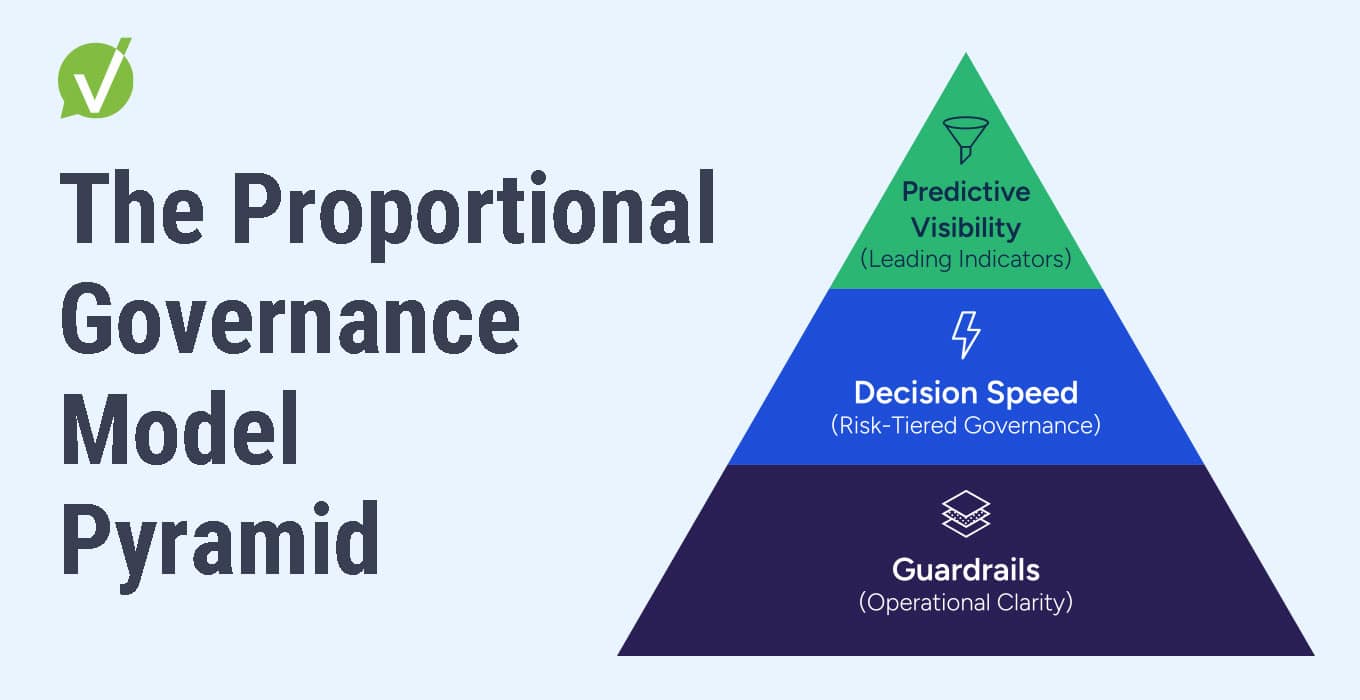
The Proportional Governance Model
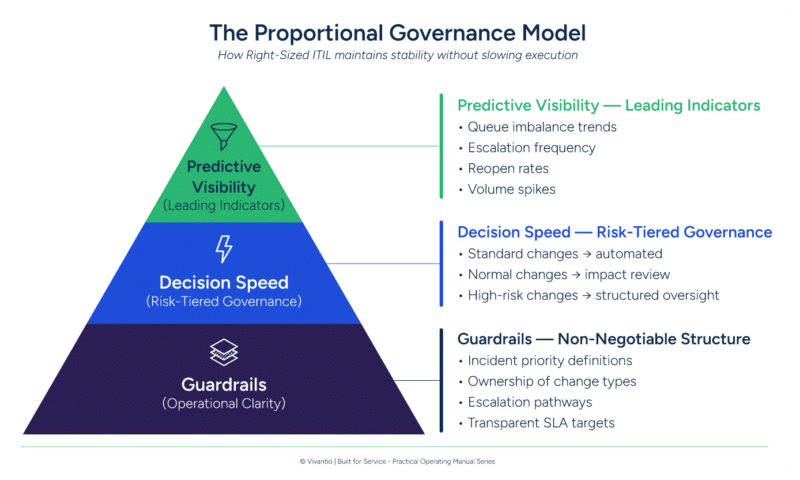
Right-Sized ITIL can be implemented through three calibrated layers.
This structure — the Proportional Governance Model — ensures stability without sacrificing speed, providing a calibrated approach for implementing Right-Sized ITIL in growing service teams.
1. Guardrails (Non-Negotiables)
Guardrails define the minimum structural clarity required for scale.
These should not flex:
- Defined incident priority logic
- Documented ownership of change types
- Transparent SLA targets
- Escalation pathways with named accountability
Guardrails reduce ambiguity.
They prevent chaos.
But they do not need to be layered with excess review.
2. Decision Speed (Tiered Governance)
Not every change carries equal risk.
A proportional model separates governance based on operational impact:
- Standard Changes — Pre-approved and automated
- Normal Changes — Impact-aligned review
- High-Risk Changes — Structured oversight and rollback planning
When every change flows through the same approval funnel, velocity declines.
When governance is tiered by risk, velocity returns.
Modern DevOps and flow-based delivery models similarly advocate for risk-tiered change control, reinforcing that not every change warrants identical oversight.
Decision speed becomes intentional — not accidental.
They prevent chaos.
But they do not need to be layered with excess review.
3. Leading Visibility (Predictive Oversight)
Lagging metrics protect compliance.
Leading metrics protect performance.
Research across service management and operational maturity consistently shows that organizations relying solely on breach reporting struggle to improve performance predictively.
Right-Sized ITIL prioritizes indicators that surface risk before breaches occur:
- Queue imbalance trends
- Escalation frequency
- Reopen rates
- Volume spikes by category
Teams implementing a proportional governance approach monitor these signals monthly — not just during quarterly reviews.
Predictive visibility restores operational clarity.
Operating Insight
Effective governance is proportional.
Guardrails provide clarity.
Risk tiers maintain speed.
Predictive signals preserve performance.
Traditional ITIL vs Right-Sized ITIL
Traditional Enterprise Model
- Uniform approval structures
- Deep procedural layering
- Centralized governance boards
- Lagging performance reporting
Right-Sized Model
- Risk-tiered approvals
- Simplified routing logic
- Automated standard workflows
- Predictive SLA monitoring
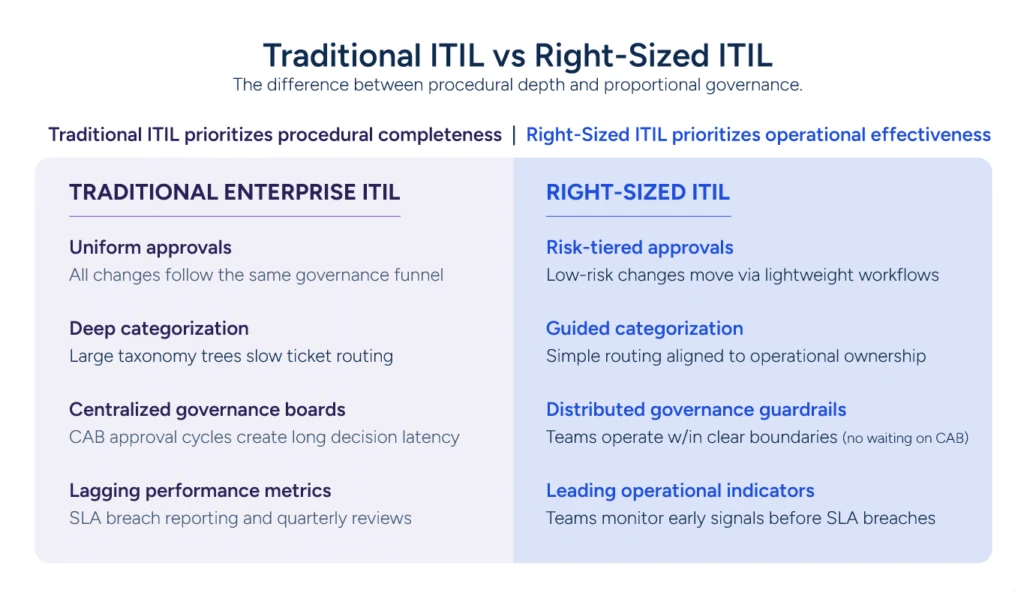
The difference is not discipline.
It is calibration.
How to Implement Right-Sized ITIL in Practice
This is not theoretical.
It is operational.
Start with five steps:
- Audit change types and categorize them by risk level.
- Identify governance layers currently applied uniformly.
- Remove approval requirements from low-risk workflows.
- Define three to five leading indicators for SLA health.
- Review predictive signals monthly at the team level.
Structure should evolve with scale — not outpace it.
For service organizations seeking enterprise-level capability without unnecessary overhead, this recalibration restores clarity, capacity, and execution speed.
Why This Matters at Scale
As service teams grow, operational complexity compounds faster than headcount.
Without proportional governance:
- Decision cycles lengthen
- Agent frustration rises
- Change throughput declines
- Burnout risk increases
Right-Sized ITIL protects both operational clarity and long-term performance stability.
It ensures service teams can scale efficiently — without adding engineers simply to manage process maintenance.
It is not about reducing structure.
It is about implementing structure intentionally.
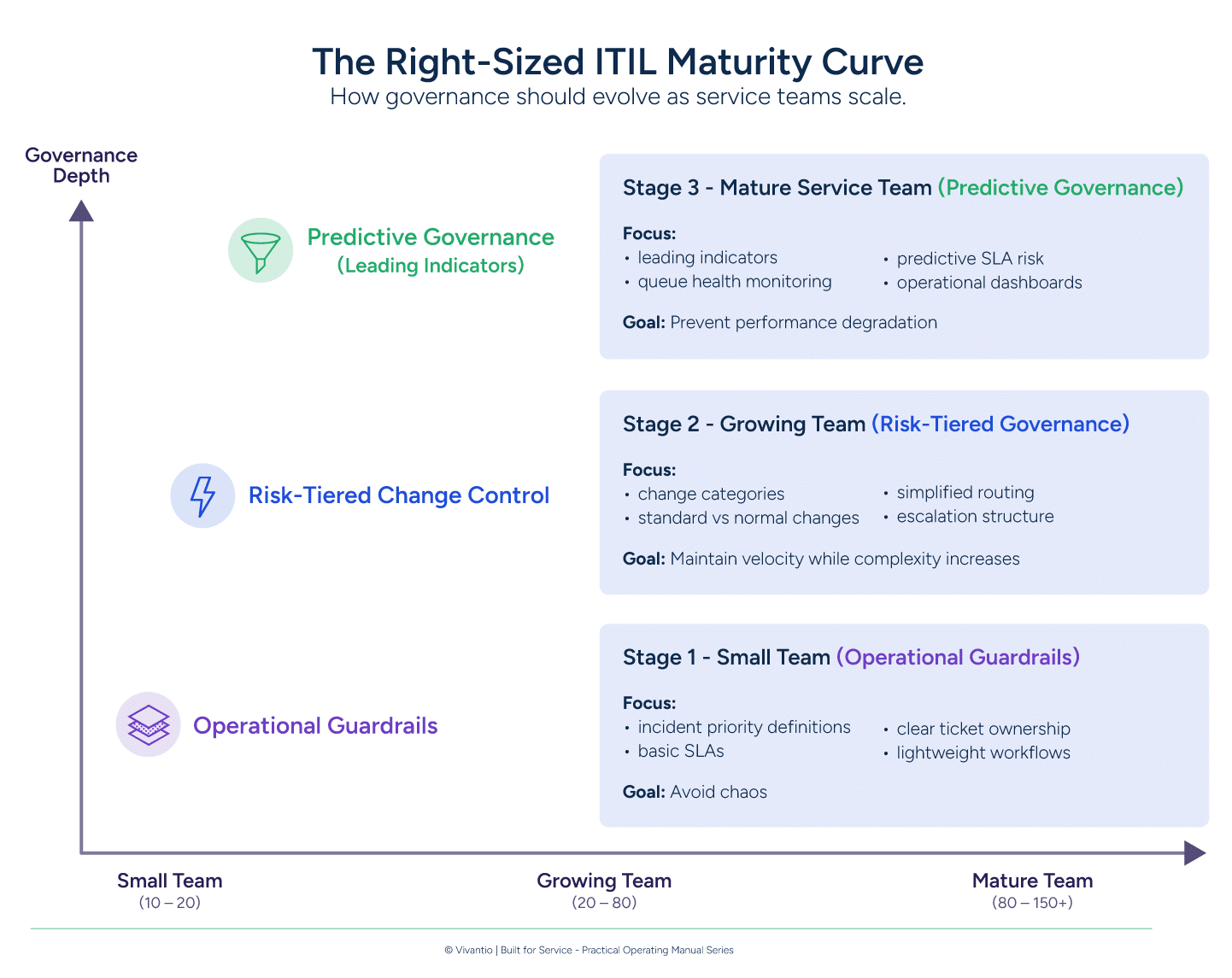
The evolution typically follows a predictable maturity curve:
Key Takeaways
- Traditional ITIL implementations can introduce unnecessary process drag when governance is applied uniformly across all service work.
- Right-Sized ITIL aligns governance intensity with operational risk and complexity.
- Service teams improve response velocity by allowing low-risk work to move through predefined guardrails.
- Operational signals and leading indicators help teams identify SLA risk before breaches occur.
- The goal is not less governance, but proportional governance.
Frequently Asked Questions

Can mid-sized IT teams use ITIL effectively?
Yes. ITIL principles apply to teams of any size when implemented proportionally to operational risk rather than replicated from enterprise models.
What makes ITIL feel bureaucratic?
Uniform approvals, excessive categorization, and lagging metrics that prioritize compliance over performance.
What is the difference between traditional ITIL and a right-sized approach?
Traditional implementations emphasize procedural completeness. A right-sized model emphasizes calibrated control aligned to team scale.
Is Right-Sized ITIL compliant with ITIL4 best practices?
Yes. It aligns with ITIL4 principles by focusing on value creation, continual improvement, and appropriate governance without unnecessary complexity.
How many change categories should a mid-sized team define?
Most growing teams operate effectively with three tiers — Standard, Normal, and High-Risk — provided risk definitions are clearly documented and consistently applied.
Further Perspective
Right-Sized ITIL is not a rejection of ITIL. It is a calibrated application of it.
Modern ITIL 4 guidance emphasizes focusing on value and optimizing and automating — principles designed to prevent process from overshadowing outcomes. Similarly, contemporary DevOps thinking reinforces risk-tiered change management, recognizing that not every operational decision requires identical governance depth.
Industry research on service desk performance and team burnout continues to show that over-layered process structures slow execution and erode morale — particularly in growing mid-market organizations.
The shift is not away from structure. It is toward proportional structure.
And that distinction is increasingly reflected across modern service management thinking.
For readers interested in the broader thinking behind proportional governance and modern ITIL application:
- ITIL 4 Guiding Principles (Focus on Value, Optimize and Automate) – ITSM.Tools
- Research on service desk performance and burnout – HDI
- Risk-tiered change management and flow efficiency – Gene Kim
These perspectives reinforce the shift from procedural depth to calibrated governance.
Operating Insight
Right-Sized ITIL does not remove structure.
It ensures structure evolves with operational scale.
Get Your Right-Sized ITIL Checklist
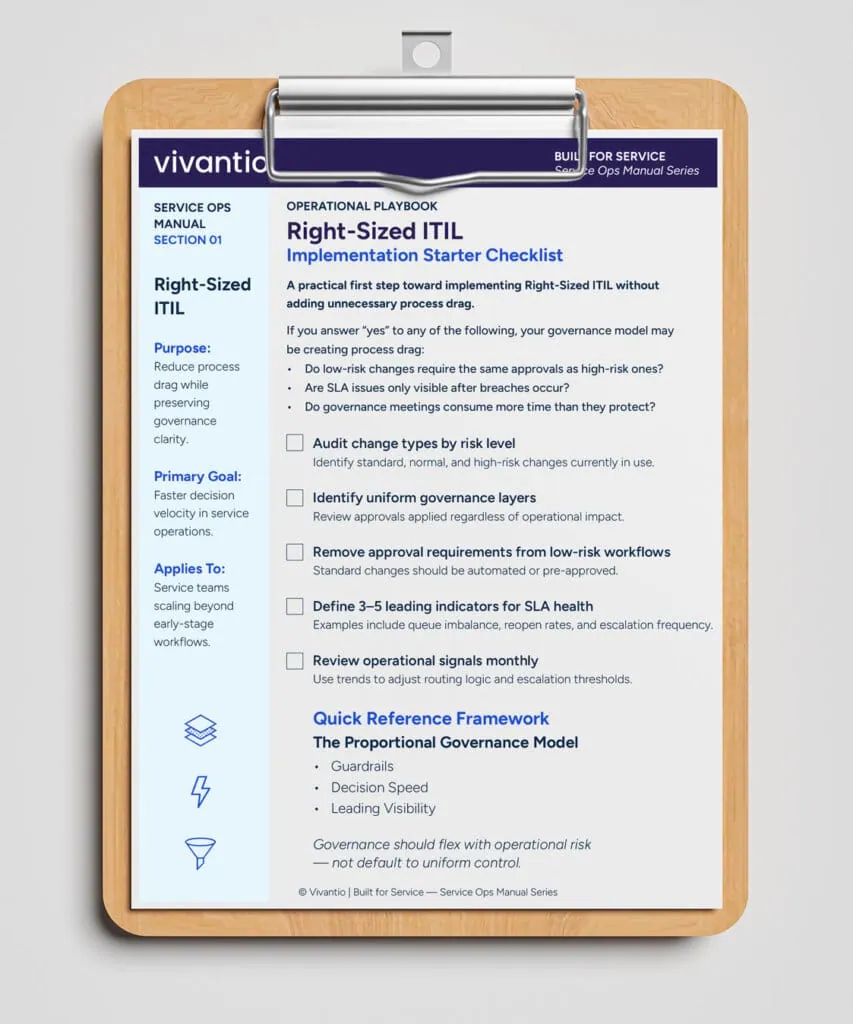
Evaluate whether your governance structure supports scale — or is slowing your team down.
A one-page operational tool used by service teams to reduce governance drag and preserve oversight.
Takes 30 seconds. No spam.
Read more
Browse all resources
Ready to see it?
See Vivantio in action
Step your team up to real service management, without the leap to enterprise. Get a walkthrough tailored to your workflows.