






Enterprise Change Management: Building Organizational Agility and Competency
Enterprise Change Management (ECM) enables businesses to implement change smoothly while building organizational agility. Learn how ECM strategies help…

Jump to section
Introduction
For every business or service provider, organizational change is inevitable. Whether it’s responding to market shifts, adopting new technologies, or reorganizing for growth, businesses and service providers must implement change effectively to remain competitive. This is where Enterprise Change Management (ECM) comes into play. ECM refers to an enterprise-wide change management approach, ensuring that companies can adapt quickly and efficiently while minimizing disruptions to day-to-day operations. By integrating ECM as a strategic capability, businesses build organizational agility and competency, helping them stay ahead in a rapidly evolving landscape.
What is Enterprise Change Management (ECM)?
Enterprise Change Management (ECM) is more than just managing individual projects; it’s about creating an overarching change management strategy that drives change at all levels of the organization. ECM is designed to align strategies, people, and processes to achieve successful, sustainable change. This capability ensures that organizations can handle multiple, complex changes while keeping operations running smoothly.
At its core, ECM is built on the idea that successful change depends on people. Without buy-in from employees and leaders, even the best-laid plans can fail. By fostering a culture of adaptability and encouraging stakeholder engagement, ECM helps companies build a solid foundation for continuous improvement and lasting transformation.
Types of Enterprise Change
When it comes to enterprise change, there is no one-size-fits-all approach. Different types of change require different strategies and execution plans. Organizations typically encounter the following three types of change:
- Evolutionary Change: This type of change occurs gradually over time and involves continuous improvement. It may involve updating processes, tweaking workflows, or optimizing existing systems. Managing change saturation becomes essential when multiple small changes are implemented simultaneously.
- Revolutionary Change: Revolutionary change is more dramatic and often involves a complete overhaul of existing structures, such as mergers, acquisitions, or company-wide restructuring. These changes are transformative and typically require significant resources and leadership alignment to ensure successful change management.
- Digital Transformation: Digital transformation is becoming increasingly important. This type of change involves adopting new technologies to improve operations, enhance customer experiences, and drive business innovation. Change management tools are often required to track progress and support change effectively in these scenarios.
| ### Type of Change | ### Description | ### Example |
|---|---|---|
| Evolutionary Change | Gradual, continuous improvement | Process automation over several years |
| Revolutionary Change | Radical, transformational change | Organizational restructuring or mergers |
| Digital Transformation | Tech-driven change for business agility | Implementing cloud solutions across departments |
Best Practices for Effective Enterprise Change Management
To successfully implement Enterprise Change Management (ECM), organizations must adopt proven best practices that support organizational change management. These practices help align organizational goals with the people and processes that drive change, ensuring smooth transitions and long-term success.
- Develop a Clear Change Strategy: A well-defined change management strategy provides a roadmap for navigating change. This includes identifying key objectives, setting milestones, and outlining a step-by-step plan for implementation. It’s important to approach this strategically, as a clear approach to change management ensures all stakeholders are aligned and the change project is executed effectively.
- Foster a Culture That Embraces Change: Leadership plays a critical role in fostering an organizational culture of adaptability. Encouraging employees to embrace change reduces resistance and ensures smoother transitions. Organizational leaders must actively support change management efforts by aligning change efforts with the broader business goals.
- Implement the Prosci ADKAR Model: The Prosci Enterprise approach, particularly the ADKAR model, focuses on building awareness, desire, knowledge, ability, and reinforcement. This people-centric model is essential for applying change management effectively and building the necessary change management capabilities to support both traditional change and enterprise-level transformations.
- Use Change Management Software: Tools like Vivantio help organizations track progress, manage resources, and evaluate the effectiveness of their enterprise change management process. These tools are critical for measuring change management maturity and ensuring that change efforts are sustainable over time. They also help organizations deploy change more efficiently.
By following these best practices, companies can streamline their change management processes and build the capacity for change and agility needed to adapt quickly to future challenges. Change management helps organizations remain competitive by reducing the friction associated with change and enabling them to respond to market demands with confidence.

Enterprise Change Management as a Strategic Capability
Successful businesses understand that Enterprise Change Management is not just about handling change reactively—it’s about building a strategic capability that fosters organizational agility. ECM provides the framework for companies to navigate change with confidence, ensuring they can respond quickly to market demands and technological advancements.
When ECM is integrated into an organization’s core operations, it becomes a strategic capability that enhances long-term resilience. With ECM, businesses can:
- Adapt quickly to market changes and customer demands.
- Reduce resistance to change among employees.
- Drive innovation and maintain a competitive edge.
- Improve the efficiency of change initiatives across departments by employing the right change management strategies.
ECM also helps organizations understand the change impacts on employees and operations, making it easier to manage both directed change and enterprise-level change. By embedding change management into the fabric of the organization, businesses can ensure their change efforts are sustainable and aligned with long-term goals.
With a solid ECM strategy, companies can enhance their change management competencies and change management maturity, which are critical for deploying change successfully and ensuring that change happens as smoothly as possible. Change capacity is key, and businesses must ensure they have the tools, processes, and leadership required to support this capacity.
| ### Strategic ECM Benefits | ### Impact on Organization |
|---|---|
| Improved Organizational Agility | Faster time-to-market for products/services |
| Reduced Resistance to Change | More efficient change adoption across teams |
| Long-term Competitive Advantage | Ability to navigate change-driven challenges |
By investing in ECM, organizations build the internal capacity to manage change more effectively and position themselves for sustained growth and success.
The People Side of Change
One of the most critical aspects of Enterprise Change Management is understanding the people side of change. Without the active participation and support of employees, change efforts can fall flat. Therefore, ECM emphasizes the importance of stakeholder engagement, communication, and training.
Effective change management focuses on minimizing resistance by involving employees in the change process. This means providing them with the tools and resources they need to adapt successfully. Leadership must be transparent about the changes, explaining the rationale behind them and outlining the benefits for the organization and its employees.
- Train Employees on Change Management Skills: Equip staff with the necessary skills and knowledge to manage and adapt to change.
- Involve Change Leaders: Appoint leaders who can guide teams through the change process and address any concerns or challenges.
Provide Ongoing Support and Training: Offer continuous support and learning opportunities to ensure that employees can fully embrace the changes and integrate them into their daily routines.
Roadmap to Building Organizational Change Competency
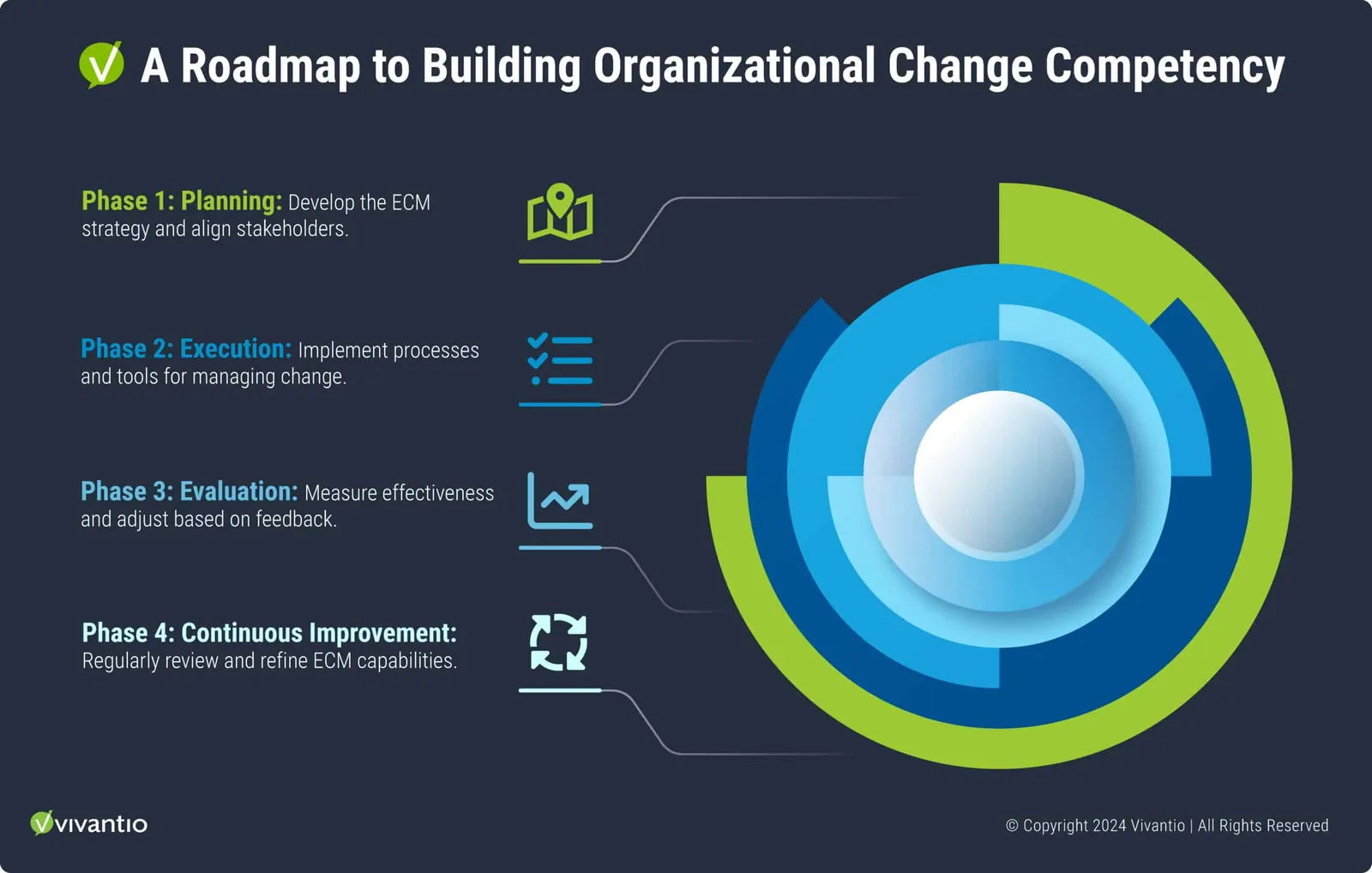
To become proficient in Enterprise Change Management, organizations must create a roadmap that guides them through the process. This roadmap outlines the steps needed to develop the skills, tools, and processes required for successful change management.
| ### Phase | ### Action Step |
|---|---|
| Planning | Develop ECM strategy and align stakeholders |
| Execution | Implement processes and tools for managing change |
| Evaluation | Measure effectiveness and adjust based on feedback |
| Continuous Improvement | Regularly review and refine ECM capabilities |
By following this roadmap, organizations can establish ECM as a core competency that drives sustainable change.
Why Invest in Enterprise Change Management?
Change is not just inevitable—it’s a constant. Enterprise Change Management (ECM) provides the framework organizations need to navigate these changes successfully. By adopting ECM as a strategic capability, companies can foster a culture of adaptability, improve organizational agility, and position themselves for long-term success.
Investing in ECM allows businesses to reduce resistance, manage change more efficiently, and build a resilient workforce that embraces innovation. With the right tools, processes, and leadership in place, ECM becomes a powerful driver of sustainable, lasting change.
Ready to Optimize Your Enterprise Change Management Strategy?
To learn more about Enterprise Change Management (ECM) and how it can empower your organization, explore our comprehensive range of ECM solutions and industry best practices. Contact Vivantio today to build a clear roadmap for navigating change effectively.
Schedule a Free Consultation:
Discuss your organization’s unique challenges and discover how our tailored ECM solutions can minimize risks, improve efficiency, and drive successful change across your business.
Request a Personalized Demo:
Experience the power of our advanced ECM software, designed to transform your change management process with:
- Streamlined Automation: Simplify routine change management tasks, so you can focus on innovation.
- Centralized Oversight: Gain complete control over every change from a single platform, ensuring smooth execution and alignment with organizational goals.
- Risk Mitigation: Proactively manage risks, reduce downtime, and ensure compliance with seamless change implementation.
- Operational Excellence: Enhance efficiency and adaptability while keeping your business agile and resilient.
With Vivantio’s holistic ECM approach, your organization will be better prepared for any transformation, from minor adjustments to large-scale changes. Take control of change today!
Read more
Browse all resources
Ready to see it?
See Vivantio in action
Step your team up to real service management, without the leap to enterprise. Get a walkthrough tailored to your workflows.