






ITIL framework explained: principles, practices, and versions
Explore the ITIL framework: what ITIL stands for, its 7 guiding principles, all 34 practices, what changed in ITIL 5, and which practices to start with.

Jump to section
Your team may still run service work in five stages: strategy, design, transition, operation, and improvement. ITIL 4 replaced that model with a flexible service value chain in 2019, and ITIL 5 has now introduced a new, non-linear eight-stage product and service lifecycle. So you may wonder whether to wait before you change anything.
So what is ITIL, and how should your team use it today? If your team has moved past basic ticketing, applying the framework matters more than memorizing the terms.
The ITIL framework gives your team a shared way to deliver, measure, and improve IT services. Built around a value system, seven guiding principles, and 34 practices, it gives you a flexible approach to service management.
This guide walks through ITIL basics, from which practices to start with to how the framework fits alongside ITSM, Agile, and DevOps. It also covers how to choose the right version for your team. Let’s see what that looks like in practice.
Main takeaways
- ITIL ties IT service management (ITSM) practices to roles, workflows, and shared terms, so incidents get handled the same way on every shift.
- ITIL sits inside ITSM and works with Agile, DevOps, and COBIT, because each framework covers a different layer of the work.
- ITIL 4 organizes service management around a service value system, four dimensions, seven guiding principles, and 34 practices, replacing the five-stage lifecycle.
- ITIL 5 builds on ITIL 4 rather than overwriting it, so the ITIL 4 practices you adopt now carry forward.
- Start with incident and service request management. Then add change enablement and problem management, followed by service level and knowledge management.
What is ITIL, and what does ITIL stand for?
ITIL stands for Information Technology Infrastructure Library. It’s a set of best practices for IT service management (ITSM) that helps teams deliver, support, and improve IT services in a consistent way. PeopleCert owns ITIL today, and ITIL (Version 5), released in 2026, is the current version.
ITIL is a framework, not a rulebook or a formal standard. Teams adopt the practices that fit their needs and adapt them over time. If you need a standard your organization can be certified against, look at ISO/IEC 20000, which draws on many of the same ideas.
A short history of ITIL
| Year | What changed |
|---|---|
| Late 1980s | The UK government’s Central Computer and Telecommunications Agency (CCTA) publishes the first ITIL guidance |
| 2000–2001 | ITIL v2 groups the guidance into service support and service delivery |
| 2007 | ITIL v3 introduces the five-stage service lifecycle, updated in the 2011 edition |
| 2019 | AXELOS launches ITIL 4 with the service value system and 34 practices |
| 2021 | PeopleCert acquires AXELOS and, with it, ITIL |
| 2026 | PeopleCert releases ITIL (Version 5), focused on digital product and service management |
Why does the ITIL framework matter for service teams?
The ITIL framework gives service teams one shared set of practices for running IT services. That shared base keeps delivery steady, easy to measure, and easy to improve as the team grows.
Ad-hoc workflows tend to break once headcount and ticket volume climb. ITIL helps teams see how well services work and improve them on purpose, instead of by accident.
Without it, the trouble usually starts small. Two agents get the same printer issue and fix it in two different ways. Nobody wrote down when a ticket should move to the network team, so escalation depends on who’s on shift. Urgent outages and minor requests sit in one queue with no clear order.
Visibility goes next. You hear about a service level agreement (SLA) breach from an unhappy user, days after it happened. With no clear data on what’s working, the week fills up with firefighting. Planned improvement keeps sliding to next quarter.
Key benefits of the ITIL framework
Teams that adopt ITIL practices usually see gains in six areas:
- Consistent service: Every agent handles the same issue the same way, on every shift.
- Less downtime: Clear incident and problem practices restore service faster and stop repeat outages.
- Lower risk: Change enablement checks each change before it reaches production.
- Clearer costs: Asset and service tracking shows where IT money goes, so you can cut waste.
- Tighter IT and business alignment: SLAs and shared terms tie IT work to business goals.
- Continual improvement: Data from every ticket shows what to fix next.
Why the stakes are rising
Those gaps get expensive once a serious incident hits. A 2026 analysis from Uptime Institute (opens in a new tab) found 57% of respondents said their most recent major outage cost more than $100,000. One in five put the cost above $1 million. Slow escalation and inconsistent diagnosis stretch every one of those outages.
Governance goals are climbing at the same time. In 2024, the National Institute of Standards and Technology (NIST (opens in a new tab)) added a Govern function to its Cybersecurity Framework 2.0. It also added an Incident Management category to its Respond function. That pulls your ITSM principles into closer step with enterprise risk work.
ITIL answers both pressures with written practices and defined roles. When an incident lands, everyone knows their part, so outages stay smaller and cost less. Without a shared framework, your team absorbs risk through personal effort. ITIL moves that load onto practices that scale with the business.
How does ITIL relate to ITSM, Agile, DevOps, and COBIT?
IT service management (ITSM) is the discipline of designing, delivering, managing, and improving IT services for users. ITIL is a specific framework inside that discipline. Think of ITSM as what you do. ITIL is one well-documented way to do it, with defined practices, roles, and shared terms.
ITIL is one of several ITSM frameworks, though it’s the one most teams know by name. It’s also a framework of good practice rather than a formal standard.
Teams often ask whether ITIL clashes with Agile, DevOps, or Control Objectives for Information and Related Technologies (COBIT). It doesn’t, because each one covers a different layer of the work. The table below shows where each one fits.
| Framework | Scope | Focus | How it works with ITIL |
|---|---|---|---|
| ITSM | All IT service work, end to end | Delivering and improving services for users | ITIL is one framework for running it |
| ITIL | Service management practices and principles | Consistent, value-focused service delivery | It supplies the shared vocabulary and workflows |
| Agile | How teams plan and build work | Short cycles and fast feedback | ITIL’s principle of iterating with feedback fits Agile delivery |
| DevOps | The path from code to production | Deployment flow and automation | Change enablement and release practices keep fast deployments safe |
| COBIT | IT governance and control | Oversight, risk, and audit | COBIT sets the controls, and ITIL practices carry them out |
Most mature teams run ITIL alongside one or more of these frameworks, so you rarely have to pick just one.
What are the 7 ITIL guiding principles?
Seven ITIL guiding principles sit under every ITIL 4 practice and every decision your team makes. Use them as filters when you decide what to work on first. The table below pairs each principle with what it looks like on a working service desk.
| Guiding principle | What it looks like on your desk |
|---|---|
| 1. Focus on value | Link every change to something users or the business care about. A new triage step should trace to a user outcome, like faster access fixes. |
| 2. Start where you are | Build on what already works before you replace anything. If agents already tag tickets by category, keep that scheme and refine it. |
| 3. Progress iteratively with feedback | Make small changes, check the results, and adjust. Try a new escalation path with one team first, then expand it. |
| 4. Collaborate and promote visibility | Work across teams and make progress easy to see. Share a live view of open major incidents with the business, so updates don’t depend on email. |
| 5. Think and work holistically | Treat each service as part of a connected system. Before you change an approval rule, check how it affects request queues, SLAs, and downstream teams. |
| 6. Keep it simple and practical | Cut any step that doesn’t add value. If agents skip half the fields on a request form, remove those fields. |
| 7. Optimize and automate | Improve a process first, then automate it. Fix how password resets get approved before you move them to self-service. |
You’ll return to these principles each time you weigh a new tool, redesign a workflow, or pick your next practice.
What are the key concepts of the ITIL 4 framework?
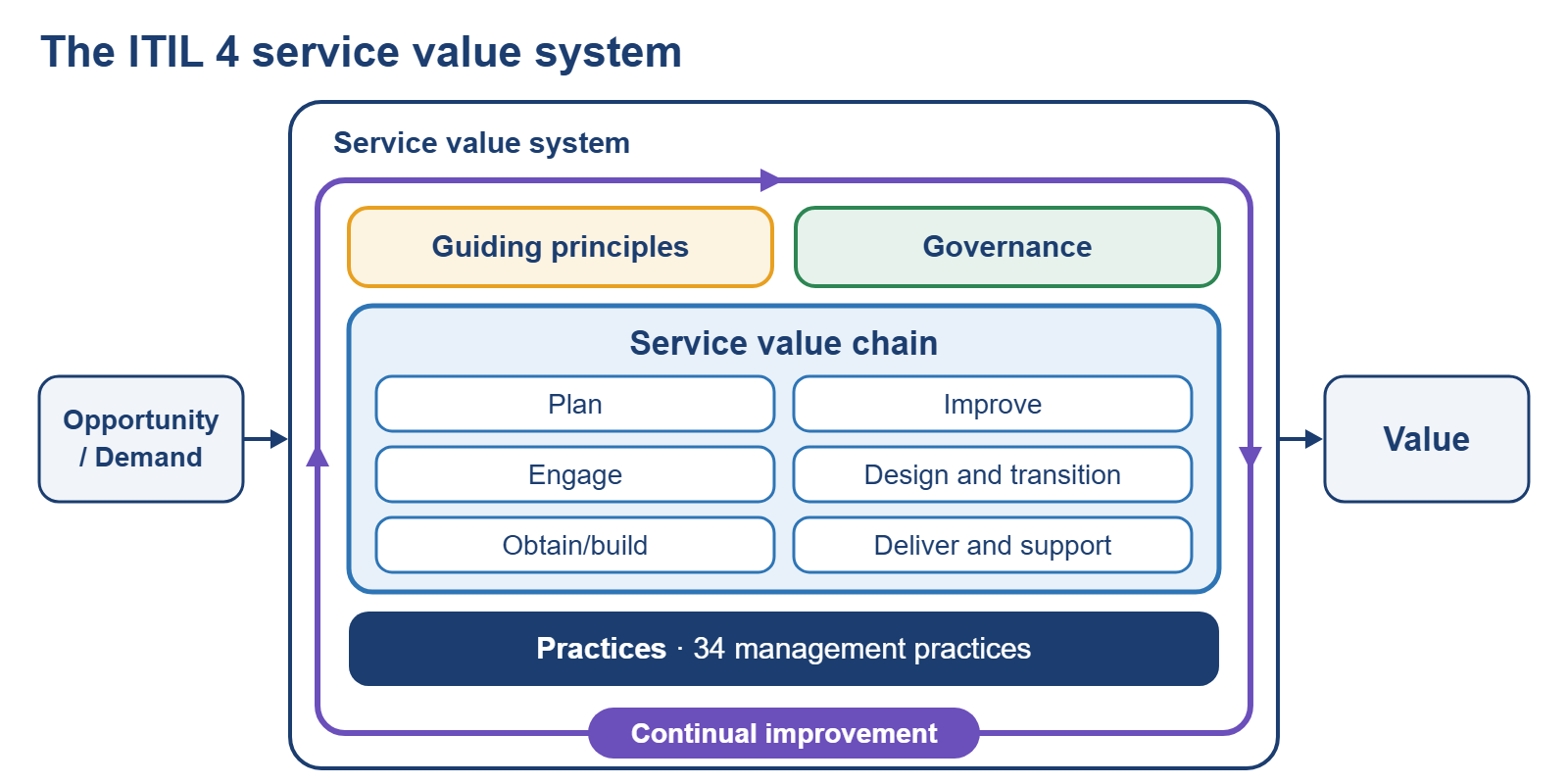
ITIL 4 arranges service management in three layers. A service value system shows how demand turns into value. Four dimensions keep your designs balanced. Then 34 management practices sit in three groups.
The service value system
The service value system (SVS) is the outer model of ITIL 4. It links opportunity and demand on one side with value on the other. It has five parts:
- The guiding principles
- Governance
- The service value chain
- Practices
- Continual improvement
Most ITIL framework diagrams draw the SVS as a flow from demand to value. The value chain sits at the center.
The four dimensions of service management
Four dimensions apply to every practice and service you run:
- Organizations and people covers roles, skills, and culture.
- Information and technology covers the data and tools behind a service.
- Partners and suppliers covers the outside companies you rely on.
- Value streams and processes covers how work moves from request to result.
Leave one out and your design gets a blind spot. Say you build a change management workflow but ignore partners and suppliers. You’ll miss the external dependencies that can derail a change.
The 34 practices at a glance
ITIL 4 swapped the word “processes” for “practices.” Each practice includes people, tools, and information along with the workflow itself. ITIL 4 sorts all 34 into three groups.
| Practice group | What it covers | Practices |
|---|---|---|
| General management (14) | Business-wide practices that ITIL applies to services | Architecture management, continual improvement, information security management, knowledge management, measurement and reporting, organizational change management, portfolio management, project management, relationship management, risk management, service financial management, strategy management, supplier management, workforce and talent management |
| Service management (17) | Practices built for running IT services, where most service desks spend their time | Availability management, business analysis, capacity and performance management, change enablement, incident management, IT asset management, monitoring and event management, problem management, release management, service catalog management, service configuration management, service continuity management, service design, service desk, service level management, service request management, service validation and testing |
| Technical management (3) | Technology practices adapted for service management | Deployment management, infrastructure and platform management, software development and management |
ITIL 5 keeps all 34 practices but regroups them into two groups: 22 product and service management practices and 12 general management practices. Our ITIL 5 guide explains what moved.
Most teams don’t adopt all 34 at once. They pick a small starting set and add more over time. That modular build lets you adopt what you need, when you need it, with the seven principles as your guide.
What are the ITIL processes in the v3 service lifecycle?
Before ITIL 4, most teams learned the ITIL processes through the v3 ITIL service lifecycle. It split service management into five stages that ran in order. ITIL 4 replaced that linear model with the service value system, but many teams still speak v3, and the stages still work as mental anchors.
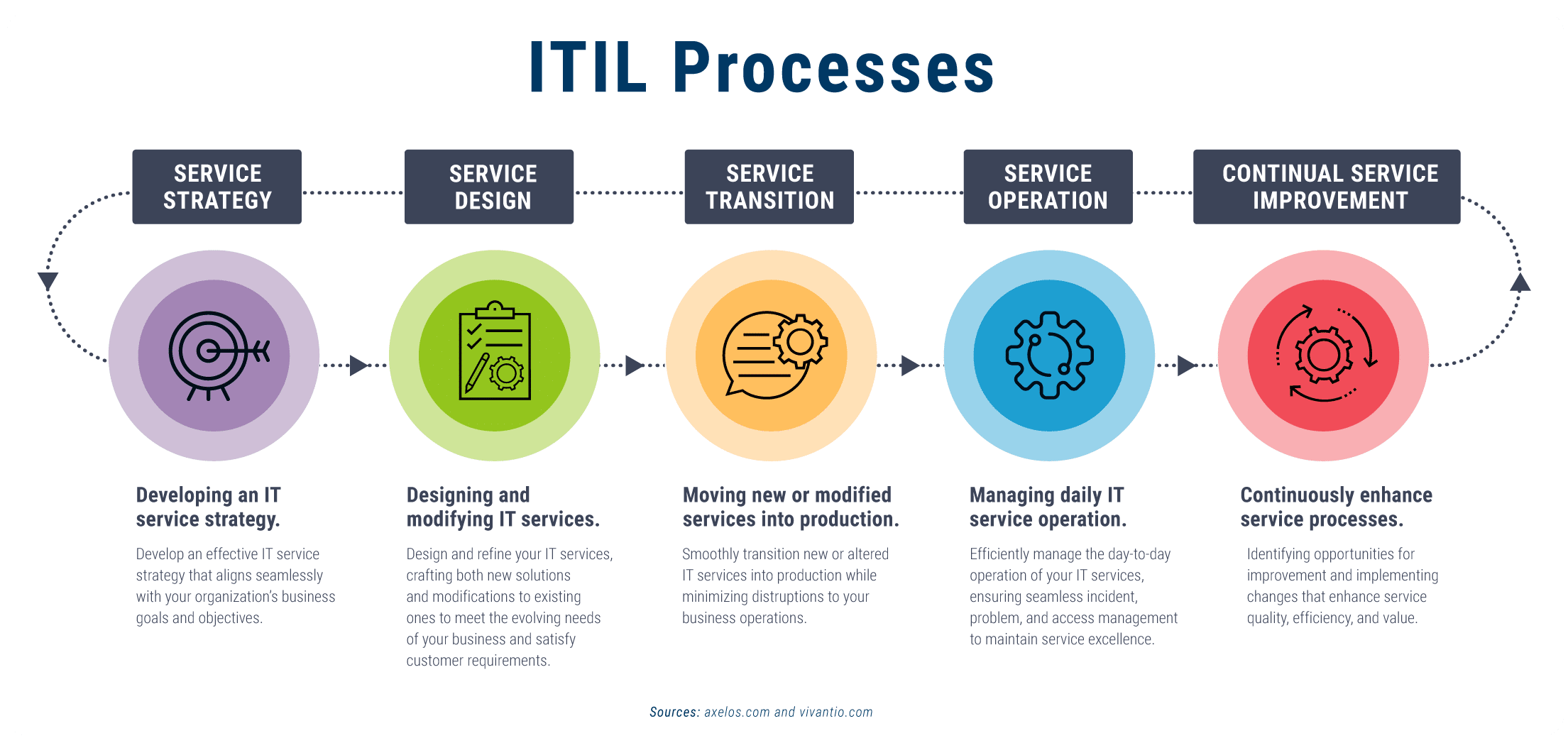
The five ITIL v3 lifecycle stages. ITIL 4 replaced this linear model with the service value system, but the stages still map to ITIL 4 value chain activities, as the table below shows.
The table below shows each v3 stage and the ITIL 4 value chain activity it roughly maps to.
| v3 lifecycle stage | What it covered | Closest ITIL 4 value chain activity |
|---|---|---|
| Service strategy | Deciding which services to offer and tying each one to business goals and demand | Plan, engage |
| Service design | Designing new or changed services, including SLAs, capacity, and availability | Design and transition |
| Service transition | Building, testing, and deploying services into production, including change and release work | Design and transition, obtain/build |
| Service operation | Running services day to day, including the service desk, incident management, and request handling | Deliver and support |
| Continual service improvement | Measuring services and using feedback and data to decide what to fix next | Improve |
ITIL 4 kept these concepts and rearranged them into a value chain with no fixed direction. The shift reflects how service work actually behaves, because real work loops back on itself. If your team still uses v3 language, keep it for now. Map each term to its ITIL 4 activity, and move to the newer model as you grow.
What changed from ITIL 4 to ITIL 5?
ITIL 5, formally ITIL (Version 5) and sometimes called ITIL v5, is the current version of the ITIL framework. PeopleCert (opens in a new tab), which owns ITIL, began releasing it in Q1 2026 through a gradual, phased rollout. It reframes ITIL around digital product and service management, with more weight on experience and on the full product and service lifecycle.
The biggest structural change is the model at the center. ITIL 5 replaces the six-activity service value chain with an eight-stage Product and Service Lifecycle Model: Discover, Design, Acquire, Build, Transition, Operate, Deliver, and Support. Our ITIL 5 guide walks through each stage.
What carries over matters most for your planning. ITIL 5 builds on ITIL 4 rather than replacing it. Your ITIL 4 Foundation certificate still counts as the entry requirement for ITIL 5 advanced modules. For a faster update, the optional ITIL Foundation Bridge (Version 5) (opens in a new tab) exam lets ITIL 4 holders move to ITIL Foundation (Version 5) without starting over.
So, don’t wait for the full ITIL 5 rollout before you adopt core practices. The practices work now, and your ITIL 4 investment carries forward. Update certifications as ITIL 5 modules become available.
Which ITIL practices should you start with?
Resist the urge to adopt all 34 practices at once. Six of them address the problems most service desks hit first. Those include incident management, service request management, and change enablement. They also span problem management, service level management, and knowledge management.
The first six practices to prioritize
Incident management restores normal service fast after an unplanned break. Most teams start here because outages are the pain everyone sees. Service request management handles routine asks, like password resets, access, and equipment orders, through repeatable workflows. Keeping requests apart from incidents cuts queue noise and speeds up both.
These two practices shape the experience your users feel most. In HappySignals’ 2026 Global IT Experience Benchmark (opens in a new tab), employees reported losing about 3 hours and 18 minutes of work per IT incident. That lost time is what a well-run incident practice works to shrink.
Once daily work is steady, stability comes next. Change enablement, called change management in v3, controls changes to production so they don’t cause new incidents. It covers risk checks, approval workflows, and post-change review. Problem management finds and fixes the root causes behind repeat incidents, so your team stops solving the same issue again and again.
Service level management defines, agrees, and tracks SLAs, so the service team and the business share the same goals. ITIL knowledge management captures what your team knows, so a fix doesn’t depend on who’s on shift. It matters more each year, because self-service and automated triage rely on a good knowledge base.
Vivantio supports all six of these practices natively, with a knowledge base built from resolution notes, so your team can run them in one place from the start.
Why sequencing matters
Too many practices at once swamp a team and lead to shallow adoption. Start with incident and request management, since that’s the daily work. Add change and problem management next as your stability layer. Then bring in service level and knowledge management as the growth layer.
Your team also has limited hours to learn new ways of working. HDI’s State of Technical Support (opens in a new tab) in 2024, a survey of more than 100 support professionals, found that roughly three-quarters of organizations handle tickets outside normal business hours. Only about 40% said staff get more than 10 days of ongoing training a year.
A sequenced rollout respects that limit, because people learn one ITIL concept before the next one arrives.
How do you implement ITIL?
An ITIL rollout happens in stages. The effort spreads across process design, training, tooling, and team-wide change management. This is ITIL in practice, and it starts with what your desk does today.
Begin by writing down how your team handles incidents and requests today, even if the process is informal. Map what actually happens on the desk, workarounds included. Then compare it with the ITIL practice descriptions and note the gaps. Keep the first designs light: one page per practice, with roles, escalation paths, and SLA targets.
Training should give your team enough ITIL skill to see why each practice exists and how its steps connect. Budget for ITIL Foundation training for at least your core team. Your ITIL tooling should support the practices you’re adopting without months of setup. Look for native incident, problem, change, request, and SLA management.
Vivantio, for example, supports these practices natively. Many teams go live in weeks.
Teams often skip team-wide change management. The only problem? New processes tend to fail when people don’t see the reason for them. They also fail when the people using them had no part in the design.
So plan to iterate. Launch incident and request management, measure for 30 to 60 days, and adjust based on what you learn. Then add the next practice. That rhythm follows ITIL’s own principle to progress iteratively with feedback.
Which ITIL certification is right for you?
PeopleCert manages ITIL certification. Under ITIL (Version 5) (opens in a new tab), every path starts with Foundation. From there, the scheme splits into three designations, and each one has its own set of modules. The table below shows who each level is for.
| Certification | Who it’s for |
|---|---|
| Foundation | Anyone on a service team who needs a broad grasp of the framework and its shared terms |
| Practice Manager | Practitioners who own and run specific practices, like incident or change enablement |
| Managing Professional | Practitioners who manage product delivery, services, and the user experience day to day |
| Strategic Leader | Leaders who tie IT strategy and transformation to business plans |
| ITIL Master | People who’ve earned all three designations above |
Already hold ITIL 4 Foundation? It still counts as the prerequisite for ITIL 5 modules, so you don’t need to retake it. If you want the Version 5 credential, PeopleCert offers the optional ITIL Foundation Bridge (Version 5) (opens in a new tab).
For most teams, Foundation is the right place to start because it gives everyone a shared vocabulary of ITIL concepts. Pick higher designations by role, and skip any that would only pad a resume.
Put ITIL practices to work with Vivantio
You’re ready to name your team’s starting practices. You can place ITIL next to the ITSM, Agile, and DevOps work you already do. And you can commit to a version path now, with no reason to hold off for ITIL 5. From there, it’s about building those practices into the workflows your team already uses.
Vivantio gives your team a practical way to run ITIL practices day to day, without the weight of an enterprise rollout. Your team gets consistent, documented workflows from the first practice onward, and your own admins can adjust them as you grow.
See how Vivantio puts ITIL practices to work on one platform.
Common questions
No. ITIL 5 builds on ITIL 4, so the practices you adopt now carry forward. The one case for waiting is a team about to buy ITIL training or certification, which may want to align with the ITIL 5 path. Even then, ITIL 4 Foundation still counts toward ITIL 5 advanced modules.
No. You can adopt practices without certification. Your team needs a shared vocabulary more than a full set of credentials. Still, one or two people with Foundation-level skill make the rollout easier to run and explain. Train the service desk manager first, along with the owners of incident, request, and change.
Keep them. ITIL covers how you run and improve services, while Agile and DevOps cover how you build and ship. Most teams run them side by side. The friction point is change enablement, because fast release cycles need light, risk-based approval instead of a full change advisory board for every change.
Capture a baseline before rollout, then compare the same measures 30 to 60 days after launch. Start with resolution time, first contact resolution rate, and SLA breach rate. Also watch for consistent ticket categories, fewer reopened incidents, and agents following the same escalation path. Outside benchmarks, like HappySignals' (opens in a new tab) lost-time-per-incident data, add context.
Yes. A mid-market team can run core ITIL practices in a platform with no long setup project. Check that incident, request, change, problem, and SLA management are native. Look for a built-in configuration management database (CMDB), and ask how setup changes get made after go-live. The platform supports the practices, but process design and team adoption still fall to you.
Read more
Browse all resources
Ready to see it?
See Vivantio in action
Step your team up to real service management, without the leap to enterprise. Get a walkthrough tailored to your workflows.