






A Complete Guide to ITIL Service Level Management Process
Service Level Management is the backbone of ITIL, ensuring IT services meet business goals and customer expectations. This guide explores key concepts like…

Jump to section
Introduction
Welcome to your comprehensive guide on the ITIL service level management process. Throughout the history of business, delivering high-quality services consistently has been a key component to success. The ITIL framework provides a proven set of best practices to ensure efficient and reliable service management, helping businesses achieve consistent success in the competitive digital landscape our modern business exists within.
In this guide, you’ll explore service level management, a vital part of the ITIL framework. You’ll learn its purpose and importance in ensuring customer satisfaction while aligning IT services with business goals. Whether you’re an IT professional, a service provider, or an Independent Software Provider (ISP), understanding how to effectively manage service levels is essential for delivering value.
We’ll cover essential concepts and terms like service level agreements (SLAs)****, service quality, and service delivery. You’ll understand how service level management fits into the ITIL framework and how it helps improve service management processes continuously.
This guide is designed for IT professionals, service providers, ISPs, and business stakeholders. It will equip you with the knowledge and best practices to implement and optimize the ITIL service level management process. Get ready to improve your service quality and meet customer expectations!
Understanding the Fundamentals of ITIL Service Level Management
In the IT world, ITIL 4 is key for top-notch services because it provides a comprehensive framework that aligns IT operations with business goals, ensuring efficiency, consistency, and customer satisfaction. Service level management; therefore, becomes vital in ITIL. It makes sure IT services match what customers and users expect. Let’s look into what ITIL service level management is all about and why it matters.
Definition and Purpose of Service Level Management
Service level management sets, agrees, watches, and boosts IT service quality. Its main goal is to keep IT service performance in line with business needs. It sets clear goals and metrics to ensure value and keep customers happy.
Key Concepts and Terminology in Service Level Management
To understand ITIL service level management, you need to know its main ideas and terms:
- Service Level Agreement (SLA): A deal between the IT service provider and the customer that outlines service levels.
- Service Catalog: A central place that lists all IT services, their details, and service levels.
- Key Performance Indicators (KPIs): Numbers that show how well IT services meet their goals.
- Operational Level Agreements (OLAs): Deals between IT teams to ensure smooth service delivery.
The Role of Service Level Management in ITIL Framework
Service level management is crucial in ITIL. It connects the service provider with the customer, making sure service expectations are clear and met. The service level manager negotiates SLAs, checks service performance, and pushes for improvement.
The table below shows how service level management works with other ITIL processes:
| ### ITIL Process | ### Interaction with Service Level Management |
|---|---|
| Service Catalog Management | Defines the services offered and their associated service levels |
| Incident Management | Ensures incidents are resolved within agreed service levels |
| Problem Management | Identifies and resolves underlying issues impacting service levels |
| Change Management | Assesses the impact of changes on service levels and minimizes disruptions |
By linking service level management with other ITIL processes, companies can offer consistent, high-quality services. The service desk is key in this system. It’s the main contact for users and makes sure service requests are handled well.

Developing Effective Service Level Agreements (SLAs)
Service Level Agreements (SLAs) are key for setting clear expectations between service providers and customers. A good SLA makes sure both sides know their roles. It keeps the relationship focused on improving service.
Components of a Well-Structured SLA
To make a strong SLA, it needs a few important parts:
- Description of the agreed-upon service and its scope
- Service level targets and performance metrics
- Roles and responsibilities of each party
- Service availability and uptime commitments
- Incident response and resolution times
- Reporting and review procedures
Negotiating and Agreeing on Service Level Targets
When setting service level targets, finding a middle ground is key. Think about these points:
| ### Factor | ### Description |
|---|---|
| Business impact | Look at how the service affects key business areas |
| Historical performance | Check past service levels to set fair targets |
| Industry benchmarks | Compare targets to what’s common in the industry |
| Resource availability | Make sure the provider has enough resources |
Aligning SLAs with Business Requirements and Objectives
Service Level Agreements (SLAs) play a critical role in ensuring that IT services deliver real business value. For SLAs to be truly effective, they must be closely aligned with the overarching goals and objectives of the organization. This alignment creates a seamless connection between IT operations and business priorities, fostering better communication, efficiency, and results.
This means:
- Understanding how each service impacts the business
- Prioritizing services based on their importance to business operations
- Setting measurable targets that directly contribute to achieving business goals
- Regularly updating SLAs to adapt to evolving business needs
When SLAs are crafted to reflect business goals, they become more than just agreements—they become strategic tools that drive success. By continuously refining SLAs to meet changing demands, companies can not only maintain exceptional service quality but also reinforce the effectiveness of their overall service level management process, ensuring long-term growth and customer satisfaction.
Implementing the ITIL Service Level Management Process
It’s key to make sure your IT services are top-notch and meet customer needs. By using a structured method and following best practices, you can set up good service level agreements (SLAs). This helps you keep track of service levels and always look for ways to get better.
Steps Involved in the Service Level Management Process
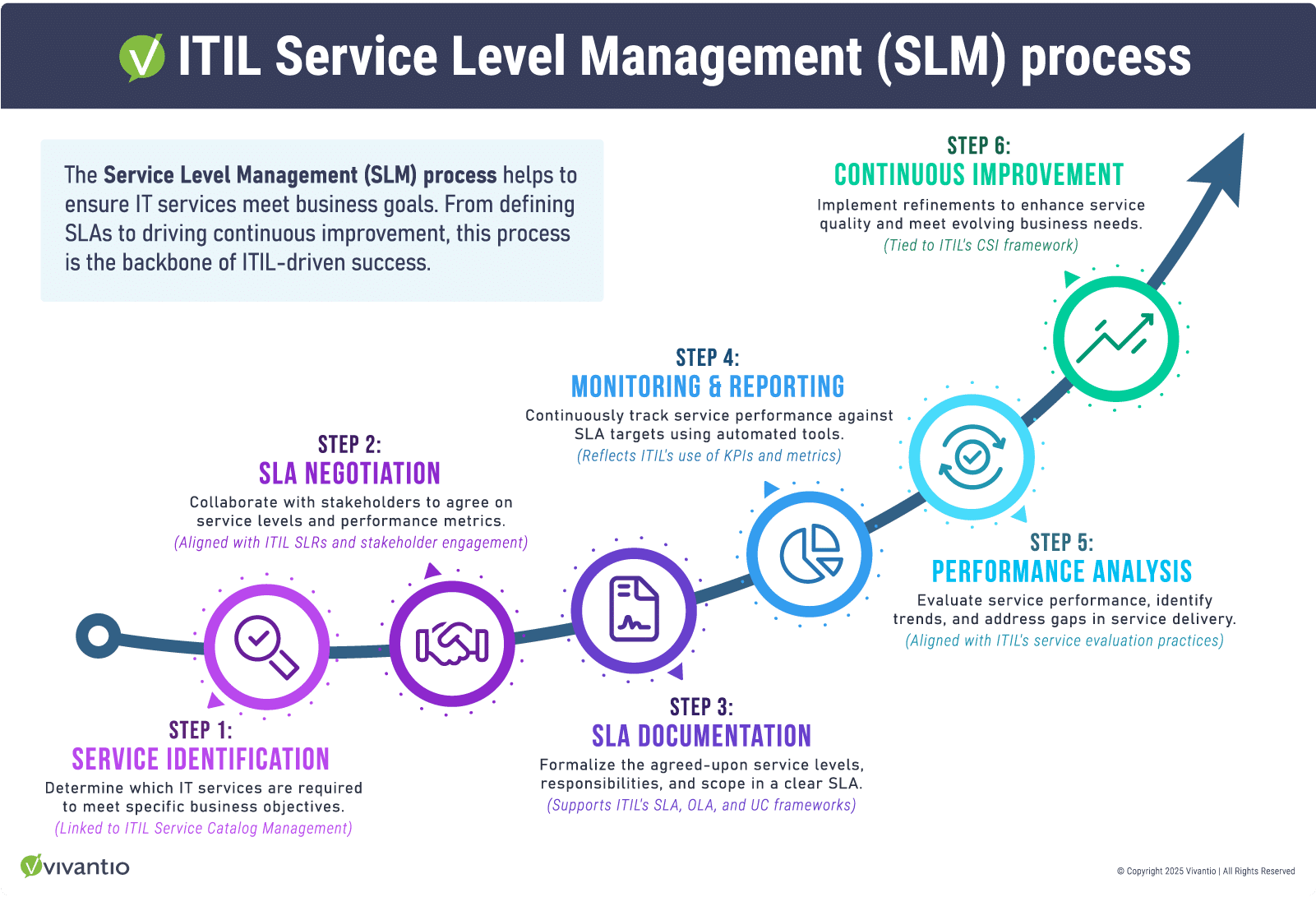
The ITIL service level management process has several important steps:
- First, figure out what services you need based on your business goals.
- Then, talk to customers and agree on service levels, including what you’ll measure.
- Next, make detailed SLAs that cover what’s agreed, who does what, and how you’ll report.
- After that, start monitoring and reporting on how well you’re doing against those SLAs.
- Keep checking service level reports to find areas for improvement.
- Work with other ITIL processes to make sure you’re delivering the best service possible.
Best Practices for Successful Implementation
To make the ITIL service level management process work well, follow these tips:
- Get everyone involved, from the service provider to the customer, to make sure everyone agrees.
- Use clear, measurable, and achievable metrics for service levels.
- Automate monitoring and reporting to see how you’re doing in real-time.
- Always be looking to improve, updating SLAs as your business changes.
- Make sure your team knows how to do their job well by training them.
Common Challenges and How to Overcome Them
Starting service level management can be tough, but there are ways to get past these hurdles:
| ### Challenge | ### Solution |
|---|---|
| Lack of alignment between IT and business objectives | Involve business stakeholders in defining service requirements and SLAs |
| Difficulty in measuring and reporting on service levels | Implement robust monitoring tools and establish clear reporting processes |
| Resistance to change from staff and stakeholders | Communicate benefits, provide training, and engage staff in process design |
| Managing multiple SLAs and service requests | Use a centralized service catalog and automated workflows to streamline processes |
By following these steps, best practices, and strategies for overcoming common challenges, you can successfully implement the ITIL service level management process. This will help you keep improving your IT service delivery.
Monitoring, Measuring, and Reporting Service Levels
To make sure your IT service provider meets the service targets in the Service Level Agreement (SLA), it’s key to monitor, measure, and report service levels. This is a big part of ITIL practices. It helps you manage service quality well.
By watching service levels, you can spot any problems fast and fix them. Tools and methods for checking service performance include:
- Network monitoring software
- Application performance monitoring (APM) tools
- Help desk and incident management systems
- Customer satisfaction surveys
Measuring service levels means collecting and analyzing data on key performance indicators (KPIs) from the SLA. This data helps make reports that show how well your IT service provider is doing. Regular reports help you and your provider make better choices to improve service quality.
When making service level reports, include this info:
| ### Report Section | ### Description |
|---|---|
| Executive Summary | A brief summary of service performance, highlighting successes and areas for betterment |
| Performance Against SLA Targets | A detailed look at how actual service levels compare to agreed targets, showing any issues |
| Trend Analysis | Historical data showing how service levels have changed over time, spotting trends and problems |
| Improvement Recommendations | Specific steps suggested by the service provider or customer to fix performance gaps and boost service quality |
By always checking, measuring, and reporting on service levels, you can build a strong partnership with your IT service provider. Together, you can deliver top-notch services that meet your business goals.
Continuously Improving Service Quality through Service Level Management
To meet service level management goals, a continuous improvement mindset is key. Using best practices and ITIL, you can spot areas to improve, helping to raise service quality and enhance customer satisfaction.
The SLM process is an ongoing task. It’s important to check how well services meet the targets set in agreements. By analyzing performance data, gathering feedback, and addressing root causes of issues, you can continuously improve each service.
Collaboration with different teams is crucial for implementing meaningful changes. Create actionable plans, assign tasks, and ensure clear communication of updates. Monitor the effectiveness of these changes and adjust as needed to better meet evolving business needs.
Optimize Your ITIL Service Level Management Process Today**
**Are you ready to take your service level management to the next level? By aligning IT services with business goals and embracing continuous improvement, you can enhance service quality and exceed customer expectations.
- Discover Best Practices: Learn how the ITIL framework can help you refine your service level management strategies.
- Empower Your Team: Foster collaboration and align service operations with business objectives.
- Track and Optimize: Leverage data-driven insights to continuously improve service delivery.
Take the next step:
- Schedule a Free Consultation: Let our experts help you implement ITIL best practices for better service outcomes.
- Request a Demo: Explore tools designed to streamline and enhance your ITIL service level management process.
With the right strategies and tools, you can elevate your IT services and drive success for your organization. Start optimizing your ITIL service level management process today.
Read more
Browse all resources
Ready to see it?
See Vivantio in action
Step your team up to real service management, without the leap to enterprise. Get a walkthrough tailored to your workflows.