






The ITIL Framework Can Be Described Best As: A Set of Best Practices
The ITIL framework is a powerful tool in IT Service Management (ITSM), providing organizations with a structured method to optimize their IT services. From…

Jump to section
Introduction
The ITIL (Information Technology Infrastructure Library) framework is one of the most widely recognized and adopted sets of best practices in IT Service Management (ITSM). It provides a structured approach to managing IT services, ensuring that they align with business needs and contribute to overall success. This article will explore the ITIL framework in detail, providing insights into its history, core components, benefits, and certification paths. By the end, you’ll have a comprehensive understanding of how the ITIL framework can be described the best and applied in modern IT environments.
What is the ITIL Framework?
Definition and Explanation
The ITIL framework is a set of best practices for IT Service Management (ITSM) that offers organizations a systematic and structured approach to managing IT services. Imagine a large organization like a hospital that relies heavily on IT services to manage patient records, scheduling, and communication. The ITIL framework helps ensure these critical IT services are delivered in a way that is not only cost-effective and efficient but also focused on the needs of patients and healthcare providers.
For example, in a hospital setting, the ITIL framework might guide the process of developing and implementing a new electronic health record (EHR) system. This process would start with the Service Strategy stage, where the hospital’s IT team would align the new system’s goals with the hospital’s overall objectives, such as improving patient care and reducing administrative costs. The Service Design stage would involve planning the technical architecture of the EHR system, including how it integrates with existing systems and meets regulatory requirements.
As the project progresses, the Service Transition stage would cover testing the system in a controlled environment, ensuring it works as intended before it’s fully deployed across the hospital. Once the EHR system is live, the Service Operation stage would focus on the day-to-day management of the system, including monitoring its performance and resolving any issues that arise. Finally, the Continual Service Improvement stage would involve regularly reviewing the system’s performance and making updates or enhancements to ensure it continues to meet the hospital’s needs.
The framework can be best described as a comprehensive guide that helps organizations like this hospital align their IT services with business objectives, ensuring that they deliver maximum value to customers—in this case, the patients and healthcare providers who rely on the EHR system.
Built on the principles of service management implementation, the ITIL framework emphasizes continuous improvement and the efficient use of resources. This means that, rather than implementing IT services in a haphazard or reactive way, the ITIL framework provides a structured approach that manages the entire lifecycle of IT services—from their initial design and development to their ongoing operation and eventual retirement. This ensures that IT services remain aligned with the organization’s goals, adapt to changing needs, and continue to deliver value throughout their lifespan.
History of ITIL
Development and Evolution
The ITIL framework was developed by the Central Computer and Telecommunications Agency (CCTA) in the late 1980s as a response to the growing need for standardized IT service management practices. Initially, ITIL was a set of recommendations designed to help the UK government improve its IT service delivery.
Since its inception, ITIL has undergone several revisions, each aimed at refining and expanding the framework to meet the evolving needs of the IT industry. The key versions of ITIL include:
- ITIL V1: The first version of ITIL, released in the late 1980s, focused on providing guidance for IT service management within government agencies.
- ITIL V2: Released in 2001, ITIL V2 expanded on the original framework, introducing new processes and best practices for IT service management.
- ITIL V3: Launched in 2007, ITIL V3 introduced the concept of the ITIL Service Lifecycle, which provided a more comprehensive view of IT service management.
- ITIL 4: The latest version, released in 2019, builds on the strengths of previous versions while incorporating new concepts such as the Service Value System (SVS) and guiding principles that reflect modern IT service management practices.
Core Components of the ITIL Framework
ITIL Service Lifecycle
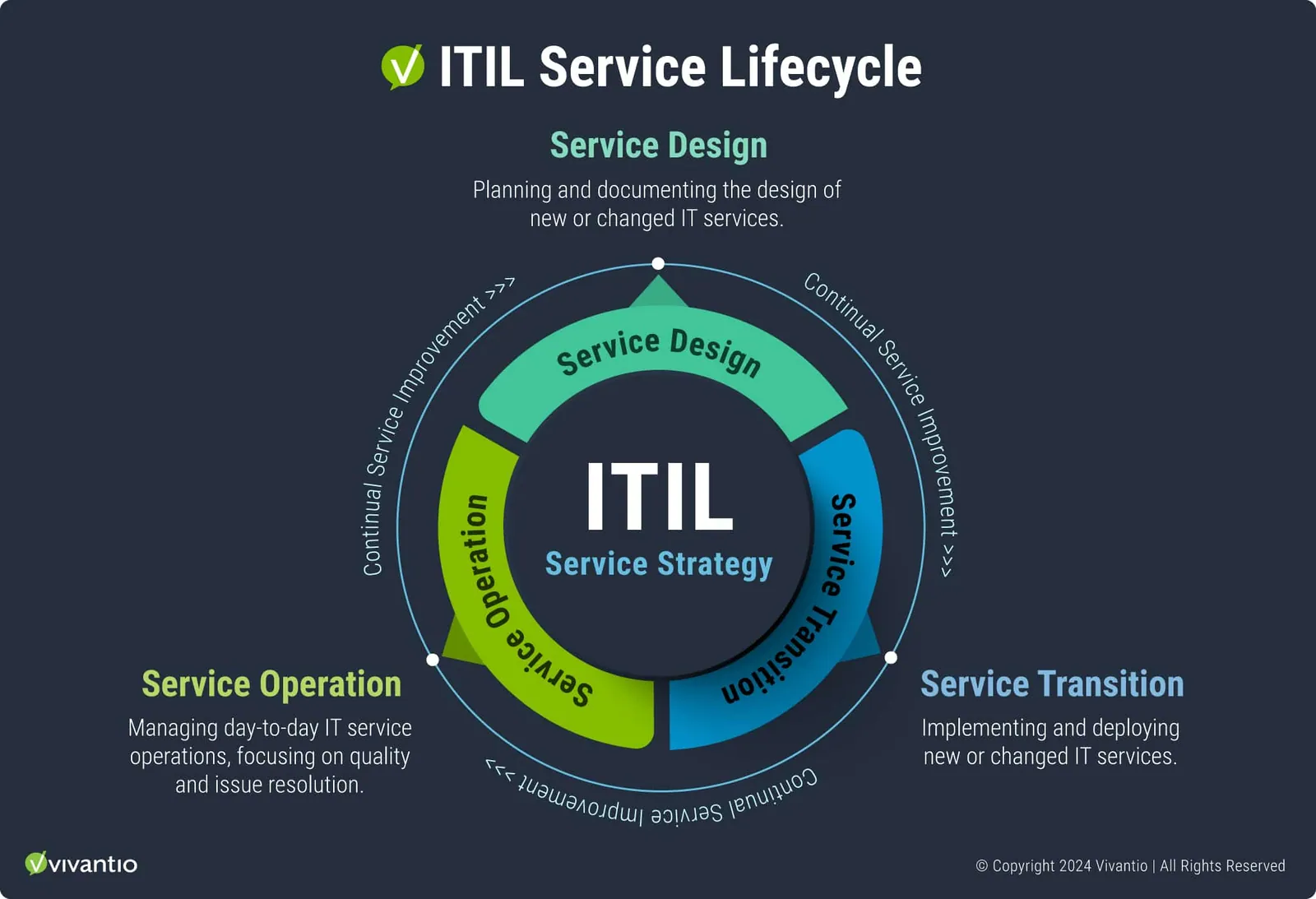
The ITIL Service Lifecycle is a central component of the ITIL framework, providing a structured approach to managing the entire lifecycle of IT services. The lifecycle consists of five stages:
- Service Strategy: This stage focuses on defining the overall strategy for IT services, ensuring that they align with business objectives.
- Service Design: In this stage, the design of new or changed IT services is planned and documented.
- Service Transition: This stage covers the implementation of new or changed IT services, including testing and deployment.
- Service Operation: The day-to-day operation of IT services is managed in this stage, with a focus on maintaining service quality and resolving issues.
Continual Service Improvement: This stage emphasizes the importance of ongoing improvement, ensuring that IT services continue to deliver value over time.
Service Value System (SVS)
Introduced in ITIL 4, the Service Value System (SVS) is a holistic approach to managing IT services that integrates various components, including governance, practices, and continual improvement. The SVS ensures that all parts of an organization work together to create value through IT services.
ITIL 4 vs. ITIL V3
Key Differences and Updates
The transition from ITIL V3 to ITIL 4 marked a significant evolution in the framework, with several key updates and improvements:
- Focus on Flexibility and Adaptability: ITIL 4 emphasizes a more flexible approach to IT service management, allowing organizations to adapt the framework to their specific needs.
- Introduction of Guiding Principles: ITIL 4 introduces seven guiding principles that provide a foundation for decision-making and best practices.
- Service Value System (SVS): As discussed earlier, the SVS is a key addition in ITIL 4, providing a more integrated approach to managing IT services.
Key Differences Between ITIL V3 and ITIL 4
| ### Feature | ### ITIL V3 | ### ITIL 4 |
|---|---|---|
| Service Lifecycle Focus | Yes | Column 3 Value |
| Flexibility | Less flexible, more prescriptive | Highly flexible and adaptable |
| Guiding Principles | No | Yes (seven guiding principles |
| Holistic Approach | Limited | Emphasizes a holistic, end-to-end approach |
| Integration with Other Frameworks | Limited | Better integration with Agile, DevOps, etc. |
7 Guiding ITIL 4 Principles
The seven guiding principles introduced in ITIL 4 are foundational to the framework’s approach to IT service management. They are designed to help organizations make decisions that align with best practices and are adaptable to various situations. Here are the seven guiding principles of ITIL 4:
- Focus on Value: Everything an organization does should contribute to the delivery of value to the customer or stakeholder. This principle emphasizes understanding what value means from the customer’s perspective and ensuring that all activities are aligned with delivering that value.
- Start Where You Are: Organizations should not start from scratch but instead assess their current state, leveraging existing processes, services, and capabilities that are functioning well. This principle encourages incremental improvements rather than wholesale changes.
- Progress Iteratively with Feedback: Large projects can be overwhelming, so this principle advocates for taking small, manageable steps that can be reviewed and adjusted based on feedback. This iterative approach helps manage risks and allows for continuous improvement.
- Collaborate and Promote Visibility: Effective collaboration and transparency are key to achieving successful outcomes. This principle highlights the importance of working together across different teams and ensuring that everyone has visibility into what is happening across the organization.
- Think and Work Holistically: IT services should be viewed as components of a larger system, rather than in isolation. This principle emphasizes understanding the entire service value chain and ensuring that all parts are working together cohesively.
- Keep It Simple and Practical: Complexity can be the enemy of good practice. This principle encourages organizations to eliminate unnecessary processes and focus on simple, practical solutions that achieve the desired outcomes.
- Optimize and Automate: Organizations should strive to optimize their processes and workflows before automating them. This principle stresses the importance of efficiency and the smart use of technology to reduce waste and improve service delivery.
These guiding principles are central to the ITIL 4 framework and represent a shift towards a more flexible, customer-centric, and integrated approach to IT service management compared to ITIL V3.

Benefits of Implementing the ITIL Framework
Advantages for Organizations
Implementing the ITIL framework offers numerous benefits to organizations, including:
- Improved Service Delivery: By following ITIL best practices, organizations can deliver IT services that are more reliable, efficient, and aligned with business needs.
- Increased Customer Satisfaction: ITIL helps organizations provide higher-quality services, leading to greater customer satisfaction and loyalty.
- Enhanced Efficiency: ITIL streamlines processes, reduces waste, and improves resource utilization, leading to cost savings and increased efficiency.
Comparison of Benefits Before and After ITIL Implementation
| ### Benefit | ### Before ITIL Implementation | ### After ITIL Implementation |
|---|---|---|
| Service Delivery | Inconsistent, reactive | Consistent, proactive |
| Customer Satisfaction | Varies, often low | High, consistent |
| Resource Utilization | Inefficient, wasteful | Efficient, optimized |
| Process Efficiency | Fragmented, disjointed | Streamlined, integrated |
ITIL Certification Path
Overview of ITIL Certifications
The ITIL certification path offers various levels of certification, each designed to validate a professional’s knowledge and expertise in IT service management:
- ITIL 4 Foundation: The entry-level certification that provides an overview of the ITIL framework and its key concepts.
- Managing Professional: A certification that covers more advanced ITIL practices, including ITIL Specialist and ITIL Strategist modules.
- Strategic Leader: Focuses on the strategic application of ITIL principles, including ITIL Leader and ITIL Strategist modules.
- ITIL Master: The highest level of certification, demonstrating deep expertise in ITIL practices and their application in real-world scenarios.
Benefits of ITIL Certification
- Career Advancement: ITIL certification is highly regarded in the IT industry, opening doors to new opportunities and higher-level positions.
- Enhanced Knowledge: Certification provides a deep understanding of ITIL practices, enabling professionals to implement them effectively.
- Increased Credibility: ITIL-certified professionals are recognized as experts in IT service management, enhancing their credibility with employers and peers.
Best Practices for ITIL Adoption
Steps to Successfully Implement ITIL
Adopting ITIL requires careful planning and execution. Here are some best practices to ensure a successful implementation:
- Prepare Your Organization: Educate stakeholders about the benefits of ITIL and secure buy-in from leadership.
- Start Small: Begin with a pilot project to demonstrate the value of ITIL before rolling it out across the organization.
- Focus on Continual Improvement: Use the Continual Service Improvement (CSI) model to make incremental improvements over time.
Address Common Challenges: Be prepared to overcome resistance to change, resource constraints, and other common challenges during ITIL adoption.
The Role of ITIL in Modern ITSM
ITIL’s Influence on ITSM Practices
ITIL has had a profound impact on IT service management, shaping how organizations approach the delivery and management of IT services. Today, ITIL is often integrated with other frameworks and methodologies, such as Agile and DevOps, to create a more comprehensive and adaptive approach to ITSM.
Real-World Examples
- Professional Services: Many professional services firms utilize ITIL to enhance service delivery and streamline their internal processes, ensuring that client engagements are managed efficiently and meet high standards of service excellence.
- Manufacturing: Manufacturing companies implement ITIL to support the seamless operation of their IT systems, enabling better coordination across production lines and ensuring that IT services contribute to maximizing operational efficiency.
- Education: Educational institutions adopt ITIL to manage their IT infrastructure, providing reliable and secure access to online learning platforms and administrative systems, thereby supporting a smooth educational experience for students and staff.
Future of ITIL
Predictions and Trends
As technology continues to evolve, so too will the ITIL framework. Future versions of ITIL are likely to place even greater emphasis on flexibility, integration with other frameworks, and support for emerging technologies such as AI and automation.
The Role of ITIL in the Changing Landscape of IT Services
As organizations increasingly adopt cloud computing, remote work, and other modern technologies, ITIL will continue to provide the guidance and best practices needed to manage these complex environments effectively.
Ready to elevate your IT service management with the ITIL framework? Contact Vivantio today!
Schedule a Free Consultation: Discuss your specific needs and explore how implementing the ITIL framework can align your IT services with business objectives, driving greater efficiency and customer satisfaction.
Request a Personalized Demo: Discover how Vivantio’s ITSM solutions can support your ITIL implementation with:
- Comprehensive Guidance: Leverage a flexible, all-encompassing approach to IT service management tailored to your organization’s unique needs.
- Enhanced Service Quality: Deliver high-quality IT services that align with your business goals and exceed customer expectations.
- Efficient Processes: Streamline your operations and improve service delivery through proven ITIL practices.
- Scalable Solutions: Adapt and grow your ITSM capabilities as your organization evolves, with tools that scale with your business.
Unlock the potential of your IT operations with Vivantio and the ITIL framework—where technical excellence meets strategic alignment.
Read more
Browse all resources
Ready to see it?
See Vivantio in action
Step your team up to real service management, without the leap to enterprise. Get a walkthrough tailored to your workflows.