






The Customer Workflow Crisis: Why Mid-Market Teams Need a New Approach
Mid-market organizations are struggling with a challenge few anticipated: workflow fragmentation across Support, Success, Ops, and Product. Tool sprawl and…

Jump to section
The Workflow Reality Mid-Market Teams Never Saw Coming
Across the mid-market, service organizations are confronting a challenge that has quietly become one of the most disruptive forces in customer experience. Customer workflows—those end-to-end sequences of work that carry a customer from onboarding to renewal—are no longer linear, predictable, or contained within a single department.
Today:
- Onboarding touches Support, Ops, Success, and Product.
- Escalations move across systems.
- Renewals depend on cross-team coordination.
The result?
A rising operational crisis rooted not in tools—but in workflow fragmentation.
Most mid-market companies never built for this level of complexity. And now, it’s starting to show.
1. The Mid-Market Landscape: Where Complexity and Constraints Collide
Mid-market organizations operate in a unique pressure zone—large enough to encounter enterprise-level workflow complexity, but without the operational resources to match it.
They’re often:
- Too complex for SMB-level tools
- Too resource-constrained for enterprise platforms
- Too distributed for manual coordination
- Too fast-moving for slow operational redesign
These organizations tend to share similar characteristics:
250–5,000 employees, multiple customer-facing teams, and anywhere from six to twelve active customer workflows happening simultaneously. With hybrid teams and fast-growing service portfolios, coordination becomes a daily challenge.
The Data Behind the Pressure
Recent research illuminates just how significant this strain has become:
- Many mid-market companies report SaaS apps running into the hundreds
(Jumpcloud, Zylo, Spendesk & Productiv)
- 49% cite overlapping tools and redundant systems as major workflow blockers
(The Sequence by iru) - A top priority appears to be reducing tool sprawl, not adding new features
(CIO, Information Week, Network World) - Manual processes and data silos remain top operational inefficiencies
- 78% of mid-market execs report adopting AI (formally or informally)—yet most still lack the workflow structures to support it
(RSM US)
In other words:
The tech stack scaled. The workflows did not.
Before diving deeper into how these pressures manifest, it helps to see them through the lens of one familiar mid-market story.
2. Meet NobleNest: A Relatable Mid-Market Story
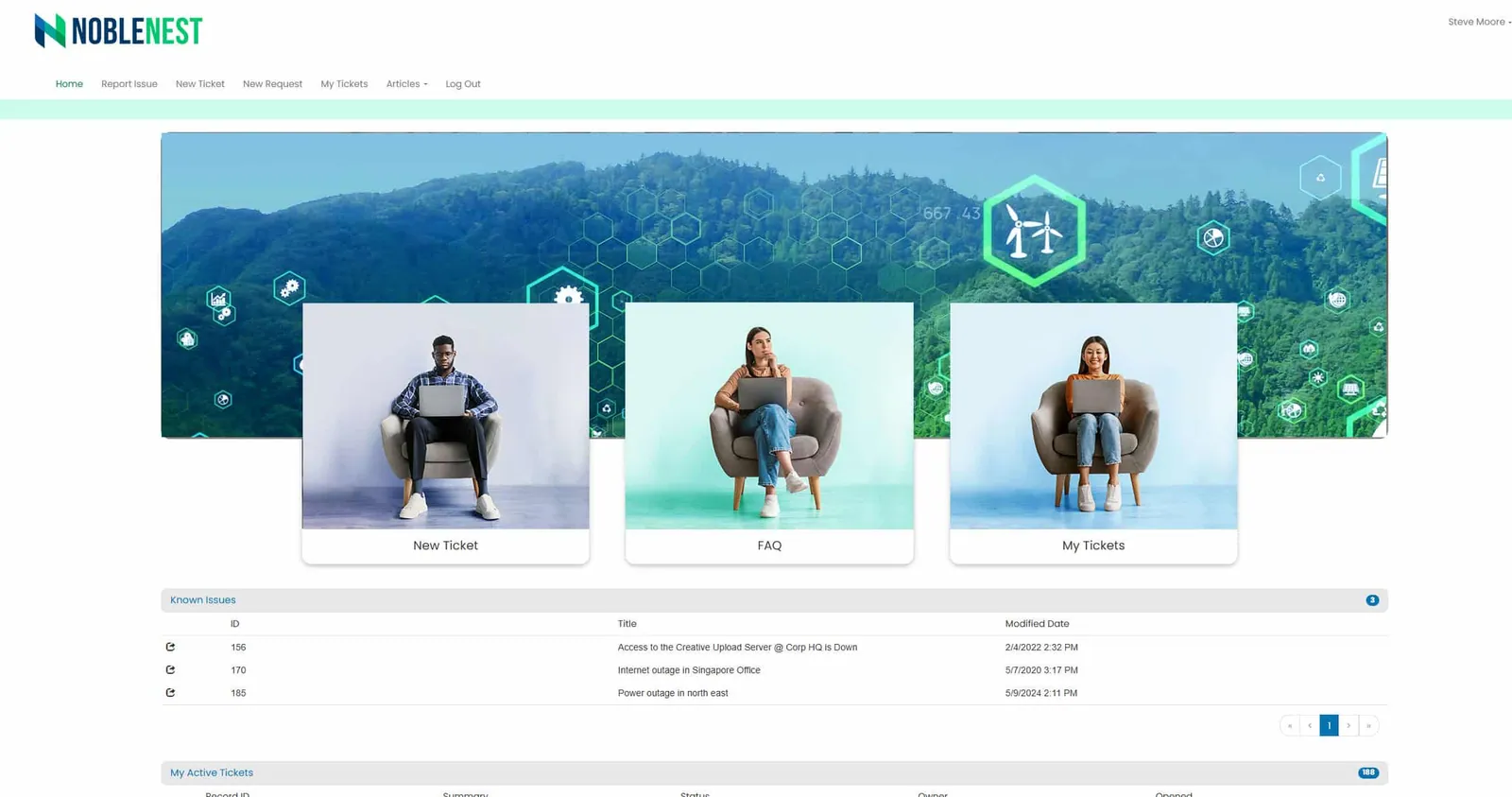
To illustrate the real dynamics at play, we introduce NobleNest, a fictional—but highly representative—mid-market service provider.
About NobleNest
- 1,200 employees
- Operating across four U.S. regions
- Multiple customer-impacting teams
- A CRM, helpdesk, success platform, project tool, and many specialized apps
- Expanding into new service lines
From the outside, NobleNest looks like a success story.
Inside, their teams tell a different story:
“We’re scaling faster than our workflows can keep up,” one manager shared—a sentiment echoed across many mid-market organizations.
NobleNest is the every-company of the mid-market—capable, growing, but struggling under the weight of increasingly fractured customer operations. This is where the challenges begin to take shape.
3. Customer Workflows Are More Complex Than Ever Before
Across the industry, customer workflows are evolving faster than organizational structures can adapt.
Today:
- A single customer issue may touch five to seven teams
- Onboarding spans technical configuration, training, compliance, account setup, and product alignment
- Escalations jump across internal systems and communication channels
- Success plans depend on accurate, timely updates from Support, Ops, and Product
- AI initiatives rely on shared customer context that rarely exists in one place
At NobleNest, this complexity was most evident in their onboarding process.
Sales closed the deal in the CRM, Ops kicked off setup in a project tool, Support handled technical questions in the helpdesk, Success managed adoption in a separate platform, and Product received feedback through a standalone form.
Each team contributed value.
But no one owned the full workflow.
The result was a customer experience shaped by invisible gaps.
4. Tool Sprawl Isn’t the Real Problem—Workflow Fragmentation Is
Yes, mid-market teams have accumulated too many tools. But the deeper issue isn’t tool count—it’s the lack of coordination across workflows.
NobleNest’s Tech Stack Looked Like This:
- CRM for customer records
- Helpdesk for issue tracking
- Project tool for onboarding steps
- Shared inbox for escalations
- Separate knowledge base
- Chat + email for internal collaboration
Each tool held part of the story.
None held the whole thing.
As one NobleNest CSM put it:
“It felt like every team held a different chapter of the book—but the customer expected one story.”
This fragmentation created:
- Lost context between tools
- Inconsistent ownership of customer issues
- Handoff failures and missed updates
- Redundant work
- Conflicting reporting
- Delays in customer communication
Over time, workflow fragmentation didn’t just slow the organization—it reshaped how customers perceived the entire company.
5. A Day in the Life of a Broken Workflow: NobleNest’s Escalation Incident
To understand how fragmentation shows up in practice, let’s walk through a scenario that could happen at any mid-market service organization.
Step 1: Support Handles the Initial Issue
A customer reports a critical technical problem.
Support diagnoses and resolves the symptom, then closes the ticket.
But Support cannot see the customer’s declining adoption trend in the success platform.
Step 2: Success Flags a Drop in Usage
The CSM notices the customer has disengaged.
They prepare to reach out.
But Success has no idea a major escalation occurred the day before.
Step 3: Ops Identifies a Process Breakdown
Ops discovers the real root cause—a misconfiguration during onboarding, documented in their project system.
But that insight never reaches Support or Success in a structured way.
Step 4: Product Needs Detailed Context
Product hears about an issue through Slack.
But without Support’s technical notes or Ops’ findings, they lack the detail needed to diagnose or prioritize a fix.
Step 5: Leadership Wants Answers
Leadership asks the most basic operational questions:
- “Where is the customer blocked?”
- “What’s the workflow status?”
- “Is this tied to churn risk?”
But no single system reflects the end-to-end reality.
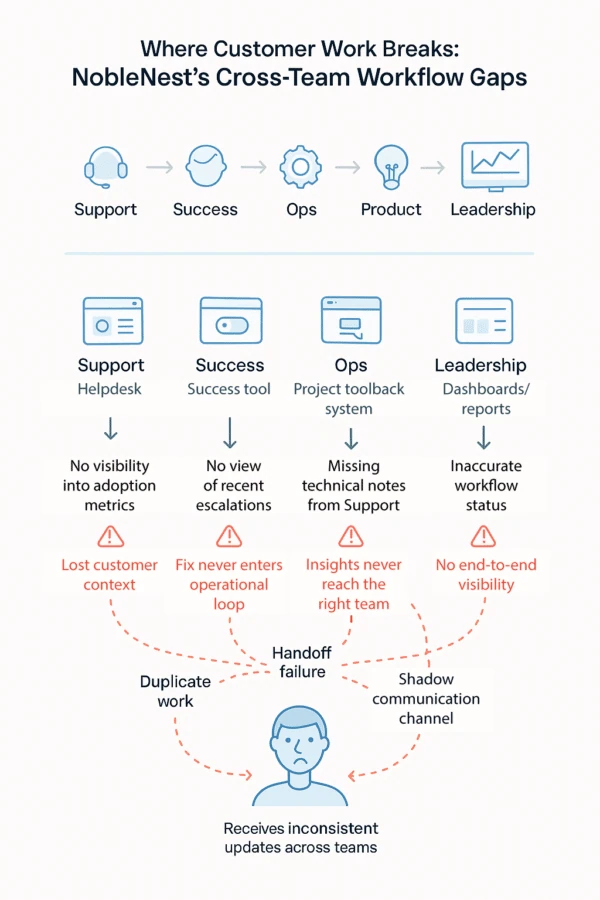
The Result?
- Redundant work
- Delayed updates
- Lost context
- Internal confusion
- Frustrated customers
- Elevated churn risk
NobleNest didn’t fail because of people.
They failed because:
The workflow moved, but the systems didn’t move with it.
6. The Hidden Cost of Fragmented Customer Workflows
Workflow fragmentation becomes expensive long before organizations notice.
Operational Costs
- Duplicate task entry
- Manual coordination
- Siloed automations
- SLA inconsistencies
- Reopened issues
Customer Costs
- Repeated explanations
- Slow or contradictory responses
- Erosion of trust
- Unpredictable experiences
Organizational Costs
- Burnout among service teams
- Poor cross-team communication
- Conflicting dashboards
- Blind spots in risk and renewal forecasting
A recent study found:
“Many organizations — nearly half in one recent survey — report overlapping or redundant tools, which often correlates with broken workflows and cross-team misalignment.”
For NobleNest, the impact was personal:
“We weren’t losing customers because of the technical issue. We were losing them because we looked disconnected.”
7. Why Mid-Market Companies Get Stuck in This Pattern
Mid-market organizations don’t lack talent or effort. They lack:
- A unified operational backbone
- A system designed for cross-team workflows
- Clear workflow ownership
- Process design resources
- Time to step back and redesign workflows
- A consolidated visibility layer
- Harmonized data across systems
And they face compounding pressures:
- Rapid scaling
- Talent shortages
- Rising customer expectations
- Pressure to consolidate tools
- Expanding service portfolios
These conditions create workflow fragility—exactly what NobleNest experienced.
8. This Isn’t Just NobleNest—It’s the Mid-Market Pattern
Many mid-market organizations report a similar struggle, even when their industries, stacks, or teams look very different.
The symptoms tend to converge:
- Workflows spread across teams and tools.
- Context gets lost between systems.
- Coordination becomes the hidden bottleneck.
It’s a pattern that’s becoming increasingly common across mid-market customer operations.
9. A Closing Thought: The Real Challenge for Mid-Market Teams
If there’s one takeaway for mid-market organizations, it’s this:
Customer experience is no longer defined by individual teams—it’s defined by the flow of work between them.
- Support may solve symptoms.
- Success may manage relationships.
- Ops may correct underlying processes.
- Product may improve the offering.
But the customer experiences all of it as one continuous journey.
The organizations gaining momentum today aren’t necessarily the ones with the most tools or the most automation. They’re the ones who recognize that the real differentiator is how effectively work moves across their teams.
Because when workflows break, customers feel it instantly. And when workflows flow, customers notice that too.
The challenge now—and the opportunity—is understanding where those gaps exist, how they affect the customer journey, and what it will take to close them.
The path forward begins with seeing workflows not as background operations, but as the backbone of customer experience.
Read more
Browse all resources
Ready to see it?
See Vivantio in action
Step your team up to real service management, without the leap to enterprise. Get a walkthrough tailored to your workflows.