






How to Master AI Data Integration: Tips for Operation Leaders
Disconnected data systems waste time and stall growth. Learn how AI-driven data integration can automate workflows, eliminate silos, and drive real-time…

Jump to section
Data access has long been the lifeblood of business. But for today’s B2B SaaS companies, how data is accessed and utilized has dramatically evolved.
For operation leaders, mastering the data integration process is now essential to making informed decisions and improving efficiency.
Ask yourself: Are fragmented systems slowing down your decision-making? How much revenue is lost due to inconsistent, siloed data that limits real-time insights?
If this scenario sounds familiar, you know how frustrating it can be to navigate fragmented data systems. AI-powered data integration can offer a solution by seamlessly connecting disparate sources, allowing you to unify, manage, and leverage customer data more effectively.
As a leader, you likely understand better than anyone how unstructured data makes it harder to drive strategic decisions. By leveraging AI algorithms, it’s now possible to enhance data by automating processes like data extraction, transformation, and matching, ensuring that accurate data is available for analysis. This not only enhances your decision-making abilities but also holds great potential to boost operational efficiency.
Overcoming Challenges in AI-Driven Data Integration
However, adopting AI-driven data integration isn’t without challenges. Many organizations encounter obstacles such as:
-
Inconsistent data quality
-
Incompatible formats
-
Fragmented data sources
These hurdles can slow progress and limit the full potential of AI-powered insights. Overcoming them requires a strategic approach—one that ensures data remains accurate, accessible, and aligned with broader business objectives.
A Strategic Guide for Operations Leaders
This article serves as your guide to navigating and overcoming these challenges. We’ll explore practical strategies and techniques to enhance your data integration efforts, ensuring your organization reaps the benefits made possible by AI technology.
Whether you’re aiming to:
-
Boost operational efficiency
-
Handle large volumes of data for strategic decisions
-
Drive business growth
…the insights shared here will help you achieve those goals.
Understanding Modern Data Integration Principles
Today’s operations leaders face a common challenge: too much data trapped in too many places. Customer records live in your CRM, usage data in your product dashboard, and financials in spreadsheets—each disconnected from the other. That’s where modern, AI-driven data integration enters the picture.
“You can’t make real-time decisions with part-time data.”
AI-powered tools help unify these sources into one intelligent, actionable ecosystem. No more juggling data exports, manually fixing formatting issues, or triple-checking reports for discrepancies.
How AI Simplifies Modern Data Integration:
-
Automates repetitive tasks like data cleaning, extraction, and transformation
-
Connects disconnected platforms, from CRMs to billing systems
-
Delivers real-time visibility across all departments
“What once took days now happens in seconds.”
Sophia, an operations leader at a fast-scaling SaaS firm, used to spend hours every week reconciling spreadsheets. After implementing an AI-driven platform, her team now gets real-time reports with reliable data—no manual clean-up required. She can focus on analyzing trends and making decisions, not fixing problems.
Core Steps in the Data Integration Lifecycle
To build a strong data foundation, organizations should align around these essential steps:
-
Gather data from multiple internal and external sources
-
Clean and transform it into a consistent, usable format
-
Store it centrally to make it accessible across teams
-
Protect privacy while maintaining accuracy
-
Leverage it to improve customer experience and drive decisions
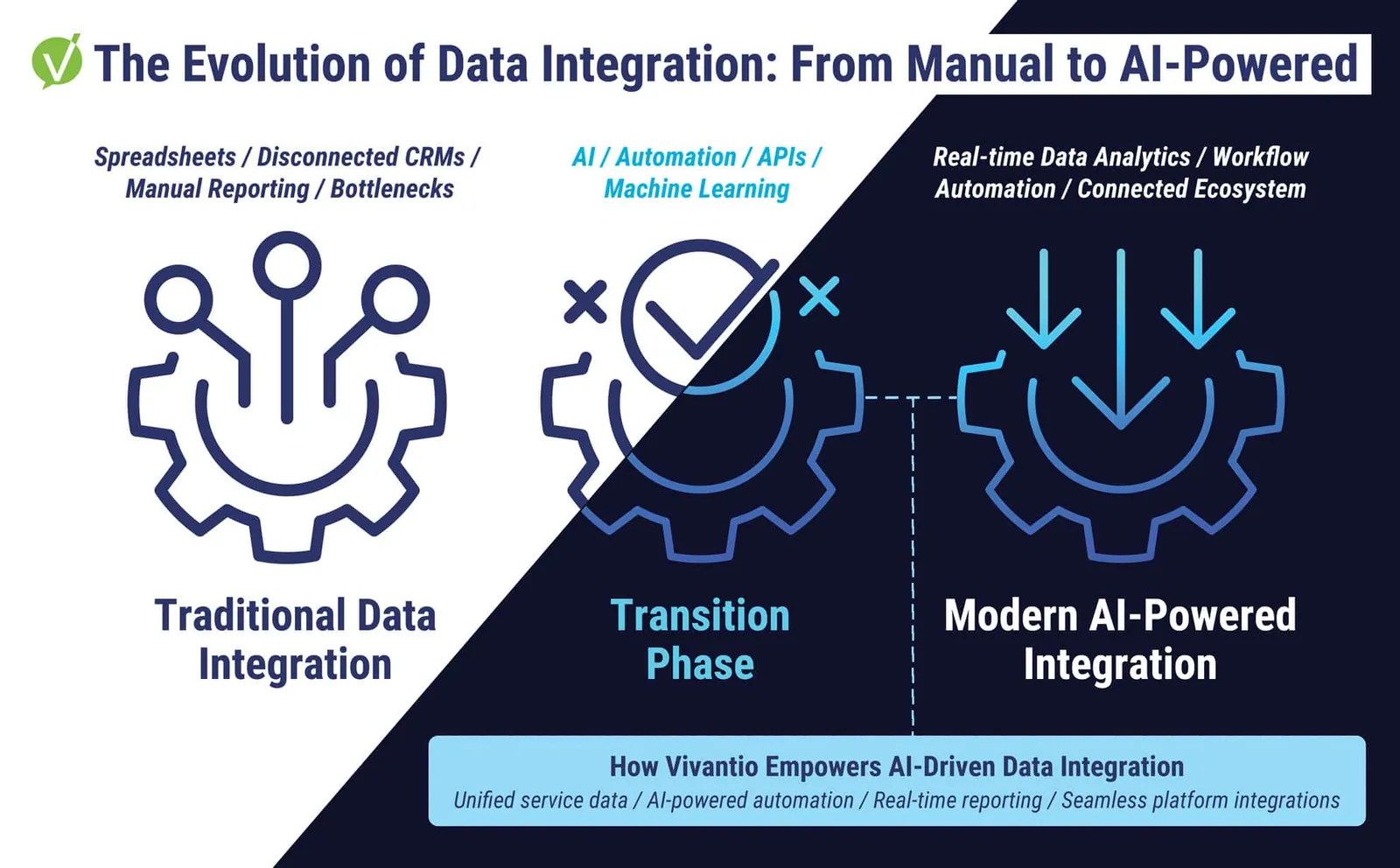
The Evolution of Data Integration: From Manual to AI-Powered
Exploring Various Data Integration Techniques
As data volumes continue to grow, choosing the right integration strategy becomes a critical decision for operations leaders. Each technique serves different needs—some focus on accessibility, others on speed or cost-efficiency.
“There’s no one-size-fits-all solution—just the right fit for your business needs.”
Understanding your infrastructure, team size, and growth trajectory will help you choose the most scalable and effective approach.
Data Consolidation
Data consolidation brings information from multiple systems into a single, centralized repository. It’s especially helpful for organizations juggling complex data sets spread across different platforms.
Benefits of data consolidation:
-
Creates a single source of truth across the organization
-
Reduces human error through automated collection and cleaning
-
Enhances business intelligence by giving analysts a full view of performance
“Consolidated data is clean data. And clean data builds confident decisions.”
Data Virtualization
Unlike consolidation, data virtualization lets you access and query data across multiple systems without physically moving or replicating it. It offers agility without storage overhead.
Benefits of data virtualization:
-
Eliminates silos with a unified, real-time view
-
Minimizes cost by avoiding redundant data movement
-
Enables AI to identify patterns and generate insights instantly
“Virtualization brings speed and structure—without disrupting existing systems.”
Choosing the Right Fit
When evaluating your options, consider:
-
Your team’s technical maturity
-
Volume and velocity of your data
-
Long-term scalability goals
Pro Tip: Use a hybrid approach that combines both methods to suit specific departments or use cases.
Data Warehousing and Federation
In fast-paced SaaS environments, structured access to reliable data is critical. Two core integration techniques—data warehousing and data federation—help organizations manage large volumes of data while enabling deeper analysis and collaboration.
“Structure isn’t a constraint—it’s your secret weapon for smarter decisions.”
1. Data Warehousing
A data warehouse is a centralized, structured repository that stores historical and transactional data from multiple sources. It’s ideal for organizations that need to analyze trends over time and rely on large-scale reporting.
Benefits of data warehousing:
-
Provides a structured, scalable home for your most valuable data
-
Supports advanced analytics and performance dashboards
-
Reduces discrepancies by ensuring consistent, reliable data
-
Automates data prep with AI-enhanced processing
“Warehousing turns raw data into strategic fuel.”
2. Data Federation
Data federation is different. Instead of storing everything in one place, it creates a virtual layer that pulls from multiple systems in real time. It’s a lightweight solution for teams that need immediate access without heavy infrastructure investment.
Benefits of data federation:
-
Unifies views across departments without duplicating data
-
Minimizes risk of data loss and storage redundancy
-
Enables collaboration around a shared version of truth
-
Speeds up decision-making by connecting systems on demand
Which Should You Choose?
-
Use warehousing when you need structured historical analysis and performance trends.
-
Use federation when you prioritize real-time access and cross-platform agility.
“The best integration systems are the ones you don’t notice—because they just work.”
✅ Decision Checklist
Ask yourself:
-
Do you need historical analytics or instant access?
-
Is your infrastructure flexible enough to support centralized storage?
-
Will different teams need to collaborate across departments?
Choosing the right technique allows your business to:
-
Reduce integration friction
-
Minimize disruption
-
Scale with confidence

The Transformative Role of AI and ML in Data Integration
Artificial Intelligence (AI) and Machine Learning (ML) are no longer emerging trends—they’re the driving force behind how modern businesses manage and scale their data strategies.
When layered into your integration efforts, these technologies unlock automation, reduce errors, and reveal powerful insights from data that would otherwise go unnoticed.
“AI doesn’t just speed things up—it smartens things up.”
How AI and ML Enhance Data Integration
🔄 Automating Data Mapping
Manual mapping is one of the most time-consuming steps in traditional integration. AI automates this by identifying relationships between data sets and formats without human intervention.
Benefits:
-
Reduces onboarding time for new data sources
-
Scales with your organization as data sources evolve
-
Frees up your team to focus on analysis, not grunt work
✅ Enhancing Data Quality
ML algorithms scan for anomalies, inconsistencies, and missing values. They can clean, deduplicate, and validate data automatically—far beyond human capability at scale.
Results:
-
Higher confidence in your analytics
-
Faster report generation
-
Fewer hours wasted on manual QA
“Good data isn’t an accident—it’s a habit powered by AI.”
🗂 Smarter Metadata Management
Your data is only as accessible as your ability to find it. AI organizes metadata by tagging and categorizing files intelligently, making it easier to search, trace, and audit records.
What it enables:
-
Instant access to the right information
-
Improved compliance with data governance standards
-
Faster integration of new sources
| #### Feature | #### Traditional Integration | #### AI-Powered Integration |
|---|---|---|
| Data Mapping | Manual and time-consuming | Automated and scalable |
| Data Quality | Prone to human error | Continuously improving with ML |
| Metadata Management | Manually tagged and sorted | AI-driven categorization |
By leveraging AI and ML, operations leaders can build smarter systems that evolve alongside their business—without the constant need to stop and reconfigure.
“The future of integration is intelligent, adaptive, and always improving.”
Overcoming Data Silos and Integration Challenges
Data silos are silent killers. They fragment your systems, isolate teams, and bury insights in spreadsheets, disconnected apps, and isolated platforms. The result? Slower decisions, misaligned goals, and missed opportunities.
“You can’t scale collaboration when your data doesn’t talk to itself.”
Modern integration tools break these barriers down—empowering teams to act on shared, real-time insights.
Common Integration Pain Points
-
Limited data accessibility across platforms and departments
-
Manual, error-prone workflows that slow down operations
-
Departmental silos that make collaboration harder than it should be
| #### Aspect | #### Traditional Approach | #### Modern Integration Tools |
|---|---|---|
| Data Accessibility | Limited, locked in silos | Unified, real-time access |
| Automation | Manual, repetitive tasks | Streamlined, rule-based workflows |
| Collaboration | Fragmented, reactive teams | Cross-functional, proactive ops |
“When everyone’s working off different numbers, no one’s making the right call.”
🚀 Real-World Example
A retail company unified data from customer feedback, sales transactions, and warehouse inventory. By integrating this information, they developed a 360-degree customer view—empowering teams to predict demand, personalize offers, and reduce inventory waste.
What This Means for You
With the right integration platform:
-
Customer support sees order history and service tickets in one place
-
Sales teams get usage metrics without needing to request a report
-
Leadership makes decisions on today’s data—not last quarter’s
“A unified platform isn’t just about efficiency—it’s about enabling better business outcomes.”
Embracing Serverless and DIaaS for Scalable Solutions
As your business grows, your data needs don’t just multiply—they accelerate. What worked for 100 customers may break under the weight of 10,000. That’s why scalability is no longer optional—it’s foundational.
Two technologies leading this charge are Serverless Architecture and Data Integration as a Service (DIaaS).
“Scaling shouldn’t mean sacrificing performance—or your sanity.”
⚙️ What Is Serverless Architecture?
Serverless doesn’t mean no servers—it means you don’t have to manage them. Your infrastructure auto-scales based on usage, so you’re not paying for idle resources or scrambling during peak load.
Benefits:
-
Eliminates infrastructure maintenance
-
Auto-scales to match real-time demand
-
Speeds up deployments and innovation cycles
-
Reduces cost by charging only for actual usage
🔌 What Is DIaaS?
Data Integration as a Service (DIaaS) offers ready-to-use, cloud-based solutions for connecting systems, applications, and databases without needing to code or manage the underlying complexity.
Benefits:
-
Easily connects disparate systems (even legacy ones)
-
Simplifies integrations across cloud platforms
-
Reduces deployment timelines and IT bottlenecks
-
Scales automatically alongside your data growth
📘 Real-Life Example
A fast-growing retail brand adopted DIaaS to integrate real-time POS data with online inventory, supply chain, and customer feedback. What used to be managed manually across four systems was unified into a real-time dashboard—helping store managers make instant restocking decisions.
Key Takeaway
“If you’re building for today, you’re already behind. Serverless and DIaaS build for tomorrow.”
These scalable technologies allow your teams to:
-
Move faster without infrastructure constraints
-
Spend less time troubleshooting and more time strategizing
-
Grow confidently, knowing your systems will scale with you
Harnessing IoT and Real-Time Data Streams
In an era where everything is connected, IoT (Internet of Things) devices are revolutionizing how companies collect and respond to data. Sensors, apps, and machines are constantly feeding organizations new insights—but only if they know how to harness them.
“Real-time data is only useful if your systems can keep up with reality.”
That’s where edge computing and data normalization come into play, enabling businesses to analyze and act on data as it happens.
🛰 Edge Computing: Process at the Source
Rather than sending all data back to a central server, edge computing processes it close to the source—like in a factory machine or on a device in the field.
Benefits:
-
Reduces latency for faster decisions
-
Limits bandwidth usage by filtering data before upload
-
Supports predictive maintenance and alerts in real time
🧹 Data Normalization: Bring Structure to Chaos
IoT data comes from a variety of sources—each with its own format. Data normalization transforms this chaotic input into consistent, usable insights.
Benefits:
-
Ensures data is structured and comparable
-
Makes analytics scalable across all sources
-
Improves data quality by enforcing format standards
🧭 Traditional vs. Real-Time Approaches
| #### Aspect | #### Traditional Approach | #### Modern Approach |
|---|---|---|
| Data Processing | Centralized, high latency | Distributed, real-time |
| Consistency | Manual, error-prone | Automated and standardized |
| Decision-Making | Delayed and reactive | Instant and data-driven |
🔍 Example in Action
A SaaS company offers a customer success platform. By integrating real-time usage analytics with support ticket data, the platform flags at-risk customers before they churn. It automatically triggers proactive outreach, in-app guidance, or escalation workflows—boosting retention and satisfaction.
“IoT isn’t just about data—it’s about delivering better experiences, faster.”
When integrated correctly, IoT and real-time streams unlock an entirely new level of agility and responsiveness for your organization.
Enhancing Data Quality for Strategic Decision-Making
You can’t make smart decisions with bad data. It’s that simple.
Even the most advanced AI system or real-time dashboard is only as good as the information it’s built on. That’s why improving data quality is a foundational step—not a final polish.
“Clean data is no longer a luxury—it’s a leadership advantage.”
🧽 Implementing Data Cleansing Techniques
Modern businesses collect data from dozens of systems—CRMs, support tickets, billing platforms, and more. Each introduces inconsistencies: duplicate records, missing fields, incorrect formatting.
AI-powered cleansing tools automatically detect and resolve:
-
Duplicate or redundant entries
-
Format mismatches (dates, currencies, units)
-
Missing or inconsistent fields
Why it matters:
-
Reduces reporting errors
-
Minimizes compliance risks
-
Restores trust in your dashboards and decisions
“With AI in charge of cleanup, your team can stay focused on strategy.”
📐 Optimizing Data for Usability
It’s not enough for data to be accurate—it also has to be usable. Structuring your data improves performance, speeds up queries, and makes integrations smoother.
Key practices include:
-
Data profiling – understanding the shape and structure of your data
-
Normalization – organizing data into consistent, scalable formats
-
Validation – ensuring data meets predefined quality thresholds
📊 Traditional vs. Modern Approaches
| Aspect | Traditional | Modern Approach |
|---|---|---|
| Data Profiling | Manual and sporadic | Automated, real-time insights |
| Data Cleansing | Prone to oversight | AI-powered with precision |
| Normalization | Static and complex | Dynamic, scalable structures |
🔁 The Business Outcome
When data quality is high:
-
Your forecasts are more accurate
-
Your automation workflows run smoother
-
Your teams stop second-guessing their tools
“Better data equals better decisions. Every time.”
Integrating Natural Language Processing in Data Strategies
Every day, your business generates massive amounts of unstructured text—from support tickets and customer reviews to internal notes, chat logs, and emails. Traditionally, this kind of data was hard to analyze.
But Natural Language Processing (NLP) changes the game.
“What used to be invisible noise is now a goldmine of insight.”
NLP makes it possible to turn messy human language into structured data points that your systems—and your team—can use.
🧠 How NLP Works in Practice
Step 1: Extract
NLP pulls meaningful elements from free-form text—like names, dates, sentiment, and keywords.
Step 2: Structure
It then organizes this data into a format your analytics tools can digest and act on.
Step 3: Apply
Now that it’s structured, you can feed this insight into dashboards, alerts, or even automation flows.
💼 Real-World Applications of NLP in B2B SaaS
-
Customer Support
Analyze tickets and chats to spot common pain points, track sentiment trends, and prioritize issues automatically. -
Sales & Marketing
Parse email threads, meeting transcripts, and CRM notes to extract buying signals, objections, or opportunities. -
Cybersecurity & Compliance
Scan system logs and alerts for unusual language patterns that could signal a threat or breach.
“With NLP, your team doesn’t just read data—they understand it at scale.”
🔄 Complementing Other Technologies
NLP works seamlessly alongside:
-
Machine Learning models to enhance predictions
-
Visualization tools to make patterns stand out
-
Automation workflows that trigger based on specific language inputs (e.g., escalation phrases like “cancel my account”)
📈 Business Benefits
-
Makes unstructured data usable
-
Improves decision-making with a full picture (not just numbers)
-
Uncovers sentiment, urgency, and hidden patterns you’d otherwise miss
“The words your customers use matter. NLP makes sure you’re listening.”
Pioneering Innovations with AI-Powered Integration Tools
As AI continues to evolve, so do the tools available to integration teams. These next-gen platforms don’t just move data—they interpret it, learn from it, and improve over time.
“Your integration tools should be more than pipelines—they should be partners.”
These innovations are uncovering previously hidden patterns, reducing operational lag, and enabling faster, smarter decisions across the enterprise.
🔍 Uncovering Hidden Data Patterns
Traditional tools often treat data as static. But AI-powered systems can detect subtle, complex relationships that help you spot:
-
Customer behavior trends
-
Workflow inefficiencies
-
Predictive triggers before issues arise
Example:
In retail, AI tools detect that customers who search for “blue” items also tend to purchase during late afternoons. That insight shapes inventory, promotions, and staffing.
“AI sees the stories your data is already trying to tell you.”
🌐 Real-World Applications Across Industries
-
Healthcare: Analyze patient data for earlier, more accurate diagnoses
-
Finance: Detect fraud by identifying unusual transaction patterns in real time
-
Logistics: Optimize routes based on evolving weather and traffic data
-
SaaS: Predict customer churn based on subtle usage shifts and support interactions
These aren’t just nice-to-haves—they’re business-critical insights.
✅ Choosing the Right Integration Platform
When evaluating AI-powered tools, look for:
-
Configurability – Can it adapt to your unique data ecosystem?
-
Intelligence – Does it offer real-time learning and recommendations?
-
Scalability – Will it grow with your data volume and business needs?
“The right tool doesn’t just connect systems—it connects strategies.”
With pioneering integration solutions in place, your business becomes more responsive, resilient, and ready for what’s next.
Unlocking Growth Through Intelligent Data Management
At the heart of every successful, scalable organization is one common thread: they treat their data like a strategic asset—not an afterthought.
It’s not just about collecting information. It’s about turning that information into insight—and turning that insight into action.
“Data management isn’t about systems. It’s about unlocking potential.”
💡 Why Intelligent Data Management Matters
When your systems are connected, your data is accurate, and your insights are timely, your business gains three major advantages:
1. Stronger Customer Insights
By integrating sales, marketing, and support data, you create a 360-degree view of your customers—allowing for personalized engagement and better retention.
2. Smarter Strategic Planning
Access to the right data at the right time allows leadership to anticipate market shifts, optimize operations, and reduce decision-making risk.
3. Sustainable Competitive Advantage
Businesses that can adapt quickly—because they can see clearly—outpace slower competitors and seize new opportunities as they emerge.
🔮 Future Trends and Opportunities
As integration technologies evolve, forward-thinking companies will embrace:
-
Predictive Analytics: Using historical and real-time data to forecast behavior and make proactive moves.
-
Dynamic Decision Engines: AI systems that adapt recommendations based on new data inputs.
-
Unified Data Ecosystems: Where structured and unstructured data coexist and complement one another.
“The future of integration is proactive, not reactive. It’s about outmaneuvering—not just keeping up.”
🚀 Take the Next Step Toward Smarter Integration
Your business already runs on data—but how much of that data is actually being put to work?
Without a seamless, intelligent integration strategy:
-
Opportunities are missed
-
Customer experiences fall short
-
Growth becomes reactive instead of intentional
💬 Where Vivantio Comes In
Vivantio isn’t just an ITSM platform—it’s a growth accelerator that helps you:
-
Break down silos between systems and teams
-
Automate workflows with AI-powered efficiency
-
Surface real-time insights for better decisions
-
Deliver seamless, data-backed customer service
-
Scale confidently, without adding complexity
“Your data is talking. Vivantio makes sure you’re hearing it loud and clear.”
📅 Ready to See It in Action?
Let Vivantio show you how AI-powered data integration can transform your operations from reactive to strategic—and unlock new levels of service excellence, team productivity, and business growth.
Read more
Browse all resources
Ready to see it?
See Vivantio in action
Step your team up to real service management, without the leap to enterprise. Get a walkthrough tailored to your workflows.