






Service Level Objectives and Indicators Explained
Discover how Service Level Objectives (SLOs) and Indicators (SLIs) can revolutionize service reliability and user satisfaction. Learn practical tips,…

Jump to section
Introduction
Did you know that companies with clear Service Level Objectives (SLOs) and Service Level Indicators (SLIs) see up to 70% fewer service issues? This shows how important SLOs and SLIs are for a smooth and reliable user experience.
As technology has advanced, customer service has often taken a back seat, but the tide is shifting, and user experience is now the focal point of service delivery. As a result, keeping services reliable is key. SLOs and SLIs are essential tools for measuring performance, setting goals, and ensuring user satisfaction. Using these metrics effectively can greatly improve your service management.
In this article, we’ll explore SLOs and SLIs in detail. We’ll cover what they are, why they matter, and how they’re used in real life. By the end, you’ll know how these metrics can boost your service reliability and user satisfaction.
What Are Service Level Objectives (SLOs)?
A service level objective (SLO) defines measurable goals for how well your service should perform, helping ensure that your team prioritizes the needs of your user base. In recent years, customer expectations for service quality and reliability have increased, making SLOs a critical tool for aligning performance with user happiness.
Definition and Importance
An SLO is a clear goal for the level of performance a service should deliver. It sets expectations for users while providing your development team with a framework to prioritize issues like service availability, request latencies, and reliability of your service. SLOs are often tied to Service Level Agreements (SLAs), ensuring compliance with contractual commitments.
Defining SLIs (Service Level Indicators) is an essential step in creating SLOs. SLIs are metrics to measure aspects like service availability, correctness, and latency. By tracking these indicators, teams can determine whether a service met its objectives or if corrective actions are needed.
SLOs help focus resources on problems that affect users most, ensuring your team pays the right level of attention to issues such as the time that a service is available or the number of requests processed successfully. This alignment builds trust with users and strengthens your reputation.
Setting Effective SLOs
To create SLOs that drive results, start by defining SLIs that matter most to your users. Indicators like service availability, latency, and error rates are important SLIs to monitor. For example, a single SLI might measure the percentage of requests successfully handled within a specific timeframe.
Best practices for setting SLOs include:
- User-Focused Goals: Engage with your user base to understand their expectations and create SLOs tailored to those needs.
- Clarity and Measurability: Ensure SLOs are specific and tied to key metrics, making them easy to track and evaluate over time.
- Flexibility: Update SLOs over time to adapt to changes in user expectations, business goals, or evolving service requirements.
- Achievability: Set challenging but realistic goals that promote continuous improvement without overburdening your development team.
For example, an SLO might define that 99.9% (or the “three nines”) of service requests should be completed successfully, ensuring high service availability.
Real-World Examples
Companies like Google and Netflix illustrate the importance of SLOs in action. Google SRE (Site Reliability Engineering) teams prioritize the reliability of their services, using SLOs to maintain compliance with SLAs and improve performance metrics. Netflix, on the other hand, creates SLOs to guarantee streaming quality and minimize downtime, relying on SLIs such as request latencies and service availability.
Both companies monitor and refine their SLOs over time, using SLI data to ensure users receive a consistent and reliable experience.
Understanding Service Level Indicators (SLIs)
A Service Level Indicator (SLI) is a precise metric used to measure a specific aspect of service performance. SLIs provide actionable insights into how well your service is functioning, acting as the foundation for maintaining reliability and delivering a consistently positive user experience.
Core Metrics for SLIs
Selecting the right customer health metrics is crucial for meaningful performance measurement. Here are three essential SLI categories and what they reveal about your service:
- Latency: This measures the time it takes for a service to process a request from start to finish. For example, how quickly a webpage loads or how fast a system responds to user input. High latency can lead to frustration, making it a critical metric to monitor.
- Throughput: This indicates the volume of data or requests handled by your service over a specific period. For instance, how many orders are processed per second by an e-commerce platform. Maintaining a high throughput is essential for scaling services to meet growing user demand.
- Error Rates: These track the frequency of failures during service delivery, such as failed transactions or system crashes. Error rates can highlight systemic issues affecting user satisfaction and trust in your service.
These metrics are vital for understanding your service’s performance and addressing areas that directly influence user happiness and retention.
Choosing the Right SLIs
The effectiveness of SLIs depends on selecting metrics that truly reflect your service quality and align with user expectations. Here’s how to ensure your SLIs are both relevant and impactful:
- Understand User Expectations: Conduct surveys, gather user feedback, or analyze customer behavior to determine which performance metrics matter most. For instance, if your users prioritize fast response times, latency should be a primary SLI.
- Align with Service Goals: Choose SLIs that are directly tied to the purpose and goals of your service. A streaming platform, for example, might prioritize buffering times and playback quality as critical SLIs.
- Ensure Measurability: Opt for metrics that are easy to track, analyze, and act upon. Using tools that provide real-time data ensures you can proactively address performance issues before they escalate.
The right SLIs allow you to focus on what matters most to your user base, ensuring your efforts are directed at meaningful improvements.
Effect on Reliability and User Experience
SLIs play a significant role in maintaining service reliability and enhancing user satisfaction. By closely monitoring SLIs, you can achieve the following:
- Boost Reliability: Regularly tracking SLIs helps you identify potential issues, such as rising error rates or increased latency, before they impact users. This enables proactive resolutions and minimizes disruptions.
- Enhance User Experience: When SLIs are consistently met or exceeded, users experience smooth, dependable service that fosters loyalty and trust.
- Informed Decision-Making: SLIs provide data-driven insights that help prioritize improvements, allocate resources effectively, and guide long-term strategies.
For instance, if a sudden spike in error rates is detected, your team can address the root cause promptly, reducing downtime and maintaining user confidence.
SLIs are more than just metrics; they are a roadmap for ensuring your service meets high standards of reliability and user satisfaction. By choosing the right SLIs, tracking them diligently, and acting on the insights they provide, businesses can consistently deliver exceptional service that meets user expectations and builds trust over time.
SLOs and SLIs: How They Work Together
SLOs and SLIs are key to checking if your services are reliable. SLOs set the goals for service performance. SLIs are specific metrics that check if these goals are hit.
Together, SLOs and SLIs show how well your systems perform. By watching SLIs, you see if SLOs are met. This is important for keeping services high in quality.
Here’s how SLOs and SLIs work together:
- Defining Targets: SLOs set clear goals for service reliability.
- Measuring Performance: SLIs check if services meet these goals, giving you numbers to look at.
- Proactive Management: Checking SLIs helps you fix problems before they hit users.
- Informed Decision Making: Good service metrics from SLIs help you make better choices, improving service quality.
Let’s say a web app service aims for 99.9% of requests to be fast. The SLI tracks how fast these requests are. This way, providers can keep their services reliable for users.
The partnership between SLOs and SLIs is key for strong service metrics. These metrics build trust and satisfaction among users, helping both tech and business goals.
Creating Measurable SLOs
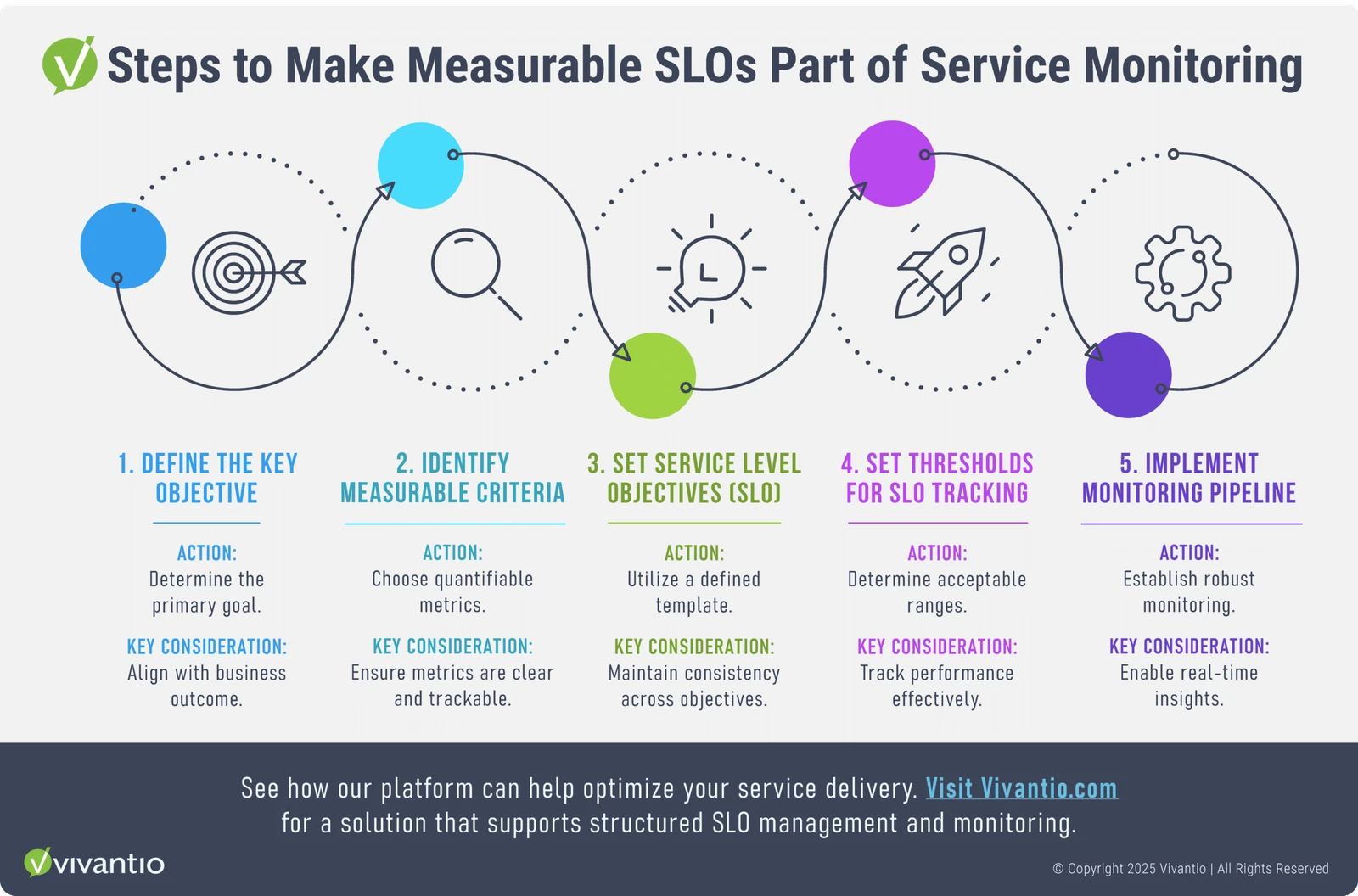
To make measurable SLOs, you need a clear plan. Follow key steps to make sure your goals are clear, reachable, and doable.
Key Steps
- Define the Objective: First, figure out what you want your service to do. This is the base for everything else.
- Identify Measurable Criteria: Pick metrics you can measure to set your goals. For example, if you want better user experience, look at load times or error rates.
- Set SLOs: With your criteria in place, set clear SLOs. Use a good template to keep everything consistent and easy to understand.
- Set Thresholds: Decide what’s okay for your metrics. This helps you see how you’re doing and when you need to change.
- Implement Monitoring Pipeline: Create a strong monitoring system to keep track of your SLOs. This gives you quick updates and helps you act fast.
Common Pitfalls to Avoid
When making measurable SLOs, some mistakes can mess things up. Here are key ones to steer clear of:
- Setting Unrealistic Targets: Make sure your goals are high but possible. Goals that are too high can cause frustration and failure.
- Failing to Consider All User Interactions: You need to see how users interact with your service fully. Missing some interactions can make your SLOs incomplete.
- Using Undefined Metrics: Stick to metrics that are clear and known. Avoid vague terms that can be misunderstood.
- Neglecting Regular Reviews: SLOs should grow with your service. Regular check-ins help you update and improve your goals based on new data.
Ignoring Feedback Loops: Talk to your users and stakeholders to get their thoughts. This keeps your SLOs relevant and in line with what users want.
Best Practices for Implementing SLOs and SLIs
Using Service Level Objectives (SLOs) and Service Level Indicators (SLIs) can make your services more reliable and user-friendly. Here are some top tips to get the best results.
Start by setting clear SLOs that match your business goals. It’s important to check and update these goals often. This way, you can adjust to new needs and expectations. Also, watching your SLIs closely gives you key insights into how well your services are doing. This helps you tweak your SLOs as needed.
Another key step is to link your SLIs with your current monitoring and alert systems. This helps spot problems early, so you can fix them fast. It keeps your services running smoothly and keeps users happy.
Here are some main practices to keep in mind:
- Regularly check and update SLOs to match changing goals.
- Keep a close eye on SLIs to get accurate service data.
- Make sure SLIs are part of your monitoring and alert systems.
- Keep everyone informed to ensure everyone is on the same page.
To really understand these practices, let’s look at how they work at different stages:
| ### Implementation Stage | ### Best Practices | ### Expected Outcome |
|---|---|---|
| Initial Setup | Define clear and measurable SLOs | Aligned objectives with business goals |
| Monitoring | Regular monitoring of SLIs | Accurate performance insights |
| Integration | Incorporate SLIs into monitoring frameworks | Early detection of issues |
| Review and Update | Frequently review and adjust SLOs | Adaptive and relevant objectives over time |
By following these best practices, you can get the most out of your SLOs and SLIs. This leads to more reliable services and happier users. Sticking to these guidelines will help you use SLOs and SLIs effectively, making your services more solid and responsive.
Error Budgets: Managing Service Reliability
An error budget is key to balancing innovation with keeping services reliable. It sets a limit for errors, helping you decide when to add new features. This way, you can meet your reliability goals.
Defining Error Budgets
Setting an error budget means figuring out how much downtime or errors you can have. It’s linked to your Service Level Objectives (SLOs). For instance, if you aim for 99.9% uptime, you can have 0.1% downtime. This gives you a clear idea of how much room you have for errors.
Balancing Innovation and Reliability
It’s tough to keep up with fast development and reliability. An error budget helps you decide between new features and improving current ones. It ensures you use your engineering resources well, keeping reliability high.
Here are some ways to keep a good balance:
- Check your error budgets often to adjust to new user needs or tech.
- Match your error budget with your team’s ability to handle issues.
- Use error budgets to improve and learn continuously.
- Let your team make decisions based on data, keeping reliability in mind.
By following these steps, you can let innovation grow while keeping your services reliable.
Role of SRE in Managing SLOs and SLIs
Site Reliability Engineering (SRE) is key in making services more reliable and efficient. It manages Service Level Objectives (SLOs) and Service Level Indicators (SLIs). This ensures systems are both strong and work well.
How SRE Teams Use SLOs
SRE teams focus on integrating SLOs and SLIs into their work. They set measurable SLOs that match business goals. Then, they use SLIs to check how well these goals are met.
By watching these metrics, SREs can spot problems early. This lets them fix issues quickly, keeping services running smoothly.
SRE teams use SLOs to set service standards. If an SLI shows a problem, they can fix it fast. This keeps services reliable and users happy.
Benefits for DevOps
Bringing SRE into DevOps brings big benefits. It creates a strong bond between the two. DevOps teams can use SRE methods to manage SLOs and SLIs better.
This teamwork makes continuous delivery smoother. It ensures new features and updates don’t harm the system. It also helps DevOps teams (Azure Devops Example) work more efficiently, as they know what to aim for.
In short, SRE and DevOps working together makes services more reliable. This leads to business success and better user experiences.

Using SLOs to Enhance User Experience
Service Level Objectives (SLOs) are key to better user experience. They set clear, measurable goals for service reliability and performance. This ensures your users get consistent quality.
To improve user experience, align SLOs with what users expect. Know how users interact with your service and what matters most to them. Focus on services that users see and use.
Clear SLOs to stakeholders build trust and transparency. This lets everyone see your commitment to quality. It also encourages teamwork to meet these goals.
Here are key points for setting and sharing SLOs to better user experience:
- Find important user interactions that need high reliability and performance.
- Set targets that are realistic and meet user expectations.
- Update SLOs based on user feedback and changing needs.
- Use SLO metrics to track and share performance with stakeholders.
Here’s a comparison of good vs. bad SLO settings:
| ### Aspect | ### Effective SLO | ### Ineffective SLO |
|---|---|---|
| Target Setting | Explicit, user-centric, achievable | Vague, overly ambitious, unrealistic |
| Communication | Clear, transparent, regular updates | Inconsistent, ambiguous, infrequent |
| Flexibility | Open to adjustments based on feedback | Rigid, not responsive to user needs |
By following these steps and using SLOs well, you can greatly improve user experience. This makes users more likely to stay and be happy with your service.
Measuring Service Performance
It’s crucial to measure service performance accurately. This ensures the reliability and effectiveness of digital services. By looking at individual SLI metrics, organizations can understand their performance. They can also spot areas that need improvement.
Key Metrics
Key metrics are key to assessing service performance. They give us numbers that show how well a service works. These metrics include:
- Latency: Shows how long it takes for a request to be handled.
- Availability: Tells us how often a service is working.
- Throughput: Shows how much data is processed over time.
- Error Rate: Tracks how often requests fail compared to those that succeed.
Tools and Techniques
Special tools and techniques are needed to monitor service performance well. They help track and analyze key metrics. This ensures the data is correct and useful. Some popular tools and techniques are:
- Prometheus: An open-source system for monitoring and alerting.
- Grafana: A tool for visualizing metrics from different sources.
- New Relic: A comprehensive platform for performance monitoring.
- Elastic Stack (ELK): A powerful suite for real-time log data analysis.
With these tools and techniques, you can measure and improve your service performance. This makes sure users have a reliable and efficient experience.
| ### Tool | ### Function |
|---|---|
| Prometheus | Monitoring and alerting |
| Grafana | Data visualization |
| New Relic | Performance monitoring |
| Elastic Stack (ELK) | Real-time log data analysis |
Put SLOs and SLIs into Action for Optimal Service Performance
Are you ready to leverage SLOs and SLIs to elevate your service delivery? By aligning key metrics with business goals, you can improve reliability, user satisfaction, and overall performance.
Discover Real-Life Applications: Learn from examples like Netflix and telemedicine providers to understand how top companies use SLOs and SLIs for reliable, high-quality service.
Tailor Metrics to Your Needs: Customize service objectives to meet the unique demands of your industry, whether it’s e-commerce, cloud services, or healthcare.
Boost Performance and Satisfaction: Track and optimize the metrics that matter most to ensure your services consistently meet and exceed expectations.
Take the next step:****
Schedule a Free Consultation: Let our experts help you implement effective SLOs and SLIs tailored to your business needs.
Request a Demo: Explore tools designed to streamline and enhance your service performance management.
With the right metrics and strategies, you can drive better outcomes for your organization and delight your users. Start optimizing your service performance today.
Read more
Browse all resources
Ready to see it?
See Vivantio in action
Step your team up to real service management, without the leap to enterprise. Get a walkthrough tailored to your workflows.