






A Complete Guide to MSP Automation: 5 Steps to a Culture of Efficiency
Explore how MSPs can enhance efficiency and client satisfaction with our comprehensive guide to ITSM and ITIL-driven automation. Follow our five essential…

Jump to section
Introduction to MSP Automation
Manual tasks for Managed Service Providers (MSPs) are becoming a relic of the past. Today, the integration of IT Service Management (ITSM) and the implementation of ITIL processes are pivotal in achieving streamlined operations and superior client satisfaction. Leveraging MSP automation significantly enhances IT service delivery, ensuring clients receive prompt and efficient solutions tailored to their needs.
ITSM and ITIL provide a structured framework that enables MSPs to implement automation effectively. This integration eliminates the inefficiencies associated with manual processes, allowing MSPs to focus more on innovation and strategic initiatives rather than mundane tasks. Clients benefit from faster response times, reduced downtime, and overall improved service quality, leading to increased client satisfaction and retention.
This comprehensive guide outlines five essential steps to cultivating a culture of efficiency through automation within your MSP. Whether you’re just beginning to explore automation or seeking to optimize existing processes, this guide equips you with the knowledge and strategies necessary to elevate your MSP business to new heights.
Let’s delve into how ITSM and ITIL-driven automation can revolutionize your MSP operations and elevate your service delivery capabilities.
MSP Automation as a Key to Operational Efficiency
For MSPs, operational efficiency is paramount. To maintain a competitive edge, incorporating automation into your business processes is essential. Automation not only streamlines workflows but also enhances productivity, allowing your team to focus on delivering exceptional service to clients.
Steps to Integrate Automation:
-
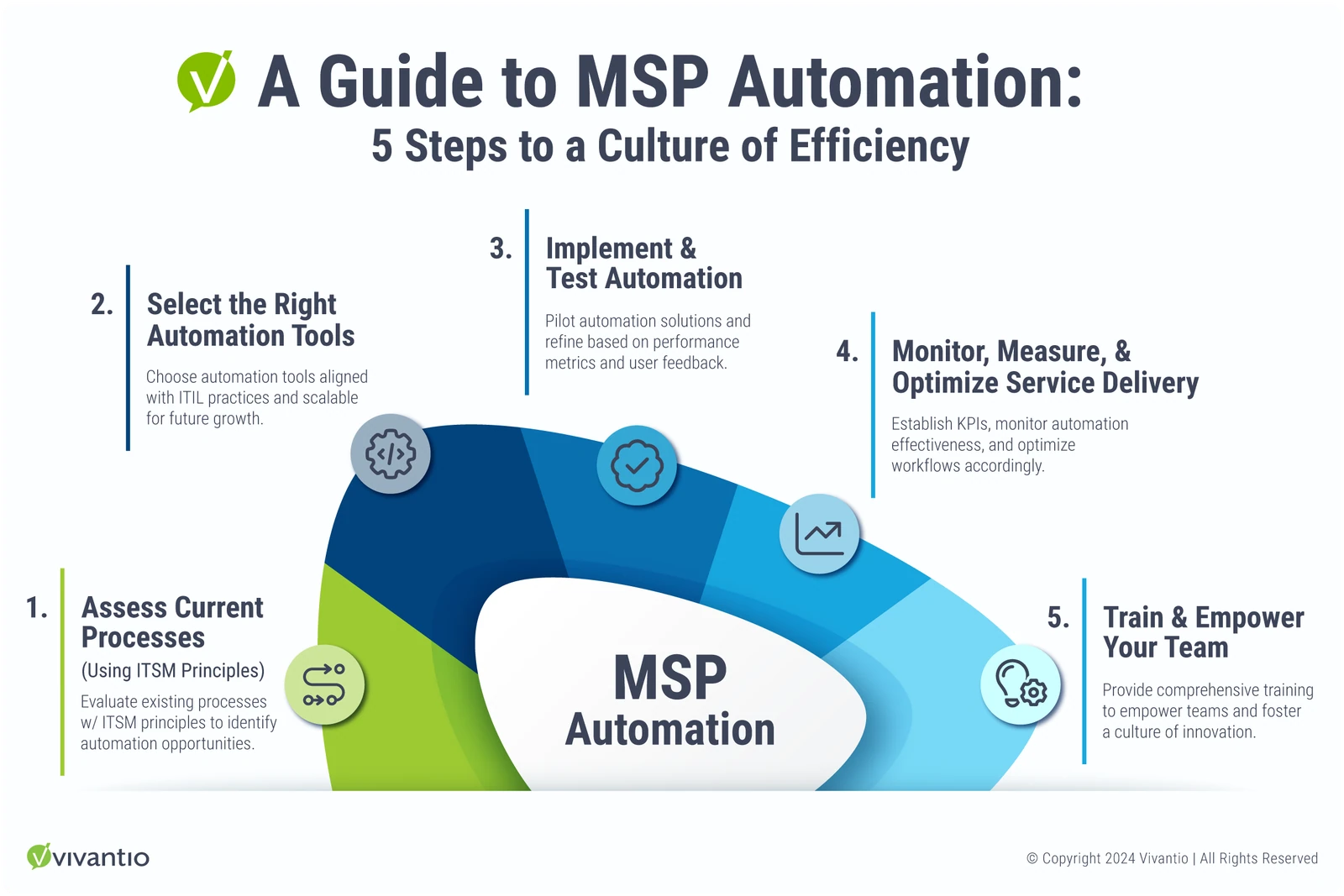
Assess Current Processes Using ITSM Principles:
- Apply ITIL frameworks to categorize processes (Incident Management, Change Management, etc.).
- Identify tasks with high potential for automation, prioritizing based on business impact and alignment with Service Level Agreements (SLAs).
-
Select the Right Automation Tools Aligned with Customer Service Management:
-
Ensure compatibility with existing systems (RMM, PSA).
-
Evaluate tools based on:
- Functionality (scheduling, customization).
- Integration capabilities with ITSM tools.
- Ease of use and scalability to meet client demands and future growth.
-
-
Implement and Test Automation:
- Start with pilot projects to validate effectiveness and ROI.
- Roll out automation gradually, refining processes based on feedback and performance metrics aligned with SLAs.
-
Monitor, Measure, and Optimize Service Delivery:
- Establish KPIs to monitor automation success and adherence to SLAs.
- Continuously review and optimize automated workflows to improve efficiency and client satisfaction.
- Gather insights from customer feedback and internal teams to refine automation strategies.
-
Train and Empower Your Team:
- Develop comprehensive training programs to ensure your team understands the automation tools and processes.
- Use hands-on workshops and ITIL-based training to help employees adapt to new workflows.
- Foster collaboration and encourage feedback to continuously refine and improve automation strategies.
By strategically integrating automation with ITSM and ITIL frameworks, MSPs can optimize operations, elevate service delivery, and foster long-term client relationships. This approach not only improves internal efficiency but also positions your MSP for sustained success in a competitive marketplace driven by service excellence and innovation.
Choosing the Right Automation Tools
Building on the framework established in Step 1, selecting the right automation tools is crucial for enhancing operational efficiency and service delivery within your MSP business. Here’s a detailed approach to selecting and implementing automation tools that align with your MSP’s specific needs and integrate seamlessly with your existing ITSM framework and leveraging ITIL best practices.
Selecting the Right Automation Tool:
-
Assess Your Requirements:
- Conduct a thorough assessment of your MSP’s current processes and workflows.
- Identify areas that can benefit most from automation, such as incident management, change management, and service request fulfillment.
- Define specific functionalities and features required from automation tools to address these needs effectively.
-
Research and Evaluate Automation Tools:
-
Research available automation tools in the market that align with ITIL practices and integrate well with your ITSM framework.
-
Consider factors such as:
- Compatibility with your existing ITSM tools (e.g., RMM, PSA).
- Support for ITIL processes like incident, problem, change, and service level management.
- Scalability to accommodate future growth and increasing demands.
- Ease of implementation and user-friendliness for your MSP team.
-
-
Request Demos and Trials:
- Narrow down your choices to a shortlist of automation tools that best fit your requirements.
- Request demos or trials from vendors to get hands-on experience with the tools.
- Evaluate how well each tool addresses your specific automation needs and integrates with your current systems.
-
Select the Best-Fit Tool:
- Based on your assessment and trials, select the automation tool that offers the best combination of functionality, compatibility, and ease of use.
- Ensure the chosen tool aligns with your ITIL-driven approach to service management and supports your MSP’s operational objectives.
-
Plan for Implementation:
-
Develop a phased implementation plan starting with pilot projects:
- Select a small-scale project or area to pilot the automation tool.
- Define clear goals and success criteria for the pilot phase.
- Assign dedicated resources and establish timelines for implementation and evaluation.
-
-
Implement and Monitor Effectiveness:
- Deploy the automation tool in the selected pilot project according to your implementation plan.
- Monitor its effectiveness in improving operational efficiency, reducing manual effort, and enhancing service delivery.
- Gather feedback from users and stakeholders to identify any adjustments needed before scaling up.
-
Scale Up Gradually:
- Once the pilot project proves successful, expand the deployment of the automation tool to other areas or processes within your MSP.
- Adjust configurations and workflows based on lessons learned from the pilot phase to optimize performance and maximize benefits.
-
Provide Ongoing Training and Support:
- Ensure your MSP team receives adequate training on using the automation tool effectively.
- Offer ongoing support to address any issues or challenges encountered during implementation and scaling.
By following these steps, you can methodically select and implement automation tools that not only streamline your MSP’s workflows but also align closely with ITIL practices for enhanced service management. This approach sets the foundation for improved operational efficiency, superior service delivery, and sustained growth in your MSP business.
Setting Automation Objectives and Measuring Success
To effectively integrate automation into your MSP operations, it’s essential to establish clear objectives and metrics aligned with ITSM and ITIL principles. This structured approach ensures that automation efforts are not only strategic but also measurable in terms of improving service delivery and operational efficiency.
Objectives and Metrics Action Steps:
-
Identify Automation Objectives:
-
Use ITIL Framework: Leverage ITIL processes such as Incident Management, Problem Management, and Change Management to identify areas where automation can add value.
-
Example Objectives:
- Reduce response times for incident resolution by X%.
- Increase service availability to meet SLA targets of Y% uptime.
- Improve resource utilization by optimizing workflow automation.
-
-
Define Key Performance Indicators (KPIs):
-
Select Relevant KPIs: Choose KPIs that directly align with your automation objectives and ITIL processes.
-
Examples of KPIs:
- Mean Time to Resolve (MTTR) for incidents.
- Service Availability %.
- Percentage reduction in manual intervention for change requests.
- Efficiency gains in resource allocation.
-
-
Set Specific Metrics:
-
Quantify Improvement Goals: Establish measurable targets for each KPI to gauge automation success.
-
Actionable Metrics:
- Define target values (e.g., reduce MTTR to less than X minutes).
- Specify the timeframe for achieving these improvements (e.g., within 6 months).
-
-
Implement Metrics Tracking:
- Utilize ITSM Tools: Leverage ITSM software to track and monitor KPIs related to automation.
- Automated Reporting: Implement automated reporting mechanisms to gather real-time data on KPI performance.
- Regular Review: Schedule regular reviews of metrics with stakeholders to evaluate progress and identify areas needing attention.
-
Optimize Based on Insights:
- Continuous Improvement: Use KPI data to identify trends and areas for further optimization.
- Feedback Loop: Encourage feedback from teams involved in automated processes to refine workflows and configurations.
- Iterative Approach: Iterate on automation strategies based on KPI results to maximize efficiency gains and service quality.
By defining clear automation objectives and metrics using ITSM and ITIL frameworks, MSPs can systematically enhance service efficiency, reduce operational costs, and deliver superior client outcomes. This structured approach not only drives measurable improvements but also fosters a culture of continuous improvement within your MSP organization.
Monitoring and Continuous Optimization
Effective monitoring, measurement, and optimization are critical to ensuring that automated processes within your MSP not only meet but exceed performance expectations. By integrating ITSM and ITIL principles into this process, you can systematically improve efficiency, enhance service delivery, and maintain high client satisfaction levels.
Monitoring Action Steps:
-
Establish Monitoring Framework:
- Utilize ITIL Guidelines: Align monitoring practices with ITIL processes such as Service Level Management and Continual Service Improvement.
- Define Metrics and KPIs: Establish key performance indicators (KPIs) that reflect the success criteria for automated processes (e.g., response times, error rates, service availability).
-
Implement Measurement Tools:
- Automation Tools Integration: Use ITSM tools to monitor and measure performance metrics of automated workflows.
- Real-time Monitoring: Implement real-time monitoring capabilities to promptly identify any deviations from expected performance levels.
-
Gather Stakeholder Feedback:
- Internal Stakeholders: Engage with team members involved in automated processes to gather insights on usability and effectiveness.
- Client Feedback: Solicit feedback from clients to assess their satisfaction levels with service delivery and responsiveness.
-
Analyze and Identify Areas for Improvement:
- Data Analysis: Analyze performance data against established KPIs to identify trends, bottlenecks, and areas for optimization.
- Root Cause Analysis: Conduct root cause analysis to determine underlying reasons for any performance issues or discrepancies.
-
Optimize Automated Workflows:
- Adjust Configurations: Modify automation configurations based on data insights to improve efficiency and reduce errors.
- Expand Automation Capabilities: Identify opportunities to expand automation to additional processes or tasks that could benefit from automation.
-
Continuous Improvement Cycle:
- Iterate Based on Feedback: Incorporate feedback from stakeholders and clients into iterative improvements of automated workflows.
- Regular Review: Schedule periodic reviews to assess the effectiveness of optimizations and ensure alignment with business goals.
By integrating ITSM and ITIL principles into monitoring, measuring, and optimizing automated processes, your MSP can achieve operational excellence, deliver superior service quality, and maintain a competitive edge in the market. This structured approach fosters a culture of continuous improvement and ensures that automation initiatives contribute effectively to overall business success.
Empowering Your Team Through Training
Training your MSP team effectively on automation tools and processes is crucial for successful implementation and integration into daily operations. By incorporating ITSM and ITIL principles, you can ensure that your team not only understands the technical aspects but also appreciates how automation enhances their roles and contributes to improved service delivery.
Training Action Steps:
-
Plan Comprehensive Training Programs:
- Utilize ITIL Framework: Structure training modules based on ITIL practices relevant to your automation initiatives (e.g., Incident Management, Change Management).
- Hands-on Workshops: Conduct hands-on workshops to familiarize team members with automation tools and their functionalities.
-
Highlight Benefits of Automation:
- Role-Specific Benefits: Explain how automation will streamline tasks specific to each team member’s role.
- Improving Service Delivery: Emphasize how automation contributes to faster response times, reduced errors, and enhanced client satisfaction.
-
Fostering Empowerment and Collaboration:
- Encourage Idea Sharing: Create forums or sessions where team members can suggest automation ideas and process improvements.
- Cross-functional Collaboration: Foster collaboration between teams (e.g., operations, support) to streamline workflows and integrate automation seamlessly.
-
Promote Continuous Learning:
- Stay Updated with ITSM Practices: Provide resources and encourage team members to stay updated with ITSM and ITIL best practices.
- Adaptation to Technology: Support ongoing education on technological advancements related to automation and IT service management.
-
Feedback and Iteration:
- Feedback Mechanisms: Establish regular feedback loops to gather input on the usability and effectiveness of automation tools.
- Iterative Improvement: Use feedback to iterate on training programs and refine automation strategies based on team insights.
By training and empowering your MSP team with ITSM and ITIL principles, you not only enhance their technical proficiency but also cultivate a culture of collaboration, innovation, and continuous improvement. This approach supports the successful adoption of automation within your MSP, driving efficiency gains and delivering exceptional service to clients.

Leveraging Automation for Client Satisfaction
Streamlined Service Delivery
Automation enables MSPs to streamline service delivery processes, significantly reducing response times and minimizing errors. By automating routine tasks such as incident management, change requests, and service fulfillment, MSPs can ensure quicker resolutions and proactive issue prevention. This translates into enhanced service availability and reliability, crucial for maintaining client trust and satisfaction.
Improved Operational Efficiency
Integration of ITSM and ITIL frameworks ensures that automation efforts are strategically aligned with business objectives and client needs. By defining clear automation objectives and metrics, MSPs can continuously monitor performance against KPIs, identify areas for optimization, and refine workflows to improve overall efficiency. This proactive approach not only enhances service delivery capabilities but also positions MSPs as proactive partners in their clients’ success.
Enhanced Client Experience
Client satisfaction hinges on consistent service excellence and responsiveness. Automation allows MSPs to deliver a more personalized and proactive service experience by focusing resources on strategic initiatives and high-value activities rather than repetitive, time-consuming tasks. This shift empowers MSPs to exceed SLA commitments, address client needs swiftly, and foster long-term client loyalty.
The Future of MSPs: Automation, Workflow, and Beyond
Looking ahead, the role of automation in MSP operations will continue to evolve alongside advancements in technology and client expectations. MSPs must embrace a culture of continuous improvement and innovation, leveraging automation not just as a tool but as a strategic advantage to drive business growth and differentiation.
Key Considerations for MSPs:
- Adaptability and Scalability: Ensure automation tools and processes are scalable to accommodate growth and evolving client demands.
- Integration with Emerging Technologies: Stay abreast of emerging technologies and trends to enhance automation capabilities and service offerings.
- Data Security and Compliance: Maintain robust security measures and adhere to regulatory requirements when automating sensitive processes and data handling.
By harnessing the power of MSP automation tools underpinned by ITSM and ITIL principles, MSPs can not only streamline operations but also elevate service standards, exceed client expectations, and pave the way for sustained growth and success in a competitive market landscape.
Embracing automation as a strategic imperative enables MSPs to deliver exceptional value, drive innovation, and forge enduring client partnerships built on trust, reliability, and superior service delivery. Contact us today to schedule a free consultation or a personalized demo, and discover how Vivantio’s solutions can empower your team, optimize workflows, and ensure unparalleled client satisfaction in today’s dynamic business environment.
Read more
Browse all resources


Ready to see it?
See Vivantio in action
Step your team up to real service management, without the leap to enterprise. Get a walkthrough tailored to your workflows.