Navigating the Path to B2B Customer Service Optimization
With actionable insights and strategies tailored to B2B organizations, this guide reveals how to leverage personalized customer interactions as a transformational engine to elevate and streamline your business operations.

Introduction
In today’s competitive landscape, delivering personalized customer interactions has become essential for any B2B enterprise aiming for excellence. Building a next-generation service infrastructure—one that unifies data into a centralized “service management platform”—empowers your customer service (CS) and customer experience (CX) teams to create exceptional, tailored experiences that drive customer satisfaction.
Whether you read this guide end-to-end or jump to specific sections, our goal is to provide valuable insights into how a customer-focused service strategy, paired with the right tools, can become a catalyst for transformative change in your organization.
Embracing B2B Service Optimization
Research shows that personalized customer interactions can directly impact the bottom line. 86% of customers are willing to pay more for a tailored experience (PwC), and companies with exceptional customer service see 1.9x higher ROI (Forrester). By 2025, customer experience is expected to overtake price and product as the main brand differentiator (Gartner).
B2B companies, in particular, benefit from delivering a personalized approach as high-value clients expect exceptional service. Not meeting this standard can lead to increased customer attrition, regulatory risks, and higher service delivery costs.
Benefits of Optimizing B2B Customer Service:
- Lower Service Costs: Reducing the resources required for each interaction.
- Faster Resolutions: Personalization cuts resolution times by addressing unique customer needs more effectively.
- Increased Satisfaction: Satisfied customers are 140% more likely to increase their spending with companies that deliver customized service (McKinsey).

High-value B2B clients are increasingly sensitive to delays and inconsistent communication. Companies that fail to optimize and personalize customer service risk losing these key accounts. Failure to achieve gains in service optimization (CS/CX) can threaten a business’s very survival across multiple KPIs:
- Cost overruns in delivering customer service
- Delays/extended waiting times for customers seeking service
- Customer attrition due to poor service experiences or lack of communication
- Greater business disruptions around disasters/outages, security issues, or regulatory lapses/penalties
B2B companies are often held to a higher standard across the board, as those high-value customers recognize their financial importance to you. Historically, service improvements in everything from telecommunications (the first mobile phones) to logistics (overnight document delivery) were spearheaded in B2B applications.

Designing a Service Optimization Model for Personalization
Sustained customer satisfaction and loyalty demand a flexible service optimization model. Many B2B companies are leveraging agile frameworks to guide their organizations through either full overhauls or incremental improvements. These models incorporate essential areas like customer journey mapping, service design, and technology integration to create a future-ready strategy. Implementing a customer-centric approach ensures that every stage of the service journey supports personalized customer interactions, enhancing customer satisfaction and engagement.
Leveraging Proven Approaches and Frameworks
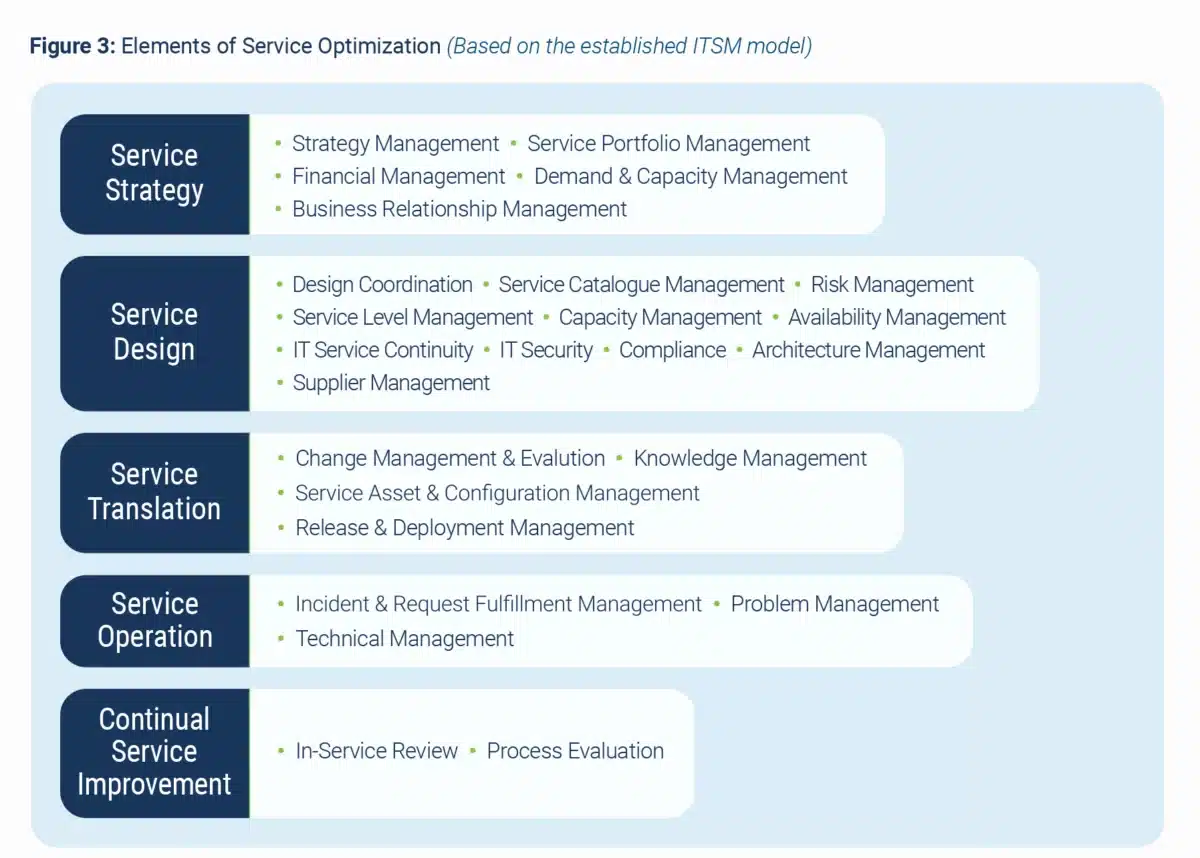
In the IT realm, there has been significant work undertaken to systematically identify and analyze best practices for service provision. Based on work by efficiency guru W. Edwards Deming, the ITIL (IT Infrastructure Library) was developed by the UK Government’s Central Computer and Telecommunications Agency (CCTA) nearly 40 years ago.
“A bad system will beat a good person every time.”
– W. Edwards Deming
B2B service optimization is guided by best practices like ITIL, designed to ensure efficient, high-quality service management. ITIL frameworks support the integration of personalized customer interactions by streamlining data, workflows, and service delivery processes. Since 2019, ITIL V4, has expanded to support Agile principles, helping organizations evolve their customer interactions with a tailored approach.
As shown below, the ideal ITSM platform will be conceived in the full context of the business world (PESTLE) and will consider the four dimensions of a typical enterprise: Information and Technology, Value Streams and Processes, Partners and Suppliers, Organizations and People.

How to measure the value of service optimization
In businesses where customer churn plays a significant factor, B2B companies are measuring significant gains by prioritizing service over sales, with the goal of achieving a phenomenon known as “Net Negative Churn.”
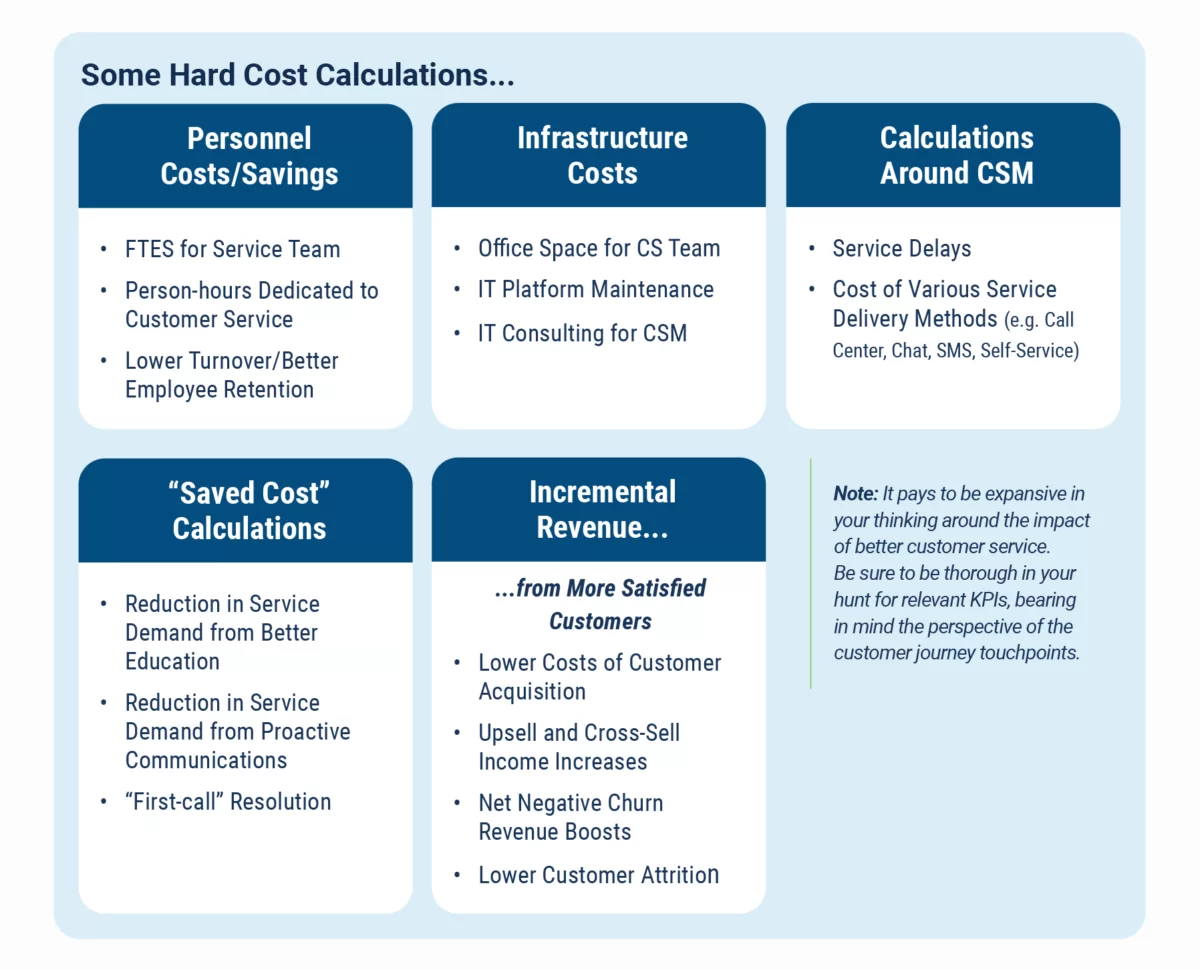
What to measure: Finding KPIs across the customer journey
Tying metrics like customer satisfaction to as many upstream influences as you can, will enable you to see areas for improvement and investment—as well as tracing back the causes of underperforming KPIs.
The following table outlines some suggested areas to locate KPIs:
How service optimization can transform customer journeys
One of the first dynamics that many organizations note is an improvement in their sales processes. Often, this can be directly traced to the beneficial effect of having a truly satisfied customer base. (Fig D.)
Results from this advantage can include a shortened sales cycle and increased performance—not only in up-sell or cross-sell situations, but in net-new business as well, using satisfied customers as an initial engagement point.

Increasing customer retention by just 5% can increase profits from 25-95%, depending on the industry according to Bain & Company and Harvard Business School.
Understanding the concepts and principles behind the Customer Journey can go a long way in helping you re-imagine current practices to find ways to streamline processes, break down silos, and increase transparency across the entire extended value chain:

Essential technology for optimizing service delivery
What do we mean when we suggest leveraging technology to improve customer satisfaction and CX?
In the old view, a Customer Relationship Management (CRM) system was used to house data about customers that could be tapped by sales and service organizations to support their efforts. Other systems—with varying degrees of connectivity and access—might house other customer data relating to things like credit terms, orders in-production, contracts, etc.
Seamless and extended, whole-enterprise connectivity is a gigantic undertaking, but unifying all your enterprise’s data that relates to customers is already possible with the right customer service technology.
A unified service management platform, connected through advanced APIs, enables personalized service by consolidating data from disparate sources. This approach allows teams to deliver personalized customer interactions across touchpoints and provide agents with the tools needed to make informed, tailored responses.
Key Benefits of a Unified Platform for Personalization:
- Consistent Customer Data: Enables service agents to understand customer history and preferences.
- Streamlined Workflows: Supports fast, accurate responses by automating routine tasks while allowing agents to focus on personalization.
- Proactive Communication: With centralized data, service teams can proactively communicate updates and address issues before they escalate.
In a B2B context, personalization is no longer optional; it’s critical to meet customer expectations and build trust.

Moving quickly toward improved customer self-service
There’s no time to waste in advancing your self-service capabilities, as business-to-business customers are already demanding a better experience. In a survey of 1,000 B2B decision makers, lack of speed in interactions with their suppliers emerged as the number one pain point, mentioned twice as often as price.
Digital solutions loom large in executives’ thinking to make routine tasks more efficient. Some 86 percent of respondents said they prefer using self-service tools for reordering, rather than talking to a sales representative.

Achieving organizational alignment around customer service optimization
Changing the way you approach customer service, self-service, and the implementation of a unified service management platform is a serious task and should be positioned as a “marathon” and not a “sprint.”
Getting buy-in from both senior leadership and the teams that will be charged with implementing these critical changes will be key to your success.
“If there’s one thing that’s certain about the future, it’s that change is here to stay. The ability to constantly transform has become a top priority for organizations. Therefore, change management is now an essential business priority that can’t be overlooked or set aside. Leaders need to urgently develop change and project management competencies across all levels of an organization, from employees and managers to senior executives.”
– Harvard Business Review (2023)
The Future of B2B Customer Service is Personalization
Customer expectations in B2B are evolving, with a clear demand for personalized customer interactions. Today’s B2B customers expect digital-first, fast, and tailored service experiences.
- Self-Service as a Standard: 86% of B2B customers prefer self-service for routine tasks (McKinsey). Providing branded portals and self-service options empowers clients while offering personalized support.
- Omni-Channel Personalization: Customers expect consistency across email, chat, phone, and mobile. A unified platform ensures cohesive, personalized interactions across all channels.
- AI-Driven Personalization: Leveraging AI to analyze past interactions and customer data enables tailored experiences that boost satisfaction and loyalty.
Fast Fact: B2B companies that adopt a holistic, digital-first approach to personalized customer interactions report 1.6x higher retention rates and a 25% increase in new customer acquisition (Harvard Business Review).
In Closing
Personalized service is no longer just an advantage; it’s essential to B2B customer service. By embracing personalized customer interactions powered by a unified platform, robust technology, and advanced frameworks like ITIL, companies can transform customer satisfaction into a powerful growth engine.
“Although customer experience improvements are typically associated with B2C players, they’re equally critical in B2B. The complexity of B2B relationships makes this effort worthwhile in terms of competitive advantage and bottom-line gains.”
With the right tools and strategy, delivering unforgettable, personalized customer interactions is within reach. Embracing customer journey mapping, advanced technology, and self-service capabilities can elevate your organization’s service model into a transformative experience that fuels long-term success.
FAQ: Common Questions on Personalized B2B Customer Service
Transform Your B2B Customer Service Today
The time to elevate your customer service strategy is now. Explore this free resource, The Complete Guide to B2B Customer Service Transformation and unlock new levels of customer satisfaction, operational efficiency, and business growth. Download now to unlock the tools and insights for creating seamless, personalized customer interactions that drive satisfaction, efficiency, and business growth.
Table of Contents
- Introduction
- Embracing B2B Service Optimization
- How to measure the value of service optimization
- How service optimization can transform customer journeys
- Essential technology for optimizing service delivery
- Moving quickly toward improved customer self-service
- Achieving organizational alignment around customer service optimization
- The Future of B2B Customer Service is Personalization
- In Closing
- FAQ: Common Questions on Personalized B2B Customer Service
- Transform Your B2B Customer Service Today